Best Antifreeze and Engine Coolant 2026
Valvoline Multi-Vehicle 50/50 is the best antifreeze for most drivers — its universal formula eliminates guessing which color coolant your car needs, and the pre-diluted 50/50 mix means no water required. For Chevy, Buick, and other GM vehicles requiring Dex-Cool, use Zerex Dex-Cool ($17). For diesel trucks, Shell Rotella ELC Coolant ($12) is the purpose-built choice.
Antifreeze and Engine Coolant Buying Guide
 Photo by Kampus Production / Pexels
## How to Choose the Right Antifreeze and Coolant
Antifreeze isn't just for cold weather — it also prevents engine overheating in summer, inhibits corrosion inside your cooling system, and lubricates the water pump. Choosing the wrong formula can void your warranty, cause seal leaks, or shorten engine life. Here's what actually matters.
Coolant color is not just aesthetic — it indicates the inhibitor chemistry. Different formulas use different corrosion inhibitors, and mixing incompatible types degrades both. The four main categories:

Green (IAT — Inorganic Additive Technology): The original formula, used in most vehicles made before 2000. Green coolant uses inorganic salts (silicates, phosphates) that work quickly but deplete faster — typically needing replacement every 2 years or 30,000 miles.
Orange/Amber (OAT — Organic Acid Technology): Introduced by GM as Dex-Cool, now standard on most modern vehicles. Uses organic acid inhibitors that last 5 years or 150,000 miles. Never mix with green coolant — the chemical incompatibility creates gel-like sludge.
Yellow/Pink/Blue (HOAT — Hybrid OAT): Used by European manufacturers (BMW, Mercedes, Audi, VW) and many Asian brands. Combines silicates and organic acids for extended life with broad material compatibility.

Universal/All-Makes: Formulas like Valvoline Multi-Vehicle use a chemistry that's compatible with IAT, OAT, and HOAT systems. Ideal for topping off when you don't know what's already in the reservoir, or for vehicles with mixed maintenance history.
Valvoline Multi-Vehicle 50/50: Best Universal Coolant
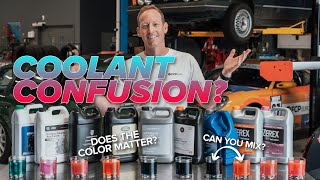
The Valvoline Multi-Vehicle formula is the safest choice when you're not certain which type your car requires (which describes most drivers). It's phosphate-free for compatibility with Asian and European vehicles that prohibit phosphate coolants, while still compatible with American vehicles. The pre-mixed 50/50 formulation means you pour it straight in — no distilled water needed. At $17/gallon, it's priced at the practical midpoint between budget and premium options.

Zerex Dex-Cool 50/50: Required for GM Vehicles
GM specified Dex-Cool (orange OAT formula) for Chevrolet, Buick, Cadillac, and GMC vehicles from 1996 onward. Using a non-Dex-Cool formula in these engines can cause seal damage and gel formation in the cooling system over time. Zerex is an OEM-approved Dex-Cool formula at the most competitive price in this guide. If your car is GM and requires Dex-Cool (check the reservoir cap — it will say "Dex-Cool" or "OAT"), this is the right choice.
Shell Rotella Nitrite-Free ELC: Best for Diesel Trucks
Diesel engines run hotter and at higher pressures than gasoline engines, which demands more aggressive corrosion inhibition — particularly for cylinder liner cavitation, a phenomenon specific to diesel block construction. Shell Rotella's Extended Life Coolant (ELC) is formulated specifically for heavy-duty diesel applications (Ford Power Stroke, GM Duramax, Ram Cummins). The nitrite-free formula meets Cummins, Detroit Diesel, and Caterpillar OEM specifications. At $12/gallon, it's the most affordable option in this guide and the correct choice for diesel owners.
PEAK OET Extended Life Orange: Best for Budget-Conscious GM Owners
PEAK OET (Original Equipment Technology) uses the same orange OAT chemistry as Dex-Cool and is a lower-cost alternative to the Zerex formulation. It meets ASTM D3306 and GM6277M standards. For drivers who simply need to top off their GM cooling system without breaking the budget, PEAK OET delivers the correct chemistry at a slight discount versus Zerex.
All four coolants in this guide come in pre-mixed 50/50 formulation (half coolant concentrate, half distilled water). This is the correct dilution for most climates — it provides freeze protection to -34°F and boil-over protection to +265°F. If you're in an extreme cold climate (below -34°F), you can use a 60/40 or 70/30 concentrate-to-water ratio, but for 99% of drivers, the pre-mixed 50/50 is correct and convenient.
Check your owner's manual first: It will specify either a color or a standard (Dex-Cool, HOAT, G-05). Use exactly what's specified. Universal formulas are safe for unknown situations but not a substitute for the correct spec. Pre-mixed vs. concentrate: Pre-mixed (50/50) is more convenient and fool-proof. Concentrate requires diluting with distilled water (not tap water — minerals cause scale buildup). Silicate vs. phosphate-free: European and most Asian vehicles (Toyota, Honda, Subaru, Hyundai) require phosphate-free coolant. Using phosphate-containing coolant can damage aluminum components in these vehicles. Extended life vs. standard: Modern OAT and HOAT coolants last 5 years/150,000 miles. Standard IAT (green) lasts only 2 years/30,000 miles. For any post-2000 vehicle, use extended life.
At $12-18/gallon, all four coolants in this guide are essentially commodity pricing — the price difference between them is small relative to the cost of engine damage from using the wrong formula. Don't optimize for price when choosing coolant; optimize for specification match. The $5 difference between Shell Rotella ($12) and PEAK OET ($18) is irrelevant compared to using the wrong chemistry. Buy the correct formula for your vehicle, regardless of price.
Coolant is one of several fluids that require regular maintenance — our car maintenance fluids guide covers oil, transmission fluid, and brake fluid alongside coolant in a single reference. For diagnosing cooling system issues before they escalate, see our OBD2 scanner comparison — a scanner that reads coolant temperature and engine codes is a useful companion tool. Drivers who prefer doing their own fluid changes will also find our DIY oil change tools guide relevant for the same service interval.
At a Glance
| # | Product | Award | Price | Our Score | |
|---|---|---|---|---|---|
| 1 | 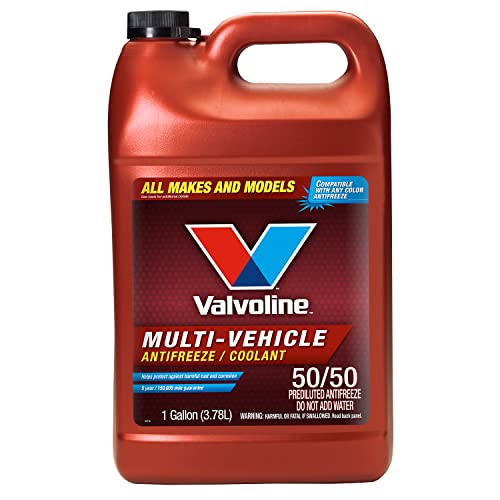 Valvoline Multi-Vehicle 50/50 Ready-to-… Valvoline Multi-Vehicle 50/50 Ready-to-… |
Best Overall | $17 | 9.2 | Buy → |
| 2 | 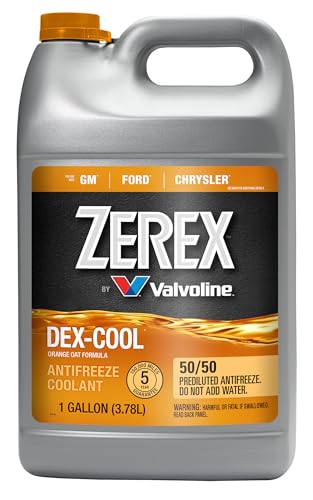 Zerex Dex-Cool 50/50 Ready-to-Use Antif… Zerex Dex-Cool 50/50 Ready-to-Use Antif… |
Best for GM/Dex-Cool | $17 | 8.9 | Buy → |
| 3 | 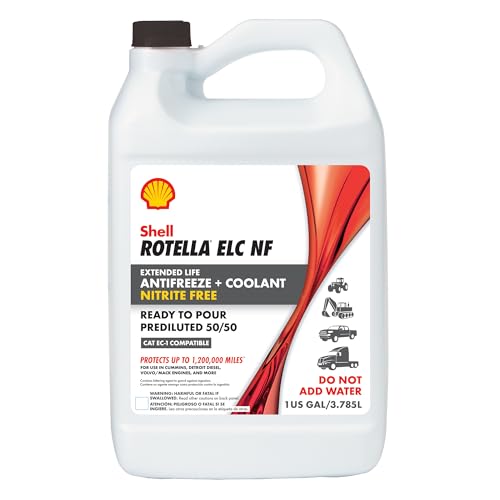 Shell Rotella Nitrite-Free Extended Lif… Shell Rotella Nitrite-Free Extended Lif… |
Best for Diesel | $12 | 8.5 | Buy → |
| 4 |  PEAK OET Extended Life Orange 50/50 Ant… PEAK OET Extended Life Orange 50/50 Ant… |
Best Budget OAT | $18 | 8.2 | Buy → |
Showing 4 of 4 products
Valvoline Multi-Vehicle 50/50 Ready-to-Use Antifreeze Coolant 1 Gallon
“Valvoline Multi-Vehicle coolant is a practical one-jug solution for households with multiple cars — always verify your vehicle's specific coolant spec before using a universal formula.”
See Today’s Price →
Zerex Dex-Cool 50/50 Ready-to-Use Antifreeze Coolant 1 Gallon
“Zerex Dex-Cool is one of the most trusted Dex-Cool-compatible coolants — correct spec and concentration are essential, making the pre-mixed 50/50 format ideal for straightforward top-offs.”
See Today’s Price →
Shell Rotella Nitrite-Free Extended Life ELC Coolant 50/50, 1 Gallon
“Shell Rotella's nitrite-free ELC coolant is the right choice for modern diesel engines — especially Cummins and Duramax — where nitrite-based coolants can damage liner seals.”
See Today’s Price →
PEAK OET Extended Life Orange 50/50 Antifreeze Coolant 1 Gal
“PEAK OET Orange is a correct replacement for GM's Dex-Cool system — using the right OAT formula prevents the corrosion and gel issues that come from mixing incompatible coolant types.”
See Today’s Price →Frequently Asked Questions
What happens if I use the wrong antifreeze?
Do I need to dilute pre-mixed 50/50 antifreeze?
How often should I change my antifreeze?
Can I mix different brands of the same color antifreeze?
Is antifreeze the same as coolant?
How We Analyze Products
We analyze Amazon review data — often thousands of reviews per product — to surface patterns that individual buyers miss. Our process aggregates star ratings, review counts, and buyer sentiment at scale, identifying which strengths and weaknesses appear consistently across the largest review samples available.
Each product earned its placement through data: total review volume, average rating, and the specific praise and complaints that repeat most often across buyers. No manufacturer paid for placement on this page. Products appear here because buyers endorsed them at scale, not because a company asked us to feature them.
We use AI to summarize review sentiment — not to fabricate opinions, but to condense what thousands of buyers actually wrote into a readable format. The pros and cons you see reflect the most common themes found in verified purchaser reviews, paraphrased for clarity. We do not claim to have accessed Reddit, YouTube, or specific publications in generating these summaries.
Prices shown reflect Amazon pricing at the time this page was last generated. Click “See Today’s Price” to get the current live price on Amazon. Read our full methodology →