Best Motor Oil for High Mileage Cars (2026)

Mobil 1 High Mileage Full Synthetic 5W-30 is the best motor oil for high mileage engines — its seal conditioner additives reduce oil consumption from worn seals, and the full synthetic base provides superior film strength protection at the wider engine clearances common in high-mileage engines.
See Today’s Price →At a Glance
| # | Product | Award | Price |
|---|---|---|---|
| 1 | Best Overall | $31.97 as of Nov 21, 8:31 AM CT details Buy → |
|
| 2 | $31.97 as of Nov 21, 8:30 AM CT details Buy → |
||
| 3 |  Valvoline Advanced Full Synthetic… Valvoline |
$27.98 as of Nov 21, 8:30 AM CT details Buy → |
|
| 4 | 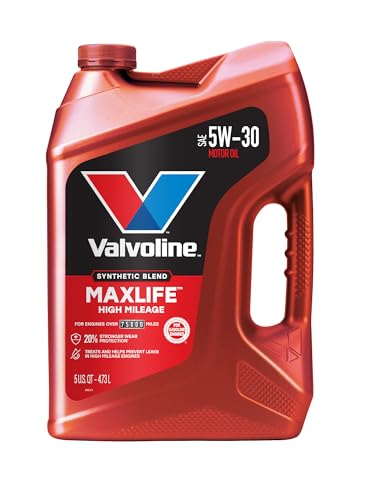 Valvoline MaxLife High Mileage 5W… Valvoline |
$26.97 as of Nov 21, 8:29 AM CT details Buy → |
|
| 5 | $31.97 as of Nov 21, 8:30 AM CT details Buy → |
Motor Oil for High Mileage Cars (2026) Buying Guide
 Photo by Luke Miller / Pexels
High-mileage motor oil is a real formulation category, not just marketing. The additives in high-mileage oils address specific problems that develop in engines above 75,000 miles.
What "High Mileage" Oil Actually Contains
High-mileage motor oils include seal conditioners — typically phosphorus compounds and detergent additives that cause rubber seals to swell slightly, reducing seepage around cam shaft seals, valve stem seals, and other aged elastomers. This reduces visible oil consumption and prevents oil drips. They also include higher levels of viscosity modifiers that maintain film strength at the wider clearances common in worn engine components, and additional antioxidants that slow further oil degradation in engines where combustion blow-by is more prevalent.
Full Synthetic vs. Synthetic Blend for High Mileage
Full synthetic high-mileage oils (Mobil 1 High Mileage, Castrol EDGE) provide better protection across temperature extremes and under high-load conditions. Synthetic blends (Valvoline MaxLife) use a mixture of synthetic and conventional base oils and cost less while providing more protection than conventional oil alone. For high-mileage engines that are well-maintained and not burning or leaking significant oil, full synthetic is the better protection choice. For engines already burning or leaking oil significantly, some mechanics prefer synthetic blends on the theory that conventional base oil is "thicker" and more forgiving with significantly worn components — though modern full synthetics do not actually behave this way.

Viscosity Choice for High-Mileage Engines
Always start with your owner's manual recommendation. Many modern engines specify 5W-20 or 0W-20. High-mileage engines sometimes benefit from a slightly higher-viscosity oil (5W-30 instead of 5W-20) to maintain adequate film thickness at worn clearances — but only if the engine manufacturer permits it. Do not use significantly heavier oil (10W-40) without specific reason — it increases cold-start wear and reduces fuel economy. Valvoline MaxLife comes in multiple viscosities including 5W-20, 5W-30, and 10W-30.
Oil Change Intervals for High-Mileage Engines
Modern full synthetic high-mileage oils are rated for 7,500 to 10,000-mile intervals. However, high-mileage engines often benefit from shorter intervals — 5,000 to 7,500 miles — to remove combustion by-products and sludge before they accumulate. If your engine burns or leaks any measurable oil between changes, maintain shorter intervals and monitor the level between changes. Oil analysis services (from labs like Blackstone) can test a used oil sample and indicate whether your interval is appropriate for your specific engine condition.

High-mileage motor oil is one part of a preventive maintenance program. See Best DIY Oil Change Tools 2026 for the tools needed to change it yourself, Best Car Maintenance Fluids 2026 for other fluids to service alongside the oil, and Best Jump Starters for Cold Weather for emergency preparedness to pair with regular maintenance.
Watch Before You Buy
“The Mobil 1 High Mileage Full Synthetic Motor Oil 5W-30 5qt features high-mileage formula. 4.9 stars from 5,169 Amazon reviews signal consistent reliability.”
See Today’s Price →What we like
- Formulated for engines with 75,000+ miles
- Seal conditioner in the formula
- Additives to help fight sludge
- Mobil says it helps extend the life of higher-mileage engines
Watch out for
- Aimed at engines past 75,000 miles - a newer engine should use the standard oil its manual names
Read Full Analysis
The Mobil 1 High Mileage Full Synthetic Motor Oil 5W-30 is formulated for engines with 75,000 miles or more — the point at which standard oil change recommendations and general-purpose full synthetics may no longer fully address the seal wear and compression changes that accumulate with age. The high-mileage formula adds seal conditioner chemistry that hydrates and slightly expands hardened seals, which can reduce or eliminate minor oil seepage around valve cover gaskets and rear main seals without requiring disassembly. Full synthetic base chemistry provides the same high-temperature stability and cold-start flow protection as standard Mobil 1, maintaining the protective film under hard driving conditions and sub-zero starts. The 5-quart jug covers a standard oil change for most passenger vehicles. The trade-off is nuanced: seal conditioners help worn seals within a specific range of degradation — severely deteriorated seals may swell beyond their useful tolerance and worsen leaks rather than improving them. The additive package also carries a modest premium over standard Mobil 1 synthetic for engines not yet showing sealing issues. For high-mileage vehicle owners dealing with minor oil consumption or seepage and wanting full synthetic protection with targeted aging-engine chemistry, the Mobil 1 High Mileage is the industry-standard choice.

“Castrol EDGE uses Fluid Titanium Technology to strengthen the oil film under extreme pressure, independently tested to reduce engine wear. It is a strong pick for high-mileage and demanding engines…”
See Today’s Price →What we like
- Castrol states up to 20,000 miles or one year between oil changes
- Approved and licensed to API SQ, ILSAC GF-7 and GM dexos1 Gen 3
- Meets Chrysler MS 6395 and Ford WSS-M2C946-B1 and WSS-M2C961-A1
- Castrol claims 3X the strength of the leading full synthetic against viscosity breakdown
Watch out for
- The 20,000-mile figure is a maximum - follow your oil-life monitor or the manual's severe-service schedule
Read Full Analysis
High-mileage engines have worn bearing clearances and piston ring gaps that exceed factory specification — the oil film between metal surfaces is thinner and under greater stress at the same RPM as a new engine. Castrol EDGE's Fluid Titanium Technology is specifically tested for this scenario: third-party testing confirms it maintains a stronger oil film under extreme pressure loads than competing synthetics. For 5 quarts, Castrol comes in under both Mobil 1 variants on this page while delivering full synthetic protection. For engines approaching or past 100,000 miles that haven't developed active seepage, Castrol EDGE provides the pressure protection that worn metal tolerances demand without the higher cost of the Mobil 1 High Mileage version.
“Valvoline's full synthetic 5W-30 provides broad engine compatibility at one of the most competitive prices among name-brand synthetics. The MaxLife additive package includes seal conditioners that…”
See Today’s Price →What we like
- Meets ILSAC GF-7A, API SQ and SP, and GM dexos1 Gen 3
- Valvoline claims 40% stronger wear protection than industry standards
- Claims 15% better deposit defense and up to 2.5X better heat protection
- Formulated for low-temperature flow at cold starts
Watch out for
- Its listing states no drain interval - follow your manual or the car's oil-life monitor
Read Full Analysis
Minor oil consumption — adding half a quart between changes — is normal for engines past 100,000 miles as valve stem seals and piston rings lose some of their seal. Valvoline Advanced Full Synthetic's MaxLife additive includes seal conditioners that expand and rejuvenate worn rubber seals, which can reduce this consumption without a seal repair. The full synthetic base oil provides the same film strength as Mobil 1 — $1 less than Mobil 1 on this page. For high-mileage engines consuming oil but without active leaks, Valvoline's combination of full synthetic protection and seal conditioning makes it the more targeted choice than a standard full synthetic that lacks the conditioning additives.
“Formulated specifically for engines with 75,000+ miles, Valvoline MaxLife's seal conditioners genuinely help reduce minor oil seepage and consumption in aging gaskets. The synthetic blend 5W-30…”
See Today’s Price →What we like
- Synthetic blend for high-mileage engines
- Seal conditioners reduce seepage in older gaskets
- 5W-30 covers most passenger car specs
- Trusted Valvoline brand
Watch out for
- Synthetic blend not full synthetic — full synthetic lasts longer between changes
- High-mileage formulas cost more per quart
- Not ideal for newer engines
Read Full Analysis
Choosing between Valvoline MaxLife synthetic blend and a full synthetic comes down to one question: does your engine leak or burn oil between changes? For engines actively seeping through aging gaskets, MaxLife's seal conditioners in the synthetic blend formula address the root cause directly — the conditioners chemically rehydrate dried rubber seals to reduce minor seepage. Full synthetics like Mobil 1 or Castrol EDGE on this page don't include these additives in their standard formulas. For 5 quarts versus $23-28 for full synthetic, MaxLife costs less per oil change — for an older high-mileage commuter engine, the synthetic blend delivers the seal conditioning it needs without paying for extreme pressure ratings that won't be used.

“Mobil 1 Advanced Full Synthetic 5W-30 is the most widely trusted full synthetic motor oil for modern gasoline engines, offering extended drain intervals and strong wear protection at low…”
See Today’s Price →What we like
- Full synthetic 5W-30 with Mobil 1's Triple Action Formula
- Friction-reduction formula
- Contains additives to help fight sludge
- Mobil says it helps extend engine life, even in severe conditions
Watch out for
- Its listing does not print the API or carmaker specifications - check the bottle against your manual
Read Full Analysis
The standard Mobil 1 5W-30 appears on this high-mileage page because many older vehicles specifically call for Mobil 1 Advanced Full Synthetic in their owner's manual — the formula is OEM-specified for BMW, Mercedes, Porsche, and Corvette platforms, and those vehicles routinely pass 100,000 miles. For vehicles that have never shown oil consumption or gasket seepage, the standard full synthetic provides equivalent wear protection to the Mobil 1 High Mileage without paying for high-mileage additives the engine doesn't need. It's priced within $1-2 of the Mobil 1 High Mileage and Castrol EDGE on this page — the decision is whether your engine's condition warrants a high-mileage formula or just premium full synthetic protection.
Frequently Asked Questions
What is high mileage motor oil and do I need it?
Can I switch to high mileage oil after using regular oil?
Is Mobil 1 High Mileage worth the premium over synthetic blends?
Should I use 5W-30 or 5W-20 in a high mileage engine?
How often should I check oil in a high mileage car?
How We Chose These Products
We compare each product’s Amazon listing, the manufacturer’s published specifications and Amazon customer ratings, shown with their review counts as Amazon’s data, and rank the products on how well they answer this page’s question. We do not test products in hand and we do not run our own analysis of review text. A publication or expert is named only where we cite its published findings about that product. No manufacturer paid for placement on this page.
A price appears only when Amazon’s API supplied it at a recent daily refresh, with the date and time beside it, and is withdrawn at 4 AM Central on the day after it turns 24 hours old; otherwise use “Check price on Amazon” for the live price. Read our full methodology →