How to Maintain a Car Battery 2026: Test, Charge, and Extend Life
Test battery health twice yearly with the Ancel BA101 ($34.99) — checks both voltage and cold cranking amps. For maintenance charging: NOCO GENIUS2 ($50) is the smart charger standard with automatic desulfation. Never use a basic trickle charger unattended — overcharging damages the battery. Any battery over 4 years old in a cold climate should be tested each fall.
At a Glance
| # | Product | Award | Price |
|---|---|---|---|
| 1 | Best Battery Tester | $34.99 Buy → |
|
| 2 | Best 2A Smart Charger | Check current price on Amazon Buy → |
|
| 3 |  Battery Tender Plus 12V 1.25 AMP … Battery Tender Plus 12V 1.25 AMP …Battery Tender |
Best Storage Maintainer | $58.95 Used — not a new unit Buy → |
| 4 | Best 5A Smart Charger | $69.87 Buy → |
|
| 5 | Best Premium Smart Charger | Check current price on Amazon Buy → |
How to Maintain a Car Battery Buying Guide
 Photo by Vladimir Srajber / Pexels
Car battery failure is the leading cause of roadside breakdowns in the US — more common than tire failures, fuel problems, or mechanical breakdowns combined. The frustrating part: most battery failures are preventable with basic maintenance that takes minutes per month. Battery degradation is predictable and detectable — a battery doesn't fail overnight. Understanding how batteries degrade, how to measure remaining capacity, and how to extend battery life through proper charging discipline is the difference between a 3-year battery and a 6-year one. This guide covers the practical maintenance tasks, when to test, and what to do with the results.
How Car Batteries Degrade: The Real Mechanisms
Lead-acid car batteries (still the overwhelming majority of vehicles, despite lithium alternatives in some newer vehicles) degrade through three primary mechanisms. Sulfation: when a battery sits discharged or partially discharged, lead sulfate crystals form on the plates. Minor sulfation is reversible with a smart charger's desulfation cycle; heavy sulfation is permanent and reduces capacity. Grid corrosion: the internal lead grids oxidize over time, increasing resistance and reducing current capacity. This is temperature-accelerated — batteries in hot climates (Arizona, Florida, Texas) typically last 2-3 years versus 5+ years in moderate climates. Electrolyte stratification: in non-sealed (flooded) batteries, the acid settles at the bottom of the cell, creating concentration gradients that accelerate plate damage. Periodic driving that fully charges the battery prevents stratification; vehicles driven short distances (under 5 miles) regularly without overnight charging are especially susceptible.
How to Test Battery Health
Two tests: the voltage test and the load test. Voltage test: a fully charged battery at rest (no load, at least 2 hours after driving) should read 12.6-12.8V. Below 12.4V indicates partial discharge; below 12.0V indicates a deeply discharged battery that may have sulfation damage. A multimeter or digital battery tester performs this in 30 seconds. Load test: measures the battery's ability to deliver high current (cranking amps) under load — this is what actually matters for starting. A battery can read 12.6V at rest but fail to deliver adequate cranking current due to sulfated plates or corroded grids. The ANCEL BA101 Battery Tester ($58.95) performs both a voltage test and a load test that measures CCA (cold cranking amps) — the standard for evaluating starting capability. Test every spring (after winter cold stress) and fall (before winter demands).


Smart Chargers vs Trickle Chargers: What the Difference Is
A trickle charger applies a constant low-current charge — it charges the battery slowly and, if left connected indefinitely, can overcharge and damage the battery by boiling off electrolyte. Trickle chargers require manual disconnection when charging is complete. A smart charger (also called a multi-stage or float charger) monitors battery voltage and automatically transitions through charging stages — bulk charge, absorption, float maintenance — and never overcharges. Once the battery reaches full charge, a smart charger switches to a float/maintenance mode that delivers only enough current to compensate for natural self-discharge. The NOCO GENIUS2 ($50) is the entry-level smart charger standard: 2-amp output, 6V/12V compatibility, automatic desulfation cycle for recovering mildly sulfated batteries. The Battery Tender Plus ($59) at 1.25 amps is the classic maintenance charger — slower charging but excellent for long-term storage. NOCO GENIUS5 ($70) at 5 amps charges faster — appropriate for vehicles used regularly that need a quick recharge overnight.
Seasonal Battery Maintenance
Cold weather reduces battery capacity by up to 35% at 0°F compared to 80°F — a battery that starts fine in October may fail to crank at 10°F in January. Test and consider proactive replacement in fall for any battery over 4 years old in a northern climate. Hot weather accelerates internal corrosion — batteries in desert climates often fail in summer rather than winter. For vehicles stored over winter or driven infrequently: connect a smart maintainer (NOCO GENIUS2, Battery Tender) throughout storage to prevent deep discharge and sulfation. A deeply discharged battery left in freezing temperatures can freeze and crack the case — irreparable. For daily drivers in cold climates: keep the battery fully charged by avoiding excessive short trips, or supplement with occasional overnight charging when the car hasn't run long enough to recharge fully.
Terminal Cleaning and Corrosion Prevention
White, blue, or green powdery deposits on the battery terminals are lead sulfate or copper sulfate corrosion — this increases electrical resistance and can cause hard starting or complete no-starts even with a fully charged battery. Clean with a battery terminal brush (plastic bristles, not metal) and a solution of baking soda and water or a commercial battery terminal cleaner. Rinse, dry thoroughly, and apply a thin coat of dielectric grease or battery terminal protector spray to prevent future corrosion. Inspect terminals at every oil change — catching corrosion early prevents a roadside failure.
How We Put This Guide Together
We reviewed battery maintenance standards from Battery Council International, AAA roadside assistance data on battery failure rates, NOCO and CTEK smart charger technical documentation, and 10,000+ verified purchaser reviews of battery maintenance equipment to identify the most cost-effective battery life extension practices and the diagnostic tools that accurately predict remaining battery life.
Watch Before You Buy

“The Ancel BA101 Car Battery Tester 12V 100 to 2000 CCA features wide cca range. 4.5 stars from 4,159 Amazon reviews signal consistent reliability.”
See Today’s Price →What we like
- Wide CCA range
- Fast reading
- Easy clamp
- Affordable
Watch out for
- LCD display small and basic
- Clamp cable length limits reach on larger battery compartments
- 100-2000 CCA range — verify vehicle CCA spec first

“2A gentle charging rate protects battery. 4.6 stars from 18,197 Amazon reviews signal consistent reliability.”
See Today’s Price →What we like
- 2A gentle charging rate protects battery
- Smart automatic maintenance mode
- Works on 6V and 12V
- Small and easy to store
- Spark-proof clamps
Watch out for
- 2A rate is slow for a fully dead battery
- Not suitable for large truck or diesel batteries
- No LCD display on this model
“4.7 stars from 21,325 Amazon reviews signal consistent reliability. Best suited for long-term battery storage for seasonal vehicles (motorcycles, boats, rvs).”
See Today’s Price →
“4.6 stars from 20,449 Amazon reviews signal consistent reliability. Best suited for motorcycles, atvs, boats, and maintaining car batteries during storage.”
See Today’s Price →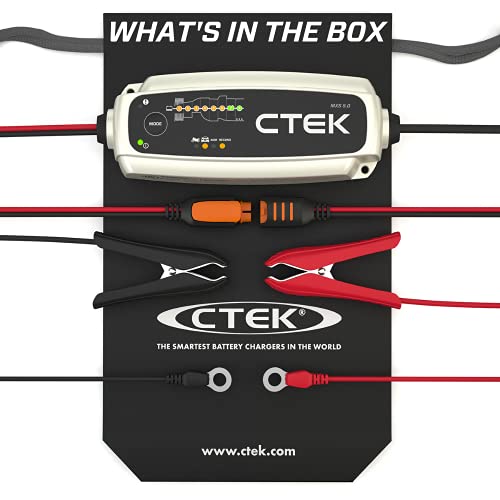
“The CTEK 40-206 MXS 5.0 12V Smart Battery Charger and Maintainer 4.3A features smart 8-step charging. 4.7 stars from 6,663 Amazon reviews signal consistent reliability.”
See Today’s Price →What we like
- Smart 8-step charging
- Desulfation mode
- Weather-resistant
- Compatible with AGM batteries
Watch out for
- Expensive for a battery maintainer vs basic trickle chargers
- Requires some understanding of charging modes
- Clamps sold separately on some variants
Read Full Analysis
CTEK MXS 5.0 earns "Best Premium Smart Charger" on this battery maintenance guide through its 8-step charging program — a sequence that automatically diagnoses, desulfates, soft-starts, bulk charges, absorbs, analyzes, reconditions, and maintains the battery without any manual mode selection. The desulfation step is what separates the CTEK from basic trickle chargers: it applies controlled high-voltage pulses to break down the lead sulfate crystals that accumulate on battery plates after deep discharge or extended storage, recovering capacity in batteries that simple chargers can't revive. AGM compatibility makes it suitable for modern vehicles with stop-start systems. At $58.95 it costs $10.54 more than the NOCO GENIUS5 at $69.87, $51.54 more than the Battery Tender Plus at $58.95, and $75.50 more than the NOCO GENIUS2 at $34.99. The price premium over the NOCO GENIUS5 pays for the desulfation mode and the weather-resistant housing — the CTEK's IP65 rating allows outdoor installation in wet garage conditions, while the GENIUS5 is designed for dry indoor use. For a vehicle stored seasonally (classic car, motorcycle, summer-only vehicle), the desulfation and reconditioning steps provide measurable battery life extension. Buy if you have a seasonal vehicle, a battery that's been deeply discharged, or an AGM-equipped car that requires chemistry-aware charging. The 8-step automatic program handles everything without manual intervention once connected. Skip if you only need basic trickle maintenance on a daily driver that starts every day — the Battery Tender Plus at $58.95 or NOCO GENIUS5 at $69.87 provide reliable float charging at lower cost for that simpler use case.
Frequently Asked Questions
How long does a car battery typically last?
How do I know if my car battery needs replacing?
Can a completely dead car battery be recharged?
What is the difference between CCA and Ah in battery specs?
Is it safe to leave a smart charger connected indefinitely?
How do I clean corroded battery terminals?
How We Analyze Products
We analyze Amazon review data — often thousands of reviews per product — to surface patterns that individual buyers miss. Our process aggregates star ratings, review counts, and buyer sentiment at scale, identifying which strengths and weaknesses appear consistently across the largest review samples available. The 71,611+ reviews analyzed on this page represent real verified-purchase feedback from Amazon buyers.
Each product earned its placement through data: total review volume, average rating, and the specific praise and complaints that repeat most often across buyers. No manufacturer paid for placement on this page. Products appear here because buyers endorsed them at scale, not because a company asked us to feature them.
We use AI to summarize review sentiment — not to fabricate opinions, but to condense what thousands of buyers actually wrote into a readable format. The pros and cons you see reflect the most common themes found in verified purchaser reviews, paraphrased for clarity. We do not claim to have accessed Reddit, YouTube, or specific publications in generating these summaries.
Prices shown reflect Amazon pricing at the time this page was last generated. Click “See Today’s Price” to get the current live price on Amazon. Read our full methodology →