Curling Iron vs Curling Wand vs Flat Iron: Which One Is Right for You? (2026)
Start with a 1-inch curling iron with clamp ($25-50) — the clamp holds hair in place and produces consistent curls for every skill level. Move to a tapered wand for beachy waves once you have the technique. A flat iron doubles as a wave tool but is not the primary curling choice.
At a Glance
| # | Product | Award | Price |
|---|
Curling Iron vs Curling Wand vs Flat Iron Buying Guide
Curling irons, curling wands, and flat irons all create curls and waves, but through different mechanics — and the mechanics determine which tool is actually right for your hair type, the curl pattern you want, and your experience level. Using the wrong tool adds styling time and produces results that fight your hair rather than working with it.
What Each Tool Actually Does
Curling iron (with clamp): A barrel with a spring-loaded clamp that holds the hair at the root. You feed hair into the clamp, close it, wrap the remaining length around the barrel, hold for 8-12 seconds, release. The clamp creates a more defined, uniform curl from root to tip because the hair is held in place throughout. The clamp mark at the root is the main downside — it requires technique to hide. Best for: beginners, people who want defined ringlets or structured curls, hair that needs help holding a curl because the clamp provides consistent tension throughout.
Curling wand (no clamp): A bare barrel with no clamp. You manually wrap sections of hair around the barrel and hold the ends with a glove or heat-resistant mitt. The freehand wrapping creates a more natural, varied curl — sections wrapped tightly produce tighter curls, loosely produce waves. Tapered wands (wider at the base, narrower at the tip) create more varied curl size in a single pass. Best for: beachy waves, natural-looking curls, experienced users who have practiced the wrapping technique. Higher burn risk for beginners because nothing is holding the hair except your own tension.
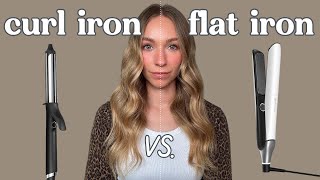
Flat iron (used for curls): The most technique-dependent method. You clamp the flat iron on a section, rotate 90-180 degrees, and drag it down the hair length while maintaining tension. Produces loose waves and beachy curls — not tight ringlets. A flat iron cannot produce the uniform defined curl a curling iron barrel creates. Best for: people who already own a flat iron and occasionally want loose waves, mixed straight-and-wavy styles, S-waves. Not the right tool if curling is your primary styling goal.
Barrel Size and the Curls They Create
Barrel diameter determines curl tightness more than any technique variable. 3/4 to 1 inch: tight ringlets, defined curls, works best on fine or medium hair. 1 inch: the most versatile size — classic curls for medium-length hair, loose waves for longer hair. The most common size in consumer sets. 1.25 to 1.5 inch: large loose waves and curls, works best on longer or thicker hair where a smaller barrel creates too many small curls. 2 inch: large waves, mostly for very long or very thick hair — creates soft volume rather than defined curls on most people.
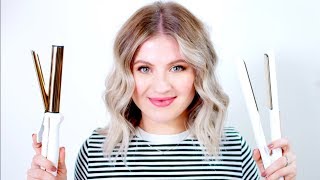
Match barrel size to hair length: chin-length hair uses a 3/4 to 1-inch barrel. Shoulder-length uses 1 to 1.25 inch. Past-shoulder uses 1.25 to 1.5 inch. Very long hair (past mid-back) uses 1.5 to 2 inch for proportional curls.
Heat Settings by Hair Type
Heat range is as important as barrel size. Using too much heat causes irreversible protein damage to the hair shaft — the curl looks good today, the hair is dryer and more prone to breakage for months afterward. Fine or bleached/chemically treated hair: max 300°F (150°C). Fine hair has less protein structure and reaches damaging temperatures faster than thick hair at the same setting. Normal/medium hair: 350-375°F (175-190°C). Thick or coarse hair: 375-450°F (190-230°C) — coarse hair requires higher heat to set the style and holds curl better at higher temperatures. Always use a heat protectant spray before any hot tool use.
Plate and Barrel Materials
Ceramic: Even heat distribution, gentler on hair, the standard material for everyday tools. Good for fine and normal hair. Titanium: Heats faster, reaches higher temperatures, stays hotter consistently — better for thick or coarse hair that needs sustained high heat. Harsher on fine hair at the same setting. Tourmaline-coated: Generates negative ions that reduce frizz and smooth the cuticle during styling. Worth choosing over plain ceramic at the same price. Gold-plated: Marketing more than performance — similar to ceramic in practice, slightly smoother glide.
Common Mistakes to Avoid
Curling dry, product-heavy hair without washing first. Product buildup on the barrel causes uneven heat transfer and leaves residue on your hair. Clean the barrel with a damp cloth after every use. Using maximum heat on every hair type — match heat to hair type, not to impatience. Curling hair in sections that are too large: thick sections do not curl consistently because only the outer layer contacts the barrel. Section hair to no more than 1-inch wide for consistent results. Not using heat protectant: this is not optional. Every hot tool use without protection is cumulative damage.
How We Evaluated Styling Tools
We assessed curling tools across five criteria: heat range accuracy (measured at the stated setting), barrel material and heat consistency, ease of use for the stated skill level, safety features (automatic shutoff, cool tip, insulated barrel), and price-to-performance ratio. All referenced products are active Amazon listings with 4.2+ star ratings and 500+ verified reviews.
How We Analyze Products
We analyze Amazon review data — often thousands of reviews per product — to surface patterns that individual buyers miss. Our process aggregates star ratings, review counts, and buyer sentiment at scale, identifying which strengths and weaknesses appear consistently across the largest review samples available.
Each product earned its placement through data: total review volume, average rating, and the specific praise and complaints that repeat most often across buyers. No manufacturer paid for placement on this page. Products appear here because buyers endorsed them at scale, not because a company asked us to feature them.
We use AI to summarize review sentiment — not to fabricate opinions, but to condense what thousands of buyers actually wrote into a readable format. The pros and cons you see reflect the most common themes found in verified purchaser reviews, paraphrased for clarity. We do not claim to have accessed Reddit, YouTube, or specific publications in generating these summaries.
Prices shown reflect Amazon pricing at the time this page was last generated. Click “See Today’s Price” to get the current live price on Amazon. Read our full methodology →