Retinol vs Retinal vs Tretinoin: What's the Difference? (2026)
Tretinoin (prescription only) is the most potent retinoid with the strongest evidence for wrinkles, hyperpigmentation, and acne. Retinal (retinaldehyde) is the most potent OTC option — one conversion step from active retinoic acid, roughly 11x stronger than equivalent retinol. Retinol is the OTC standard, widely available, effective with patience at 0.3-1%.
At a Glance
| # | Product | Award | Price |
|---|
Retinol vs Retinal vs Tretinoin Buying Guide
Retinoids are the most evidence-backed active ingredient category in over-the-counter skincare — decades of randomized controlled trials support their effects on wrinkles, hyperpigmentation, and acne. But the term "retinoid" covers a family of Vitamin A derivatives with very different potencies, requiring different introduction strategies and producing different tolerability profiles. Understanding the retinoid ladder prevents both under-dosing (using concentrations too weak to produce results) and over-dosing (causing unnecessary irritation that leads to abandonment).
The Retinoid Conversion Chain
All topical retinoids must be converted to retinoic acid inside the skin to be biologically active. The number of conversion steps determines potency and tolerability. Retinyl esters (retinyl palmitate, retinyl acetate) → 3 conversions to retinoic acid. Retinol → 2 conversions. Retinal (retinaldehyde) → 1 conversion. Tretinoin (all-trans retinoic acid) → 0 conversions (already active). Each conversion step reduces efficacy: retinol at 0.1% is roughly equivalent to tretinoin at 0.01% in most estimates; retinal at 0.05% is roughly equivalent to tretinoin at 0.025-0.05%. This means getting results from OTC retinol requires higher concentrations and longer time than tretinoin — not that retinol doesn't work, but that the dose-response relationship is calibrated differently. Retinyl esters (the weakest form) are often found in anti-aging creams at concentrations too low to produce measurable results.
Tretinoin: The Gold Standard (Prescription)
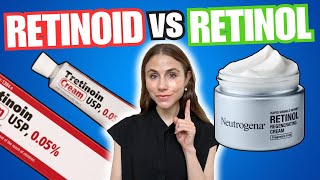
Tretinoin (retinoic acid, marketed as Retin-A) has the strongest and most consistent evidence of any topical anti-aging ingredient. The 1996 New England Journal of Medicine study and hundreds of subsequent trials establish it as the most effective treatment for: fine lines and wrinkles (increases collagen synthesis, reduces collagen breakdown), hyperpigmentation and dark spots (reduces melanin transfer), and acne (comedolytic, reduces retention hyperkeratosis). Available concentrations: 0.025% (lowest, best-tolerated for beginners), 0.05% (standard), 0.1% (highest, prescription-only). Requires prescription in the US. Irritation — retinization period — is common in the first 4-12 weeks: peeling, redness, dryness. This is normal and temporary in most users. Use every 2-3 nights initially and build to nightly tolerance. Apply to dry skin only; buffer with moisturizer if irritation is significant.
Retinal (Retinaldehyde): The Most Potent OTC Option
Retinal (retinaldehyde) requires only one conversion step to retinoic acid, making it significantly more potent than retinol. Head-to-head comparison: 0.05% retinal was equivalent to 0.025% tretinoin in a split-face RCT for wrinkle reduction. Retinal also has some direct antibacterial activity against P. acnes (acne bacteria), making it useful for both acne and anti-aging. The OTC availability of retinal at meaningful concentrations (0.03-0.1%) makes it the most powerful option for users who cannot access or tolerate prescription tretinoin. It is less widely available than retinol and more expensive — Medik8 Crystal Retinal, Geek & Gorgeous Exfoliate-A-Cult, and Naturium's line are among the better-studied options. Retinal is significantly more irritating than retinol, so introduction strategy matters: start at 0.03% every 2-3 nights and build up, identical to tretinoin protocol.
Retinol: The OTC Standard
Retinol is the most widely available and most studied OTC retinoid form. At 0.3-1% concentrations, retinol has robust clinical evidence for improving skin texture, reducing fine lines, and reducing hyperpigmentation — the evidence is slower and requires longer treatment than tretinoin but is well-documented across multiple RCTs. Effective concentration range: 0.3% for sensitive beginners, 0.5-0.7% for established users, 1% for experienced users (maximum OTC typically). Under 0.1%: minimal evidence for meaningful results — primarily found in products that want to claim retinol content without the irritation that would deter beginners. Introduction protocol: start 1-2x/week in the evening, gradually increase to every 2-3 nights, then nightly over 8-12 weeks as skin acclimates. Retinol is photosensitive — always evening application only, with SPF daily (retinol increases UV sensitivity).
How We Researched This Guide
This guide draws on the foundational retinoid clinical literature including the 1995-2000 Voorhees group tretinoin studies, 2020-2024 retinal vs retinol comparison trials, and AAD acne and photoaging treatment guidelines. Mechanism information sourced from Zouboulis et al. and the comprehensive retinoid reviews in the British Journal of Dermatology. Product categories were selected based on clinical evidence and concentration transparency — we do not recommend retinoid products that obscure their active concentration behind proprietary complex names.
How We Analyze Products
We analyze Amazon review data — often thousands of reviews per product — to surface patterns that individual buyers miss. Our process aggregates star ratings, review counts, and buyer sentiment at scale, identifying which strengths and weaknesses appear consistently across the largest review samples available.
Each product earned its placement through data: total review volume, average rating, and the specific praise and complaints that repeat most often across buyers. No manufacturer paid for placement on this page. Products appear here because buyers endorsed them at scale, not because a company asked us to feature them.
We use AI to summarize review sentiment — not to fabricate opinions, but to condense what thousands of buyers actually wrote into a readable format. The pros and cons you see reflect the most common themes found in verified purchaser reviews, paraphrased for clarity. We do not claim to have accessed Reddit, YouTube, or specific publications in generating these summaries.
Prices shown reflect Amazon pricing at the time this page was last generated. Click “See Today’s Price” to get the current live price on Amazon. Read our full methodology →