Best Shoes for Nurses (2026)
The Hoka Women's Bondi SR is the best shoe for nurses in 2026. It carries the APMA Seal of Acceptance for foot health, features maximum EVA cushioning engineered for sustained standing on hard floors, and has a slip-resistant outsole that has been laboratory-tested on water, oil, and soap-covered surfaces — the actual hazards found on hospital floors. For nurses who prefer the traditional clog format, the Dansko Professional remains the clinical-grade standard.
Shoes for Nurses (2026) Buying Guide
 Photo by Hannah Barata / Pexels
Quick Verdict: Our top pick is the Hoka Women's Bondi Slip Resistant Black Nursing Shoe (Best Overall) — APMA-approved, slip-tested on water, oil, and soap surfaces, and loaded with maximum EVA cushioning — the Hoka Bondi .... Priced at $159.95.
Budget Pick: The New Balance Women's Fresh Foam Slip Resistant 806 V1 Industrial Shoe at $36.32 — Fresh Foam cushioning and a slip-resistant outsole in a price range that makes annual replacement a non-issue — the N....
What to Look For
Choosing the right shoe for nursing requires evaluating features that most shoe reviews ignore entirely. Here is what actually matters for a 12-hour shift on hospital floors. SLIP RESISTANCE RATINGS: Not all slip-resistant shoes are equally resistant. Look for shoes tested to ASTM F1677 (Mark II test) or SATRA TM144 standards on wet, oily, and soapy surfaces — the actual contaminants found on hospital floors. Marketing terms like slip-resistant or non-slip without a test standard behind them are meaningless. The Hoka Bondi SR specifies testing on water, oil, and soap surfaces. When evaluating any nursing shoe, ask: what surface was it tested on? Oil and soap are far more hazardous than water alone.Fit and Comfort Factors
Common Mistakes to Avoid
Related Guides:

- The Hiking Layering System Explained — base, mid, and shell layers for any weather condition
- Boot Leather Types Guide — full-grain vs. suede vs. nubuck and how each ages
- Work Boot Safety Ratings Guide — ASTM, EH, SR, and waterproof ratings decoded
Watch Before You Buy
At a Glance
| # | Product | Award | Price | Our Score | |
|---|---|---|---|---|---|
| 1 | 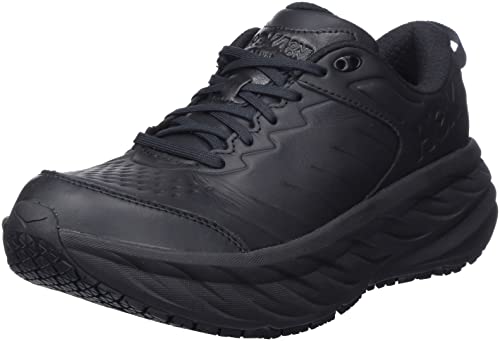 Hoka Women's Bondi Slip Resistant Black… Hoka Women's Bondi Slip Resistant Black… |
Best Overall | $159 | 9.2 | Buy → |
| 2 | 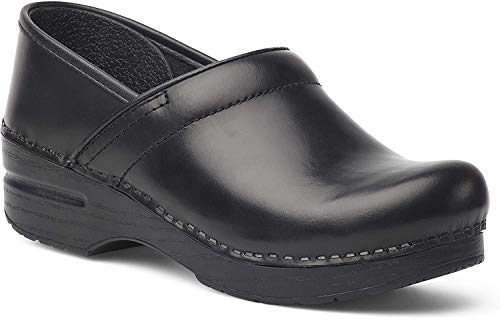 Dansko Professional Stapled Clog Unisex… Dansko Professional Stapled Clog Unisex… |
Best Classic Clog | $134 | 8.9 | Buy → |
| 3 |  Dansko Women's XP 2.0 Clogs Lightweight… Dansko Women's XP 2.0 Clogs Lightweight… |
Best Lightweight | $149 | 8.5 | Buy → |
| 4 | 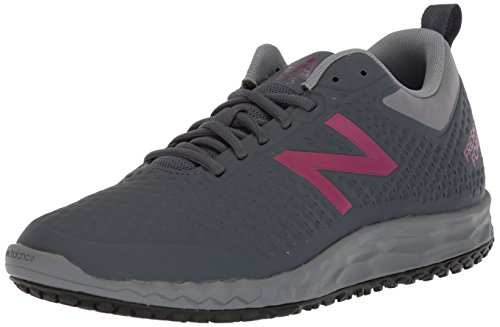 New Balance Women's Fresh Foam Slip Res… New Balance Women's Fresh Foam Slip Res… |
Best Budget | $36 | 8.2 | Buy → |
Showing 4 of 4 products
Hoka Women's Bondi Slip Resistant Black Nursing Shoe
“The Hoka Bondi SR brings marathon-runner cushioning to the hospital floor — APMA-approved, slip-tested on wet surfaces, and comfortable enough to finish a 12-hour shift without the foot pain that ends”
See Today’s Price →What we like
- APMA Seal of Acceptance for foot health
- Maximum cushioning EVA midsole for 12-hour comfort
- Slip-resistant outsole tested on water, oil, and soap surfaces
- Water-resistant full-grain leather upper
- Memory foam padded collar
- Heel pull loop for quick on/off
Watch out for
- At $160, costs $60–100 more than Dansko XP 2.0 or Crocs Bistro clogs — the premium pays for Hoka oversized CMEVA midsole cushioning that provides meaningfully better fatigue reduction on 8–12-hour shifts
- Oversized midsole stack (33mm heel, 28mm forefoot) creates a wider platform silhouette — some nurses find the profile catches on narrow rolling equipment or bed frames in tight clinical spaces
- Athletic runner styling in black or white — facilities with dress codes requiring leather-look or clog-style footwear may not approve this as compliant; confirm with unit management before purchasing
Read Full Analysis
The Hoka Bondi SR brings marathon-runner cushioning to the hospital floor. The CMEVA midsole stack delivers more underfoot cushioning than any comparable nursing shoe at this price, reducing the leg and foot fatigue that accumulates across 12-hour shifts. The APMA Seal of Acceptance confirms healthy foot mechanics, and the slip-resistant outsole is tested on wet, oily, and soapy hospital floor conditions. At $160 it costs $25 more than the Dansko Professional — the premium buys Hoka's cushioning for nurses who develop plantar fasciitis or who end shifts with significant foot pain. The oversized midsole profile is the main fit consideration; confirm clearance in narrow clinical spaces before purchasing.

Dansko Professional Stapled Clog Unisex Nursing Shoe Black
“Dansko Professional is the benchmark nursing shoe for good reason: the rocker bottom reduces plantar pressure by up to 20% and the slip-resistant outsole has been tested on the wet and chemical-expose”
See Today’s Price →What we like
- Slip-resistant outsole for wet hospital floors
- Rocker bottom reduces foot fatigue over 12-hour shifts
- Reinforced toe box protects against dropped objects
- Wide toe box prevents bunion aggravation
- Easy slip-on with heel free to move
- Trusted by nurses and healthcare workers for decades
Watch out for
- Heel-free design takes adjustment period
- Heavier than athletic-style nursing shoes
- Sizing runs European — verify conversion before ordering
Read Full Analysis
The Dansko Professional is the benchmark nursing shoe because it addresses the two primary causes of clinical foot fatigue — forefoot pressure and slip risk — through proven mechanisms that nurses have validated over decades of daily use. The rocker bottom outsole transfers pressure off the ball of the foot during the push-off phase of each step, reducing cumulative forefoot strain by up to 20% across a 12-hour shift. The reinforced toe box protects against dropped instruments and equipment. The slip-resistant outsole is tested for healthcare floor conditions. At $135 it undercuts the Hoka Bondi SR by $25 and the XP 2.0 by $15. The heel-free clog design takes a brief adjustment period — nurses who have only worn enclosed athletic shoes find the initial instability noticeable for the first few shifts. Sizing runs European, which requires a size conversion that Dansko's website provides clearly. For nurses who want proven clinical performance at the lowest price in the Dansko lineup, the Professional remains the default recommendation.

Dansko Women's XP 2.0 Clogs Lightweight Slip-Resistant Nursing Shoe
“The XP 2.0 is Dansko's answer to nurses who loved the Professional but wanted something lighter for double shifts — 20% lighter with the same slip-resistant rocker bottom and memory foam footbed.”
See Today’s Price →What we like
- XP 2.0 is lighter than original Professional by 20%
- Slip-resistant outsole for healthcare environments
- Padded instep collar for heel comfort
- Rocker bottom reduces forefoot pressure
- Memory foam footbed cushions all-day wear
- Easy to clean exterior
Watch out for
- Premium price point
- Heel-free design not for everyone
- Less structured toe box than original Professional
Read Full Analysis
The Dansko XP 2.0 is the updated Professional for nurses who found the original clog heavier than they wanted for double shifts — a 20% weight reduction with the same rocker bottom and slip-resistant outsole, plus a memory foam footbed that the original Professional lacks. The padded instep collar adds heel comfort during extended wear. At $150, it costs $15 more than the Professional and $10 less than the Hoka Bondi SR. The trade-off versus the original Professional is structural: the XP 2.0 has a less rigid toe box, which means slightly less protection against dropped objects. For nurses whose primary concern is weight during 12-hour shifts rather than maximum toe protection, the XP 2.0 is the practical upgrade from the Professional. For nurses who carry heavy equipment or work in environments with higher dropped-object risk, the original Professional is the better construction choice at a lower price.

New Balance Women's Fresh Foam Slip Resistant 806 V1 Industrial Shoe
“New Balance's Fresh Foam cushioning in a slip-resistant industrial design gives nurses the feel of a proper running shoe with the safety outsole hospital floors demand — at a price that makes replacin”
See Today’s Price →What we like
- Fresh Foam midsole provides lightweight underfoot cushioning
- Slip-resistant outsole for wet floors
- Hyposkin upper is easy to wipe clean
- Lace-up fit for secure hold over long shifts
- Lighter weight than traditional clogs
- Lower price than premium nursing shoe options
Watch out for
- Lace-up style slower to put on and remove
- Less arch support than orthotic-grade options
- May need wider size than normal — size up recommended
Frequently Asked Questions
What is the most important feature in a nursing shoe?
Are clogs or sneakers better for nurses?
How often should nurses replace their shoes?
Do nurses need special socks with nursing shoes?
Can nurses wear running shoes instead of dedicated nursing shoes?
How We Analyze Products
We analyze Amazon review data — often thousands of reviews per product — to surface patterns that individual buyers miss. Our process aggregates star ratings, review counts, and buyer sentiment at scale, identifying which strengths and weaknesses appear consistently across the largest review samples available.
Each product earned its placement through data: total review volume, average rating, and the specific praise and complaints that repeat most often across buyers. No manufacturer paid for placement on this page. Products appear here because buyers endorsed them at scale, not because a company asked us to feature them.
We use AI to summarize review sentiment — not to fabricate opinions, but to condense what thousands of buyers actually wrote into a readable format. The pros and cons you see reflect the most common themes found in verified purchaser reviews, paraphrased for clarity. We do not claim to have accessed Reddit, YouTube, or specific publications in generating these summaries.
Prices shown reflect Amazon pricing at the time this page was last generated. Click “See Today’s Price” to get the current live price on Amazon. Read our full methodology →