Best Investment Apps for Beginners 2026: Start With $0
For most beginners, Fidelity is the best starting point: $0 account minimum, $0 trades, fractional shares from $1, and zero-expense-ratio index funds (FZROX, FZILX) that beat nearly every robo-advisor on cost. If you want to completely hands off, Betterment's 0.25% robo-advisor is the top pick. For spare-change micro-investing, Acorns at $3/month gets you started, though the fee math only works once you have more than $14,400 invested. Open a Roth IRA over a taxable account if you qualify.
Start Investing →At a Glance
| # | Product | Award | Account Min | Expense Ratio | Key Feature | |
|---|---|---|---|---|---|---|
| 1 | Fidelity Investments | Our Top Pick | $0 | 0.00% (FZROX/FZILX) — 0.03-0.15% on other index funds | Zero-expense-ratio index funds; 24/7 customer service | Apply → |
| 2 | Charles Schwab | Also Excellent | $0 (Intelligent Portfolios: $5,000) | 0.03% (SWTSX) — competitive across most index funds | Free Intelligent Portfolios robo-advisor; largest brokerage education library | Apply → |
| 3 | Betterment | Best Value | $0 | 0.25% annual management fee + underlying ETF fees (~0.08%) | Automatic rebalancing; tax-loss harvesting on all accounts; SRI option | Apply → |
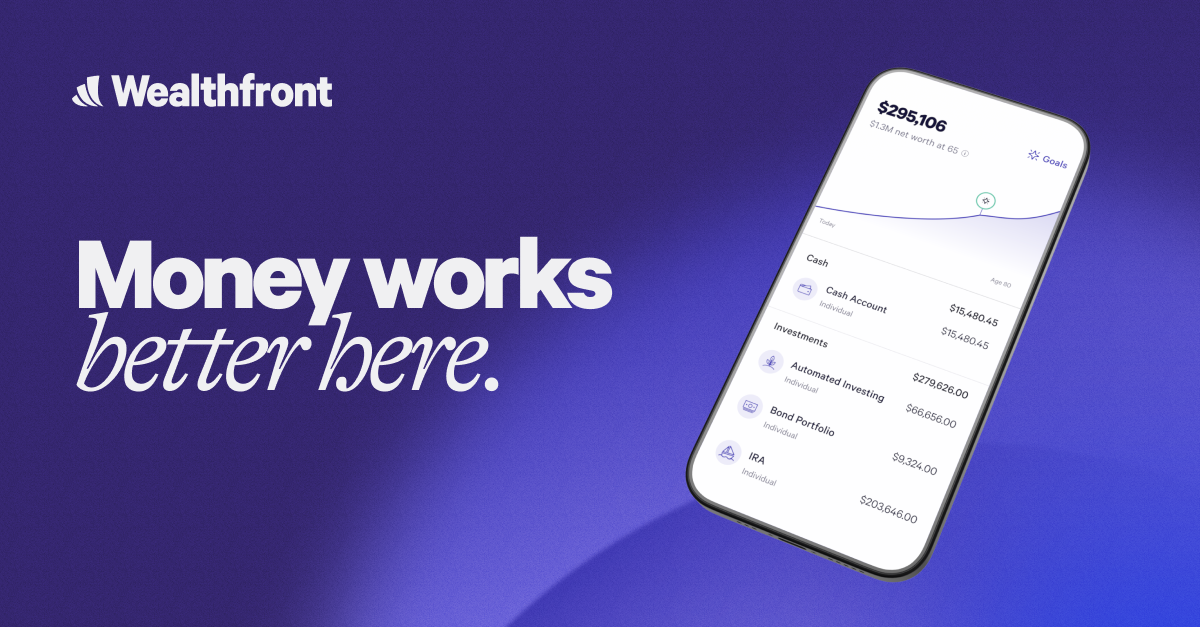
| 4 | Wealthfront | Worth Considering | $500 | 0.25% annual management fee + underlying ETF fees (~0.08%) | Direct indexing at $100,000+; 4.50% APY cash account; 529 plans | Apply → |
| 5 | Acorns | Budget Pick | $0 (round-up investing) | $3/month (Personal) or $5/month (Premium) + underlying ETF fees (~0.05%) | Automatic round-up investing; 5 diversified ETF portfolios; Roth IRA included | Apply → |
Fidelity Investments
“Fidelity's zero-expense-ratio funds (FZROX, FZILX) have no equivalent anywhere else. Add $0 minimums, $0 trades, fractional shares from $1, and 24/7 customer service, and Fidelity is the clear startin”
What we like
- Zero-expense-ratio index funds: FZROX and FZILX (0.00% — unbeatable)
- $0 account minimum, $0 trades, $1 fractional shares
- 24/7 phone and chat customer service
- Free financial planning tools and educational resources
- Cash management account with competitive APY
- SIPC insured + supplemental coverage
Watch out for
- Website and app can feel overwhelming for absolute beginners
- No automatic portfolio rebalancing in standard accounts (use robo option separately)
- Fidelity Zero funds (FZROX, FZILX) not transferable to other brokerages
- Research tools are deep but can be paralyzing for new investors
- Physical branches limited compared to Schwab
Rates as of April 8, 2026. Terms apply. Verify on issuer site.

Charles Schwab
“Schwab's Schwab Learning Center is the best free financial education resource offered by any brokerage. Add $0 minimums, near-zero expense ratio index funds, and a free robo-advisor at $5,000, and Sch”
What we like
- Schwab Stock Slices: fractional shares of any S&P 500 stock from $5
- Extensive free education library: Schwab Learning Center, webcasts, articles
- Schwab Intelligent Portfolios robo-advisor free at $5,000 minimum
- $0 account minimum, $0 trades
- Large physical branch network for in-person support
Watch out for
- No zero-expense-ratio funds like Fidelity (SWTSX is 0.03% — excellent but not zero)
- Schwab Intelligent Portfolios holds ~10% in cash — drag on returns
- Fractional shares limited to S&P 500 stocks (not any ETF)
- App is good but lags Fidelity's mobile experience
- International fund options fewer than Fidelity
Rates as of April 8, 2026. Terms apply. Verify on issuer site.
Betterment
“Betterment builds you a diversified ETF portfolio, rebalances it automatically, and harvests tax losses — all for 0.25% annually. Perfect for beginners who want to set it and forget it. Just be aware ”
What we like
- $0 minimum to start, 0.25% annual fee (low for robo-advisor)
- Automatic rebalancing — portfolio stays on target without effort
- Tax-loss harvesting on all accounts (not premium-only)
- Socially responsible investing (SRI) portfolio option
- Smart Beta portfolio and Goldman Sachs bond portfolios available
Watch out for
- 0.25% annual fee = $250/year on $100,000 — adds up over decades
- Cannot hold individual stocks — ETF portfolios only
- No in-app financial advice — Premium plan ($100,000 minimum) for advisor access
- Less tax-efficient than Wealthfront for high-income investors
- No fractional share support for self-directed stock picks
Rates as of April 8, 2026. Terms apply. Verify on issuer site.
Wealthfront
“Wealthfront matches Betterment on features and fees but adds a stronger tax optimization story — particularly direct indexing at $100,000+ balances. The 4.50% APY cash account is a compelling home-bas”
What we like
- Tax-loss harvesting on all accounts at $500 minimum
- 529 college savings plan option (rare among robo-advisors)
- High-yield cash account (4.50% APY) integrated in-app
- Direct indexing available at $100,000 (maximum tax efficiency)
- Risk parity and smart beta portfolio options
Watch out for
- $500 minimum — higher than Betterment's $0
- 0.25% fee same as Betterment, with no clear advantage at lower balances
- No human advisor access (fully algorithmic)
- Less flexible account types than full-service brokerages
- Tax-loss harvesting benefit requires taxable account (not Roth IRA)
Rates as of April 8, 2026. Terms apply. Verify on issuer site.

Acorns
“Acorns rounds up your purchases to the nearest dollar and invests the difference in a diversified ETF portfolio. It's the easiest possible entry point to investing. The fee math only works at $14,400+”
What we like
- Round-up feature invests spare change automatically from debit card purchases
- No investment knowledge required — 5 pre-built ETF portfolios
- IRA option included (Roth, Traditional, SEP) in Personal plan
- Found Money: partner brands invest cash back for you
- Acorns Early: custodial investment account for kids
Watch out for
- $3/month fee is 0.25% annually only if balance exceeds $14,400 — below that, percentage cost is extremely high
- Round-up amounts are typically $2-10/week — very slow wealth building alone
- Cannot buy individual stocks or ETFs — locked to 5 Acorns portfolios
- Fee structure penalizes small accounts: $3/mo on $500 balance = 7.2% annual fee
- No tax-loss harvesting or advanced tax features
Rates as of April 8, 2026. Terms apply. Verify on issuer site.
Investment Apps for Beginners Buying Guide
 Photo by DΛVΞ GΛRCIΛ / Pexels
Index Funds vs. Individual Stocks (For Beginners, Index Funds Always Win)
The single most important investing decision for a beginner is between buying individual stocks and buying index funds. Individual stocks require researching companies, understanding financial statements, and accepting concentration risk — one bad pick can cost you 50% or more in that position. Index funds like FZROX (Fidelity Total Market Index) buy a tiny slice of every company in the US market in one purchase. You get instant diversification. From 1928-2025, the S&P 500 has returned an average of ~10% per year before inflation. Most actively managed funds and individual stock pickers underperform this benchmark over 10+ year periods.
Robo-Advisors vs. Self-Directed Investing

Robo-advisors (Betterment, Wealthfront, Schwab Intelligent Portfolios) build and manage a diversified portfolio for you automatically. They rebalance when allocations drift, reinvest dividends, and handle tax-loss harvesting. The cost is a management fee — Betterment and Wealthfront charge 0.25% annually, meaning $25/year on a $10,000 account. Self-directed investing (Fidelity, Schwab brokerage) has no management fee but requires you to select funds and rebalance occasionally. For beginners who don't want to think about their portfolio, a robo-advisor is a reasonable trade. For beginners willing to spend 30 minutes learning, a self-directed account with two index funds (total US market + total international market) beats any robo-advisor on cost.
How to Start With $100
Open a Fidelity or Schwab account — takes 15 minutes online. Fund it with any amount ($1 works). Buy FZROX (Fidelity Total Market Index Fund, 0% expense ratio) or SWTSX (Schwab Total Stock Market Index, 0.03% expense ratio). Set up automatic monthly transfers of whatever you can afford — $25, $50, $100. Increase the amount each year as income grows. Don't check the balance daily — this is a 10-20 year project, not a trading account.
Roth IRA vs. Taxable Account: Start with Roth IRA

A Roth IRA is a tax-advantaged retirement account funded with after-tax dollars. Investments grow tax-free, and qualified withdrawals in retirement are tax-free. The 2026 contribution limit is $7,000/year ($8,000 if 50+). If you qualify (income under ~$150,000 single / $236,000 married, roughly), open a Roth IRA before a taxable account. The tax-free growth over 30-40 years is enormously valuable. A $7,000 investment at 22 growing at 8% annually until age 65 becomes approximately $170,000 tax-free.
Why Fees Matter: The Compound Cost of 1% vs 0.25%
Over 30 years, a $10,000 investment growing at 7% per year: at 0% management fee = ~$76,000; at 0.25% = ~$69,600; at 1% = ~$57,400. A 1% annual fee costs $18,600 over 30 years on a $10,000 initial investment. This is why zero-expense-ratio index funds at Fidelity (FZROX, FZILX) are so powerful for long-term wealth building. Every basis point of fee is a dollar of your retirement taken permanently.
Related Guides
- Best Micro-Investing Apps
- Best Roth IRA Accounts
- Best Online Savings Accounts
- Best Money Market Accounts
- Best Checking Accounts With No Fees
Frequently Asked Questions
What is the best investment app for beginners?
How much money do I need to start investing?
What should a beginner invest in?
What is the difference between a Roth IRA and a regular brokerage account for beginners?
How do investment apps make money if trading is free?
How We Evaluate Financial Products
We compare financial products based on objective criteria: annual fees, APR ranges, rewards rates, sign-up bonuses, and key perks. We do not factor in issuer relationships or compensation when determining rankings. Products are ranked based on overall value for the target use case described on this page.
Rates and terms change frequently. We update these pages regularly, but always verify current rates directly on the issuer’s website before applying. APR ranges shown reflect the full possible range — your actual rate depends on your creditworthiness.
This content is for informational purposes only and should not be considered financial advice. We compare products; we do not advise on which product is right for your personal financial situation. Read our full methodology →