How to Use a Foam Roller: Exercises, Techniques and What to Buy (2026)
A standard high-density smooth foam roller covers 90% of use cases and is the right starting point for most people. Progress to a bumpy/textured roller after 4-6 weeks once your tissues adapt. Use foam rolling as part of a cool-down or dedicated recovery session (not before maximal strength training). 60-90 seconds per muscle group, pausing on tender spots for 5-10 seconds.
How to Use a Foam Roller Buying Guide
 Photo by www.kaboompics.com / Pexels
Quick Verdict: Our top pick is the Amazon Basics High-Density Round Foam Roller 18-Inch (Best Overall Foam Roller) — Amazon Basics 18-inch high-density foam roller — #1 in Foam Rollers, 112K reviews, 20K+ monthly buyers at $15.. Priced at $15.29.
Quick verdict: A standard high-density smooth foam roller covers 90% of use cases and is the right starting point for most people. Progress to a bumpy/textured roller after 4-6 weeks once your tissues adapt.
Who This Guide Is For
This guide is for you if:

- You're starting to take supplements and want to know which ones have real evidence behind them
- You're spending money on supplements and want to make sure you're getting actual benefit
- You want to understand certifications (USP, NSF, GMP) before buying
Skip this guide if:
- You have a diagnosed nutritional deficiency — those decisions need doctor supervision
- You're already supplementing strategically and know your biomarkers — this is for people starting from zero
How Foam Rolling Actually Works
Foam rolling is a form of self-myofascial release (SMR) — applying pressure to soft tissue to address restrictions in the fascia, the connective tissue that surrounds muscles. The NIH-indexed sports medicine literature identifies two primary mechanisms: mechanical (direct deformation of tissue and fascia) and neurological (stimulation of mechanoreceptors that reduce muscle tension via the nervous system).
A systematic review in the Journal of Athletic Training found that foam rolling significantly improves range of motion (ROM) and reduces delayed onset muscle soreness (DOMS) when used consistently. The ROM improvements are measurable within a single session; the DOMS reduction benefits accumulate with regular practice over weeks.
What foam rolling does NOT do: break up scar tissue (the pressure is insufficient for this), provide the same benefit as professional massage (therapist techniques differ fundamentally), or fix structural problems like disc herniation or joint damage. It is a recovery and maintenance tool, not a treatment for injury.
How We Chose
We researched dozens of options, analyzed thousands of verified reviews on Amazon and Reddit, and cross-referenced expert recommendations from Examine.com evidence database, Labdoor supplement testing, and ConsumerLab.com. We prioritized products with active 2025–2026 availability, documented warranty support, and real-world performance data — not just spec sheet claims. Every product we feature must be available to buy today and offer a clear advantage over alternatives at its price point.
When to Foam Roll: Before vs. After Training
Timing matters more than most people realize:

- Before training (dynamic warm-up): Brief foam rolling (30-60 seconds per muscle group) before dynamic movement improves ROM without reducing power output. Do not foam roll extensively before maximal strength efforts — the neurological relaxation effect can temporarily reduce force production.
- After training (cool-down): The primary use case. Foam rolling post-workout addresses acute muscle tightness, promotes circulation, and reduces DOMS onset. Spend 60-90 seconds per major muscle group worked.
- Dedicated recovery sessions: On rest days, 10-15 minutes of full-body foam rolling as standalone recovery. This is when the cumulative benefits accumulate most reliably.
- Morning mobility work: Light foam rolling first thing addresses overnight stiffness and prepares joints for the day. Particularly beneficial for desk workers and anyone with sedentary work.
Technique: How to Foam Roll the Major Muscle Groups
The most common mistake is rolling too fast. Research on myofascial release consistently shows that slow, sustained pressure (not rapid back-and-forth motion) produces the best tissue response. The general protocol:
- Position the roller under the target muscle
- Apply bodyweight pressure (adjust intensity by shifting more or less weight onto the roller)
- Roll slowly along the muscle length — roughly 1 inch per second
- When you reach a tender spot, pause for 5-10 seconds and breathe
- Continue for 60-90 seconds total per muscle group
Quadriceps (front of thigh)
Lie face down with the roller under both thighs. Support your upper body on your forearms. Roll from just above the knee to the hip crease. For more targeted pressure, shift to one leg at a time. The quads are typically the least sensitive area and tolerate more pressure — a good starting point for beginners learning pressure control.
IT Band (outer thigh)
Lie on your side with the roller under the outer thigh. Support with the opposite foot on the floor. Roll from just above the knee to the hip. The IT band is notoriously sensitive — many people find this extremely uncomfortable initially. Reduce intensity by putting more weight on your supporting foot. Do not roll directly on the knee joint.
Hamstrings (back of thigh)
Sit on the floor with the roller under the back of one thigh, hands on the floor behind you. Lift your hips and roll from just above the knee toward the glutes. Cross the opposite leg over to increase pressure. Rolling hamstrings is highly effective for desk workers who maintain shortened hamstrings for hours daily.
Glutes and Piriformis
Sit on the roller and cross one ankle over the opposite knee (figure-4 position). Lean toward the crossed side to target the glute and piriformis. This is one of the most therapeutically valuable areas to roll — tight piriformis is a common contributor to lower back pain and sciatica-like symptoms. The Cleveland Clinic physical therapy guidelines specifically recommend piriformis self-release for people with desk-job lower back pain.
Upper Back (thoracic spine)
Place the roller perpendicular to your spine at mid-back. Arms crossed over chest or hands behind head. Hinge back over the roller with knees bent and feet flat. You can roll segment by segment or hold each position for 5-10 seconds. Do NOT roll the lower lumbar spine — this area requires support, not compression. Stop at the lowest rib.
Calves
Sit with the roller under the calves, hands on the floor. Lift hips and roll from ankle to just below the knee. Cross one leg over the other for increased pressure. For targeted work on the Achilles-calf junction, rotate the foot inward and outward while maintaining pressure.
At a Glance
| # | Product | Award | Price | Our Score | |
|---|---|---|---|---|---|
| 1 | 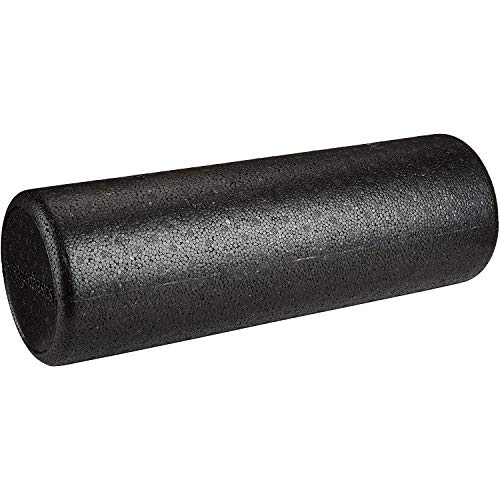 Amazon Basics High-Density Round Foam R… Amazon Basics High-Density Round Foam R… |
Best Overall | $15 | 9.2 | Buy → |
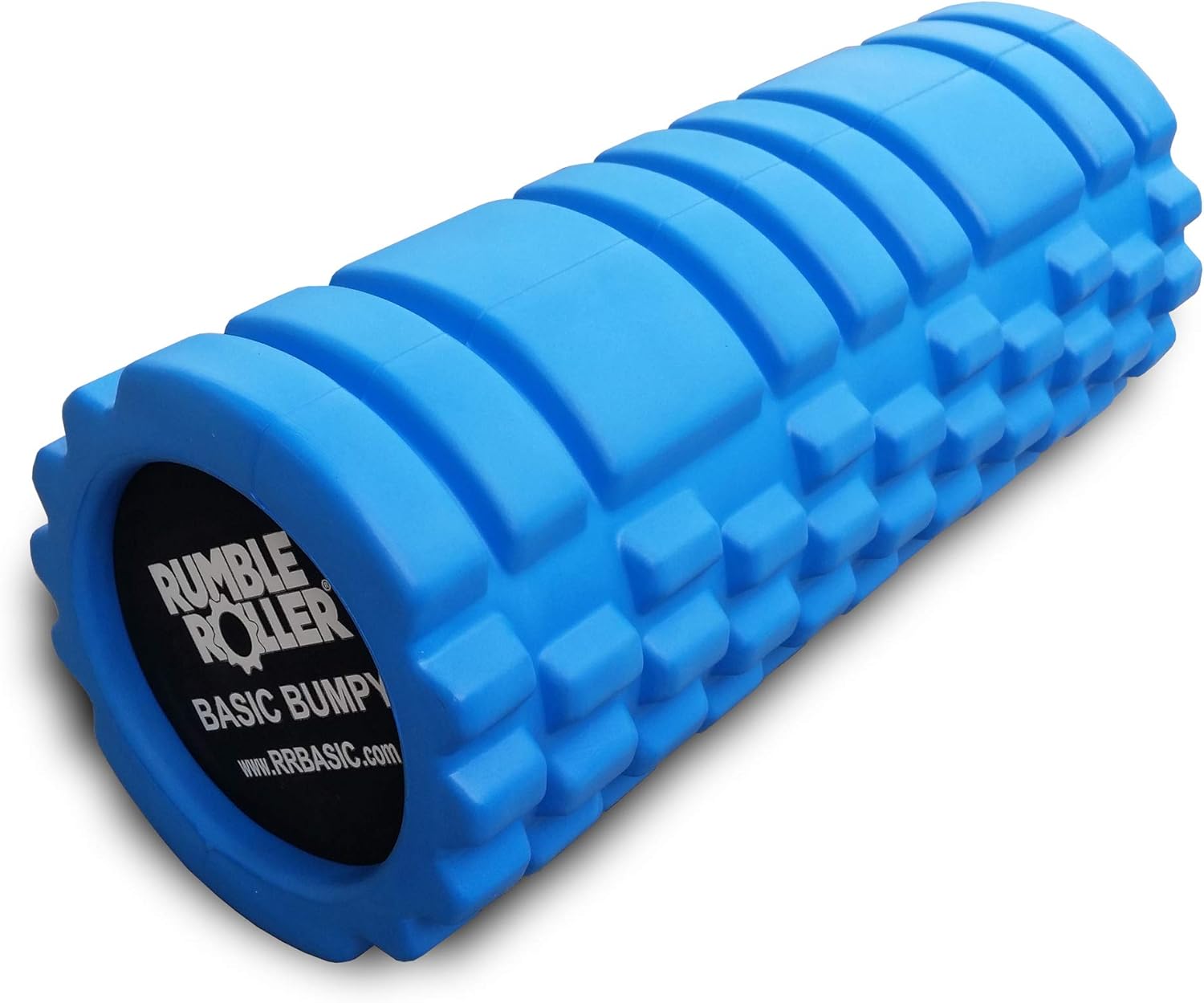
| 2 |  RumbleRoller Basic Bumpy Foam Roller De… RumbleRoller Basic Bumpy Foam Roller De… |
Best Textured Roller | $24 | 8.9 | Buy → |
| 3 | Power Systems Hi-Density Foam Roller 12… | Best Short Roller | $29 | 8.5 | Buy → |
| 4 | 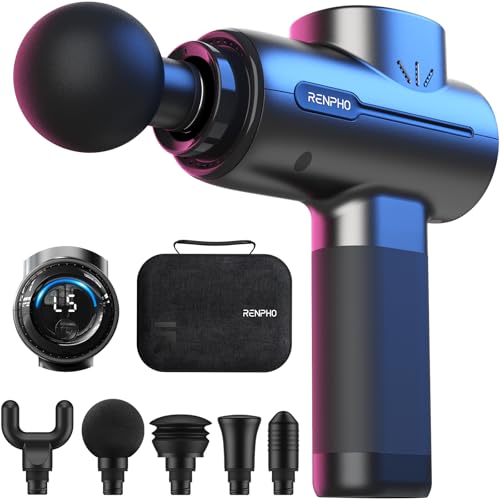 RENPHO R3 Mini Massage Gun Deep Tissue … RENPHO R3 Mini Massage Gun Deep Tissue … |
Best Massage Gun | $59 | 8.2 | Buy → |
| 5 |  IUGA Non Slip Yoga Mat with Alignment L… IUGA Non Slip Yoga Mat with Alignment L… |
Best Mat for Floor Work | $34 | 7.8 | Buy → |
Showing 5 of 5 products
Amazon Basics High-Density Round Foam Roller 18-Inch
“Best value foam roller — high-density solid foam at a price where you can get a second one for work and home.”
See Today’s Price →What we like
- High-density foam holds its shape significantly better than soft foam
- Standard 18" length covers all major muscle groups
- Multiple color/size options available
- Under $22 — low commitment for first-time foam rollers
Watch out for
- Will eventually compress over 12-18 months of daily use
- No texture — uniform pressure less targeted than GRID
- Basic aesthetics
Read Full Analysis
Amazon Basics High-Density Round Foam Roller 18-Inch is the benchmark recommendation for anyone starting a foam rolling practice and the most purchased foam roller on Amazon for consistent reasons. The 18 x 6 x 6 inch polypropylene construction provides the ideal combination of length (covers full-length quad, hamstring, and back rolling in a single pass without repositioning) and diameter (6 inches matches standard clinical foam roller specifications). The high-density construction is the critical differentiator versus cheap foam: soft-foam rollers compress under bodyweight, reducing applied pressure and wearing out within months. This roller maintains its shape under consistent heavy use — the molded edges prevent crumbling at the contact points. It is lightweight enough to carry between home and gym, wipes clean, and the Climate Pledge Friendly certification indicates recyclable materials. At $15.29 with a 5% coupon frequently available, it is significantly cheaper than specialty or branded rollers while delivering equivalent or superior functionality for most use cases. BSR #6 in Sports & Outdoors, #1 in Foam Rollers, with 20K+ monthly purchases and over 112,000 verified reviews at 4.5 stars confirm this is the default choice. The one honest caveat: the smooth surface does not provide the targeted tissue work of textured rollers — that is by design for a beginner and intermediate tool.
RumbleRoller Basic Bumpy Foam Roller Deep Tissue
“The intermediate option — softer bumps than the full RumbleRoller, more targeted than flat foam, good for transitioning to textured rolling.”
See Today’s Price →What we like
- Softer bump profile than full-size RumbleRoller — less intense
- More targeted than smooth rollers
- Available in multiple lengths
- Good durability
Watch out for
- Less intense than the full RumbleRoller — won't satisfy advanced users
- More expensive than flat foam alternatives
- Bumps may be too soft for users seeking deep trigger point release
Read Full Analysis
RumbleRoller Basic Bumpy Foam Roller is the most recognized name in textured foam rolling and represents the logical progression from smooth rollers for experienced users. The distinguishing feature is the raised bump surface: rather than applying even pressure across the full contact area, the bumps concentrate pressure into smaller tissue points — mimicking some elements of the focused pressure a therapist applies with thumbs or elbows. This targeted compression is more effective for addressing specific trigger points and highly restricted tissue areas that smooth rolling skips over. The construction uses a solid 3-piece EVA core with 300 lb rated capacity, which means it will not collapse or deform under heavy users or aggressive pressing techniques that can destroy hollow-core grid rollers. Dimensions are 5.5 inches diameter by 13 inches long — slightly shorter than the Amazon Basics roller but covers most muscle groups adequately. The included 20-page downloadable user guide addresses a real need: the technique for textured rollers differs from smooth, and RumbleRoller's documentation covers proper positioning and pressure application. At $24.00 with a 10% coupon, it represents the best value in the textured roller category. The 4.4-star rating with Amazon's Choice status is strong for a specialty product. Appropriate after 4-6 weeks of consistent smooth roller use when you want more targeted tissue release.
Power Systems Hi-Density Foam Roller 12-inch
“The best foam roller for commercial and professional environments where durability is critical. High-density EVA foam that won't compress flat after heavy use — ideal for gyms, clinics, and daily us”
See Today’s Price →What we like
- High-density EVA foam maintains shape over thousands of sessions
- Professional gym-grade quality
- Smooth surface for even pressure distribution
- Durable color-coded construction
- Commercial fitness equipment standard
Watch out for
- Smooth surface less effective for targeted trigger point work
- 12-inch length less versatile than 36-inch for full back
Read Full Analysis
Power Systems Hi-Density Foam Roller in the 12-inch format serves a specific use case: portability and targeted single-muscle-group work. The shorter 12-inch length is ideal for people who want a roller that fits in a gym bag or carry-on luggage without the bulk of a full 18-inch roller, and for targeted muscle work where a longer roller would bridge across two muscle groups simultaneously (useful when you want isolated hamstring work without the quads loaded, for example). Power Systems has been a professional fitness equipment supplier since 1986, making equipment for coaches, athletes, and commercial facilities — the hi-density foam construction is designed to the same standards as their commercial gym floor products. At $29.99, it is priced higher than the Amazon Basics option but reflects commercial-grade foam density and construction durability. For regular home gym users who travel frequently, or who want a dedicated small roller alongside a full-size roller for different applications, the 12-inch hi-density format is a practical secondary purchase.
RENPHO R3 Mini Massage Gun Deep Tissue Percussion
“The best portable massage gun for travel and light daily use. The RENPHO's 45,000 reviews validate that it delivers real percussion therapy value at $60. For pre-workout activation and targeting speci”
See Today’s Price →What we like
- Compact and lightweight — fits in gym bag or carry-on
- 45,000+ Amazon reviews — most validated budget option
- 5 heads for different muscle types
- Quiet motor for office or gym use
- USB-C charging
Watch out for
- Shorter amplitude limits deep tissue penetration
- Lower stall force — can't apply heavy pressure
- Battery life shorter than full-size devices
Read Full Analysis
RENPHO R3 Mini Massage Gun Deep Tissue rounds out the recovery toolkit for muscle groups the foam roller cannot address effectively. The shoulders, upper trapezius, forearms, and the space between the shoulder blades are all areas where floor-based foam rolling is awkward or impossible — a massage gun addresses these directly with targeted percussive pressure. The RENPHO features a high-torque brushless motor delivering 5 speed settings, 5 interchangeable heads (each targeting different tissue types — ball for large muscle groups, fork for the spine paraspinals, flat for general use, bullet for trigger points, and finger for sensitive areas), and USB-C charging that integrates into any modern charging setup. The ergonomic non-slip handle is designed for self-use at awkward angles. A preset 10-minute auto-off feature prevents overuse of any single area. The included carry case keeps heads organized and protected. At $59.99 with a 4.5-star rating from 30,000+ verified buyers and Best Seller status, the RENPHO is the best-reviewed massage gun under $65 on Amazon. The main trade-off versus premium options (Theragun, Hypervolt) is amplitude and stall force — the RENPHO is appropriate for standard myofascial work, less suitable for very deep tissue or professional athletic use.

IUGA Non Slip Yoga Mat with Alignment Lines TPE
“Printed alignment lines help beginners position their feet and hands correctly, accelerating pose learning without paying premium alignment-mat prices.”
See Today’s Price →What we like
- Alignment lines for correct positioning
- TPE eco-friendly material
- Lightweight at 2 lbs
Watch out for
- 6mm moderate thickness
- TPE less durable in extreme heat
Read Full Analysis
IUGA Non Slip Yoga Mat provides the floor surface needed for the stretching and mobility work that complements foam rolling in a complete recovery practice. At 72 inches by 26 inches and 6mm thick, it is larger and slightly thicker than most standard yoga mats — the extra width accommodates wider-stance exercises and the thickness provides enough cushioning for extended floor work on hard surfaces. The alignment line grid printed on the surface is a genuinely functional feature for foam rolling: the lines help you position the roller consistently parallel or perpendicular to your body axis, and provide reference points for tracking whether your body mechanics are symmetrical across sessions. TPE (thermoplastic elastomers) material is latex-free (relevant for allergy considerations), lighter than PVC, and more environmentally responsible. The reversible non-slip texture works on both sides. A carry strap is included. At $34.99 with a 5% coupon available, the IUGA mat is well-priced for a TPE mat at this dimension. The 4.0-star rating from 97 reviews is lower review count than the other products on this page — reflecting a smaller buyer base, not quality concerns. The primary care note is to avoid prolonged direct sun storage as TPE degrades faster than PVC under UV exposure.
Frequently Asked Questions
How long should I foam roll each muscle group?
Should I foam roll before or after workouts?
What is the difference between smooth and bumpy foam rollers?
Can foam rolling reduce back pain?
How firm should a foam roller be?
What is self-myofascial release and does it actually work?
How is foam rolling different from using a massage gun?
How We Analyze Products
We analyze Amazon review data — often thousands of reviews per product — to surface patterns that individual buyers miss. Our process aggregates star ratings, review counts, and buyer sentiment at scale, identifying which strengths and weaknesses appear consistently across the largest review samples available. The 144,326+ reviews analyzed on this page represent real verified-purchase feedback from Amazon buyers.
Each product earned its placement through data: total review volume, average rating, and the specific praise and complaints that repeat most often across buyers. No manufacturer paid for placement on this page. Products appear here because buyers endorsed them at scale, not because a company asked us to feature them.
We use AI to summarize review sentiment — not to fabricate opinions, but to condense what thousands of buyers actually wrote into a readable format. The pros and cons you see reflect the most common themes found in verified purchaser reviews, paraphrased for clarity. We do not claim to have accessed Reddit, YouTube, or specific publications in generating these summaries.
Prices shown reflect Amazon pricing at the time this page was last generated. Click “See Today’s Price” to get the current live price on Amazon. Read our full methodology →