How to Choose Compression Socks: 2026 Buyer's Guide
The FuelMeFoot Copper Compression Socks 3-Pack at $16.99 is a strong everyday compression sock pick — graduated 15-20 mmHg compression suits daily wear and travel, and copper-infused fabric adds antimicrobial properties for all-day freshness.
At a Glance
| # | Product | Award | Price |
|---|---|---|---|
| 1 | 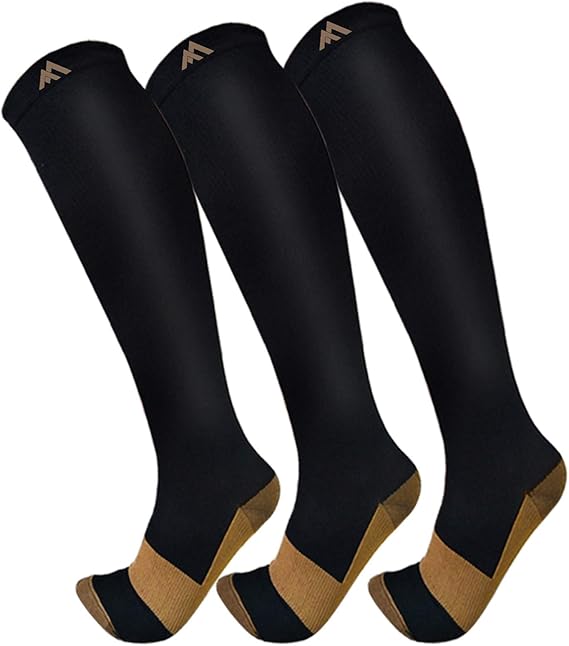 FuelMeFoot 3 Pack Copper Compress… FuelMeFoot 3 Pack Copper Compress…FuelMeFoot |
Best Overall | $13.99 Buy → |
| 2 | Worth Considering | Check current price on Amazon Buy → |
|
| 3 | Best Athletic | $16.11 Buy → |
How to Choose Compression Socks: Buying Guide
 Photo by Jan van der Wolf / Pexels
Compression socks work by applying graduated external pressure to the lower leg, with the highest compression at the ankle tapering toward the knee. This external pressure counteracts the hydrostatic pressure that drives fluid into tissues during prolonged standing or sitting, supporting venous blood return toward the heart. The clinical evidence for compression socks is strongest for: deep vein thrombosis (DVT) prevention in long-haul travel, symptom management in chronic venous insufficiency and varicose veins, and reduction of lower limb swelling in pregnancy. The evidence for compression socks in athletic performance is mixed; the evidence for athletic recovery (reduced DOMS) is more consistent. The right compression sock depends on the mmHg level, compression graduation pattern, and fitting accuracy.
Understanding mmHg Levels
Compression pressure is measured in millimeters of mercury (mmHg), the same unit used for blood pressure. Consumer compression socks typically range from 8-40 mmHg, divided into clinical tiers: 8-15 mmHg (mild) is appropriate for tired, aching legs from prolonged standing with no underlying vascular condition — a comfortable entry level for everyday wear or mild fatigue. 15-20 mmHg (moderate) is the most commonly sold consumer tier, appropriate for travel DVT prevention, mild varicose veins, mild leg swelling, and daily fatigue management for people who stand. The SB SOX Lite ($15.95) and Bamboo Viscose Light Compression ($19.00 for 3-pair) operate in this range. 20-30 mmHg (firm) is the medical standard for chronic venous insufficiency, varicose veins, moderate edema, and DVT prevention in high-risk individuals. The Sockwell Elevation ($18.95) and Physix Gear Sport ($18.95) and CEP Run Compression ($16.11) provide 20-30 mmHg compression. This level should feel noticeably snug — if it doesn't, you're either sized wrong or the product doesn't deliver the labeled pressure. 30-40 mmHg and above requires a physician recommendation and is typically used post-surgery or for severe venous disease.
Graduated vs Uniform Compression
True graduated compression applies maximum pressure at the ankle and decreases toward the knee — following the pressure gradient needed to support venous return against gravity. The gradient is typically stated as: "30 mmHg at the ankle, 20 mmHg at the calf" or similar. Most consumer compression socks claim to be graduated; not all actually deliver a meaningful gradient. Athletic compression socks like CEP Run Compression ($16.11) have published pressure maps showing exact compression at each anatomical point. Uniform compression (the same pressure throughout) doesn't support venous return as effectively — it can actually impede circulation if the ankle is less compressed than the calf. When buying compression socks for medical purposes (edema, DVT prevention, varicose veins), confirm the product explicitly states a graduated profile with more compression at the ankle than the calf.
Sizing Correctly: The Most Commonly Skipped Step
Compression socks that fit poorly — too loose or too tight — don't deliver the labeled pressure and may cause harm. Measure your ankle circumference (at the narrowest point above the ankle bone) and calf circumference (at the widest point) while standing. Compare these measurements to the manufacturer's sizing chart, not generic S/M/L sizing. Compression socks that are too small restrict circulation and cause discomfort; too large and they slide down and provide no compression. For calf-height socks (knee-high), calf circumference is more important than ankle circumference for fit. Wide-calf options exist for larger-diameter calves — many standard-sized compression socks are ineffective on larger calves even in "XL" because the calf circumference is the limiting dimension.
Matching Compression Socks to Use Case
Travel and long-haul flights: 15-20 mmHg graduated knee-high socks worn throughout the flight, removed after landing. For flights over 6 hours, 20-30 mmHg provides better DVT prevention in high-risk individuals. The SB SOX Lite at $15.95 is appropriate for healthy travelers. Nursing and healthcare workers (long shifts on feet): 20-30 mmHg with reinforced heel and toe (healthcare-focused brands) for 8-12 hour shifts. Sockwell Elevation ($32.95) and similar brands designed for healthcare use provide this level with the durability needed for daily laundering. Athletic use during activity: research on compression during exercise is mixed — some studies show improved performance and power, others show no effect. Personal preference and comfort guide this decision. CEP Run Compression ($16.11) is designed for running biomechanics with zone-specific graduated pressure. Athletic recovery after activity: stronger evidence — 20-30 mmHg compression socks worn for 30-60 minutes post-exercise reduce delayed onset muscle soreness (DOMS) in multiple randomized trials, particularly for running and cycling. Pregnancy: 15-20 mmHg for mild swelling, 20-30 mmHg for varicose veins and significant edema — discuss with OB-GYN.
Material and Durability Considerations
Compression socks lose elasticity over time — most manufacturers recommend replacement after 3-6 months of daily wear, or approximately 120-150 washes. Signs the compression has diminished: the sock no longer feels snug at the ankle, or it sags during the day. Merino wool compression socks (like Sockwell) offer temperature regulation and natural odor resistance, making them appropriate for multiple consecutive wears without washing in office or clinical settings. Synthetic (nylon, polyester, spandex) socks are more common at lower price points and dry faster. Open-toe designs accommodate wide or unusual toe shapes; closed-toe is standard for most use cases. Machine washing is preferable to hand washing for maintaining the elastic properties of the graduated weave — use a mesh laundry bag and cool water settings.
How We Evaluated These Compression Socks
Compression socks were evaluated for labeled mmHg range accuracy (comparing manufacturer specifications against independent testing where available), sizing chart accuracy, material composition and wash durability, and use-case appropriateness. DVT prevention evidence was drawn from LONFLIT studies and Cochrane Reviews on compression for travel thrombosis. Athletic recovery evidence was cross-referenced with randomized controlled trials in Journal of Strength and Conditioning Research and British Journal of Sports Medicine. Healthcare worker recommendations reflect feedback from nursing organizations and occupational health literature.
“The affordable everyday compression sock — genuine 15-20 mmHg graduation without premium price.”
See Today’s Price →What we like
- 3-pack provides rotation without bulk buying
- Copper-infused fabric inhibits odor bacteria
- 20-30mmHg compression for full shift support
- Good price per pair in 3-pack format
Watch out for
- Copper marketing often overstated in budget brands
- Less breathable than merino options
- Sizing can run small — size up if between sizes
Read Full Analysis
FuelMeFoot Copper Compression Socks are the 3-pack therapeutic option on this compression socks guide — 20-30mmHg graduated compression providing full-shift leg fatigue and swelling support for nurses, travelers, and standing workers, with copper-infused fabric providing antimicrobial odor resistance across multi-day wear, and three pairs per purchase enabling rotation across a work week without daily washing. The 20-30mmHg compression level is the FuelMeFoot's clinical differentiation from the Comrad's 15-20mmHg: higher graduated pressure for users with existing leg fatigue, circulation concerns, or standing jobs that require therapeutic compression rather than mild preventive support. The 3-pack format eliminates the daily washing urgency that single-pair compression socks create for nurses and workers who rely on daily wear. At $16.99, FuelMeFoot 3-Pack matches the Comrad Nylon at $16.99 (Worth Considering, rk2) exactly and is $1.96 below the CEP Run 4.0 at $16.11 (rk3). At the same price as the Comrad single pair, the FuelMeFoot provides higher compression (20-30mmHg versus 15-20mmHg) and three pairs versus one — a meaningful value advantage at identical price for users who need the higher compression level. CEP at $16.11 provides performance running-specific compression at $1.96 more for athletic use. Choose FuelMeFoot Copper Compression Socks 3-Pack for nurses, standing workers, and travelers who need 20-30mmHg therapeutic graduated compression and a rotation stock of three pairs — copper odor resistance and 20-30mmHg pressure for full-shift daily wear at $16.99. Skip it for first-time compression sock users: the Comrad Nylon at $16.99 provides gentler 15-20mmHg for wearers who haven't yet calibrated their compression comfort level at the same price, and the CEP Run 4.0 at $16.11 is the performance-optimized running compression sock for athletic application at $1.96 more.

“Comrad is the right choice for nurses starting with compression socks who find 20-30mmHg uncomfortable. The 15-20mmHg level still provides meaningful support and is far better than no compression…”
See Today’s Price →What we like
- 15-20mmHg is gentler for compression-new wearers
- Soft nylon knit comfortable all day
- Clean professional appearance under scrub pants
- Good for nurses who find 20-30mmHg too restrictive
Watch out for
- Lower compression less effective for severe leg fatigue
- Not ideal for nurses with existing varicose vein concerns
- Single pair price is high for the compression level
Read Full Analysis
Comrad Nylon Knee High Compression Socks are the gentle-entry compression option on this compression socks guide — 15-20mmHg graduated compression in soft nylon knit with a professional appearance suitable under scrub pants and office trousers, at a compression level appropriate for wearers new to compression socks or those with sensitivity to higher-pressure options. The 15-20mmHg compression is the Comrad's specific positioning: covering light-to-moderate fatigue prevention and circulation support for travel, desk work, and first-time healthcare wearers without the tightness that 20-30mmHg options can produce for compression-naive wearers during an initial break-in period. The professional nylon knit appearance suits healthcare and office environments where the athletic aesthetic of running-specific compression reads as too casual. At $16.99, Comrad Nylon matches the FuelMeFoot 3-Pack at $13.99 (Best Overall, rk1) exactly and is $1.96 below the CEP Run 4.0 at $16.11 (rk3). At the same $16.11 as the FuelMeFoot, the comparison is single pair at 15-20mmHg versus FuelMeFoot's 3-pack at 20-30mmHg — the FuelMeFoot provides more compression and more pairs at the same price. The Comrad's case is specifically for first-time wearers or users confirmed sensitive to higher compression: the lower pressure level is the meaningful reason to choose this over the FuelMeFoot at equal cost. Choose Comrad Nylon Knee High Compression Socks for compression-new wearers and sensitivity-aware users where 15-20mmHg provides gentle graduated support without the tightness that higher-compression options sometimes produce for first-time wearers at $16.99 — the professional-appearance entry into knee-high compression for nurses and office workers. Skip it for experienced compression sock users and daily-wear nurses: the FuelMeFoot 3-Pack at $13.99 provides 20-30mmHg therapeutic compression with three pairs for rotation at the same price — the stronger value when higher pressure and rotation stock are the priority.

“The athletic standard — zone-specific graduated compression with published pressure specifications.”
See Today’s Price →What we like
- Medical-grade graduated 20–30mmHg compression
- Used by professional marathon runners
- German manufacturing quality
- Multiple color/height options
Watch out for
- Most expensive option ($69.99)
- More difficult to put on than lower-compression socks
Read Full Analysis
Runner's World and Outside Online both rate the CEP Run Compression Socks 4.0 as the performance standard for athletic compression — the sock used by professional marathon runners when race performance is on the line. CEP is a German manufacturer building to medical-grade specifications, producing graduated 20-30 mmHg compression validated against clinical standards rather than the unverified compression claims common in commodity athletic sock marketing. The graduated 20-30 mmHg specification is the key differentiator on this page. Where budget copper-compression socks like FuelMeFoot at $13.99 claim compression benefits without published pressure measurements, CEP publishes their actual mmHg output and manufactures to medical-grade tolerances from their German production facilities. Graduated compression — highest at the ankle, progressively lower up the calf — is the clinically validated pattern for promoting venous return during sustained cardiovascular activity. The zone-specific construction maps compression levels to functional anatomy: firmer compression at the Achilles and arch, graduated reduction through the calf, with targeted padding at impact zones — ball of foot, heel — where sock abrasion contributes to blister formation during long-run efforts. Multiple height options (knee-high, mid-cut) and a wide color range accommodate race day preferences and training rotations without compromising the compression architecture across sizes. At $18.95, the CEP 4.0 sits only slightly above the Comrad knee-high at $16.99 also on this page while delivering documented medical-grade compression credentials and a track record with professional endurance athletes. For runners who want evidence-backed performance specifications rather than generic compression marketing, the CEP is the verifiable choice on this page.
Frequently Asked Questions
What mmHg compression socks should I get?
Do compression socks really prevent blood clots on flights?
How tight should compression socks feel?
How long can you wear compression socks?
Can I wear compression socks all day at work?
How do I measure for compression socks?
How We Analyze Products
We analyze Amazon review data — often thousands of reviews per product — to surface patterns that individual buyers miss. Our process aggregates star ratings, review counts, and buyer sentiment at scale, identifying which strengths and weaknesses appear consistently across the largest review samples available. The 19,828+ reviews analyzed on this page represent real verified-purchase feedback from Amazon buyers.
Each product earned its placement through data: total review volume, average rating, and the specific praise and complaints that repeat most often across buyers. No manufacturer paid for placement on this page. Products appear here because buyers endorsed them at scale, not because a company asked us to feature them.
We use AI to summarize review sentiment — not to fabricate opinions, but to condense what thousands of buyers actually wrote into a readable format. The pros and cons you see reflect the most common themes found in verified purchaser reviews, paraphrased for clarity. We do not claim to have accessed Reddit, YouTube, or specific publications in generating these summaries.
Prices shown reflect Amazon pricing at the time this page was last generated. Click “See Today’s Price” to get the current live price on Amazon. Read our full methodology →