How to Choose a Bed Frame: 2026 Buying Guide
For a Queen foam or hybrid mattress, choose a platform frame with slats no more than 3 inches apart and a center support leg — wider slats allow foam to sag, voiding most mattress warranties. The Zinus Platform Bed Frame with Storage ($97.19) leads for space efficiency and easy assembly. Check weight capacity (500+ lbs) and clearance height for storage needs.
At a Glance
| # | Product | Award | Price |
|---|---|---|---|
| 1 | Our Top Pick | $97.64 Buy → |
|
| 2 |  Amazon Basics Foldable Metal Plat… Amazon Basics Foldable Metal Plat…Amazon Basics |
Best Foldable | $78.74 Buy → |
| 3 |  Olee Sleep 14 Inch Heavy Duty Ste… Olee Sleep 14 Inch Heavy Duty Ste…Olee Sleep |
Best Heavy Duty | $50.99 Buy → |
| 4 | Best Canopy | $118.99 Buy → |
|
| 5 | Best Upholstered | $164.57 Buy → |
How to Choose a Bed Frame: Buying Guide
 Photo by Max Vakhtbovych / Pexels
Bed frames seem simple until your mattress sags at month three or you wake up to squeaking at 2am. The frame isn't just furniture — it's the structural foundation that determines how your mattress performs and how long it lasts. Most mattress warranties require specific frame support conditions, and failing those voids coverage.
The 5 Frame Types and When Each Makes Sense
Platform frames have a flat surface or closely-spaced slats (3" apart or less). No box spring needed. Height typically 6-14 inches off the floor. Best for: foam, latex, and hybrid mattresses (which all need solid, even support). This is the most popular type for good reason — compatible with modern mattresses, available from $80-500. Brands: Zinus, Nectar, Casper, IKEA Malm.
Panel/traditional frames use wider-spaced slats designed to hold a box spring. Box spring adds height and some additional support. Best for: innerspring mattresses that were designed for box spring support. Avoid using these with foam mattresses — the wide slat gap causes foam to deform. Height with box spring: 20-28 inches.
Storage frames have either under-bed drawers or a hydraulic lift mechanism for full under-bed access. Drawer storage = 8-9 inches clearance (usually 2-4 drawers per side). Hydraulic lift = access to entire under-mattress area. Best for small bedrooms. Cost premium: $50-200 over standard platform frames. Most storage frames sacrifice slat closeness — verify 3" max spacing for foam mattresses.
Upholstered frames include fabric-wrapped side rails and headboards. Provide a finished look without a separate headboard purchase. Fabric collects dust and pet hair — harder to clean than wood or metal. Cost: $200-800 for quality options. Brands: Zinus Ricardo, Novogratz, South Shore.
Metal frames are the most affordable ($40-150) but often lack a headboard and have wider slat spacing. Good for guest rooms and temporary setups. Heavy-duty steel frames with center support legs are durable; thin L-shaped frames with few support legs squeak and flex under weight.
Slat Spacing: The Rule That Mattress Companies Care About
This is the most overlooked spec and the source of most mattress warranty claims. The rule: slats must be no more than 3 inches apart for foam and hybrid mattresses. Some mattress brands (Casper, Purple, Saatva) specify 2.75 inches. Why? Foam is viscoelastic — it deforms under sustained point pressure. Gaps over 3 inches create permanent depressions in foam layers over time.
Innerspring mattresses are more forgiving — 4-5 inch slat spacing is acceptable because the spring coils distribute weight laterally. Platform frames designed for foam typically have 14-20 slats for a Queen size; budget frames sometimes have as few as 9 slats (4+ inch gaps) — not sufficient for foam.
Always count slats or confirm the gap specification before purchasing for a foam or hybrid mattress.
Center Support Legs Are Non-Negotiable for Queen+
Any frame for a Queen, King, or Cal King mattress must have center support legs (also called center support bars). Without them, the center of the frame flexes over time, creating a hammock effect where the mattress sags in the middle. This typically takes 6-18 months to develop. A properly built Queen frame has at least one center leg; King frames need two. Check the product listing — the presence of center support is usually listed in specs, not always shown in photos.
Weight Capacity and Sizing
Manufacturer weight ratings are for the total load: mattress + people + bedding. A typical queen mattress weighs 60-100 lbs. Two adults at 170 lbs each = 340 lbs. Total = 400-440 lbs. Budget frames often rate at 500 lbs, which is fine for average use. If combined weight (people + mattress) is over 400 lbs, target 750-1,000 lb rated frames (heavy-duty steel construction, $150-300).
Size dimensions to verify:
Twin: 38" × 75" | Twin XL: 38" × 80" (college dorms)
Full/Double: 54" × 75"
Queen: 60" × 80" (most common)
King: 76" × 80"
California King: 72" × 84" (taller, narrower — verify your room is wide enough)
Assembly and Noise
Most platform frames assemble in 30-60 minutes with basic tools. Tool-free designs (Zinus, Lucid) use hook-and-lock systems and genuinely take 15-20 minutes. Squeaking is almost always caused by wood-on-metal or metal-on-metal contact points. Fixes: add felt pads between contact surfaces, tighten all bolts (they loosen over months), or add a thin rubber mat under the mattress. Most squeaking develops 6-18 months after assembly as components settle.
What We Recommend
For most buyers with a foam or hybrid mattress: the Zinus Moiz or Zinus SmartBase platform frames ($100-180) hit the sweet spot of close slat spacing, center support, easy assembly, and 5-year warranty. For storage: the Zinus Deluxe Wood Platform with drawers ($250-350) is the most reliable at this price. For heavier sleepers (combined weight over 400 lbs): the Olee Sleep T-3000 steel frame (1,200 lb capacity) at $150-200. See our best bed frames and best bed frames under $200 for specific product picks.
Common Mistakes to Avoid
Buying the wrong size for your room — measure the room and leave 24 inches of clearance on both sides and the foot of the bed for comfortable movement. Ignoring slat spacing for foam mattresses — verify before purchasing or your mattress warranty may be void in year 1. Forgetting clearance height — standard frames sit 13-14 inches off the floor (enough for most under-bed storage bins). Storage frames have only 8-9 inches. Measure your storage needs before choosing. Not accounting for headboard compatibility — if you want a separate headboard, verify the frame has headboard attachment points (bolts/slots on the headboard end).

Watch Before You Buy

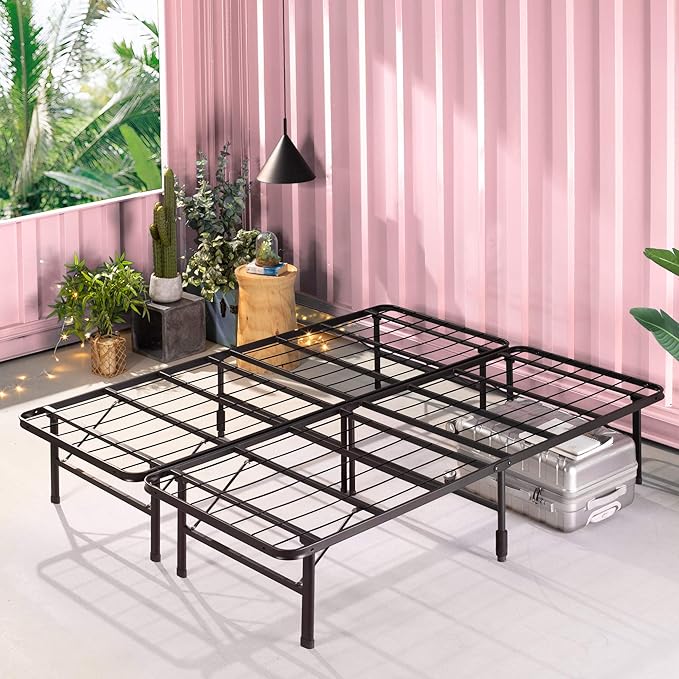
“The Zinus Platform Bed Frame with Storage No tools needed to set up this, 2-piece metal bed frame. features a one-and-done solution. 4.7 stars from 103,429 Amazon reviews signal consistent…”
See Today’s Price →What we like
- 13 inches of underbed clearance provides substantial storage room for bins, boxes, or rolled items
- No box spring required — heavy steel platform supports mattresses directly for a cleaner setup
- Tool-free one-touch assembly gets the frame functional without hardware or instruction complexity
Watch out for
- Steel platform can transmit squeaking sounds if mattress shifts during sleep
- Minimalist design lacks a headboard — requires purchasing separately for a finished look
Read Full Analysis
The Zinus Platform Bed Frame with Storage tops this comparison at $97.19 with a feature that most buyers at this price tier underestimate: 13 inches of underbed clearance is substantial storage real estate. A standard platform bed sits 6–8 inches off the ground; 13 inches accommodates full-height storage bins, rolling drawers, and luggage, effectively adding a hidden storage tier to the room without additional furniture. For small apartments and bedrooms without dedicated closet space, that clearance is the most practical differentiator in this comparison. The heavy steel platform eliminates the box spring requirement, supporting memory foam, hybrid, and innerspring mattresses directly on a solid foundation. Tool-free one-touch assembly is one of the more genuinely simple setups in the category — the Zinus system snaps into a stable configuration without bolt threading or leg hardware. The 103,000+ Amazon reviews at 4.7 stars represent one of the largest and most consistent satisfaction bases in any bed frame category. The steel platform can transmit creaking sounds if the mattress shifts during sleep — the main comfort complaint from long-term users. The minimalist design lacks a headboard, requiring a separate purchase for a fully finished bedroom look. At $50.99 versus $50.99 for the foldable Amazon Basics and $78.74 for the Olee, the $50.99 premium over the Amazon Basics buys fixed (non-folding) stability and the storage clearance advantage. For buyers who value practical storage access and weight-bearing performance, the Zinus is the right anchor pick in this comparison.
“14-inch-clearance metal platform frame folds flat for moving and requires no box spring at $78.74 — the Amazon Basics for renters who move frequently and need a bed frame that packs down quickly. No…”
See Today’s Price →What we like
- Foldable design packs flat for moving or storage without disassembly
- 14-inch leg height provides above-average underbed clearance for storage bins and vacuum access
- Tool-free assembly snaps together in minutes without floor-level hardware placement
Watch out for
- Wire grid surface requires a bunkie board or solid slat insert under foam mattresses to prevent sagging
- No headboard or footboard attachment points — frame is functional only, not decorative
Read Full Analysis
The Amazon Basics Foldable Bed Frame earns its placement through one practical feature no other frame on this page offers: it folds flat for moving without disassembly. Every other frame in this comparison requires tool or tool-free disassembly into multiple pieces before transport — the Amazon Basics collapses to a single flat unit for apartment transitions, guest room setup and teardown, or seasonal storage. For renters who move frequently, this functionality justifies the $78.74 price independently of other features. The 14-inch leg height matches the Zinus storage clearance advantage at $5 less, and the folding capability adds the moving benefit on top. Tool-free snap assembly typically takes under 5 minutes from unboxing to a stable frame, and 18 steel slats support memory foam and hybrid mattresses directly without a box spring. The wire grid surface has wider spacing than a dense slat system, which can cause foam mattresses to develop soft spots over time without a bunkie board or solid insert beneath the foam layer. The frame has no headboard or footboard attachment points, making it purely functional in form. At $91.79 versus $97.19 for the Zinus and $97.64 for the Olee, the Amazon Basics occupies the middle of this comparison with a meaningful practical advantage: it is the only frame here that moves with you without a disassembly step. For renters and frequent movers, that trade-off is the right one to make.
“Heavy-duty steel slat frame at $50.99 with center support legs to prevent middle sag — the Olee Sleep for heavier sleepers or couples who want a rigid non-flex foundation without spending on…”
See Today’s Price →What we like
- Heavy-gauge steel construction supports up to 1,500 lbs — handles heavier sleepers and couples reliably
- Center support leg prevents mattress sagging on queen and king configurations
- Noise-free glides protect flooring from scratches during position adjustments
Watch out for
- Slat spacing may be too wide for memory foam mattresses without an additional support board
- Lower storage clearance — sits closer to the floor than elevated platform alternatives
Read Full Analysis
The Olee Sleep at $50.99 is the budget anchor of this comparison — $40 below the Amazon Basics and $46 below the Zinus — with a specific design strength: the 1,500 lb weight capacity from heavy-gauge steel construction. Most platform bed frames in this price range are rated for 500–800 lbs; the Olee's higher capacity makes it genuinely suitable for heavier sleepers, couples, and anyone who has had cheaper frames deflect or creak under combined body weight. The center support leg in queen and king configurations prevents the middle-sag problem that affects lower-cost frames without center support, where the mattress foundation bows toward the floor over time under sustained load. Floor glides protect hardwood and laminate surfaces from scratching during position adjustments — a detail that matters for rental apartments with damage deposits or newly refinished floors. The trade-off for the budget price is storage clearance: the Olee sits lower to the ground than the 13-inch Zinus or 14-inch Amazon Basics, limiting the size of storage items that fit underneath. The slat spacing is wider than recommended for unsupported memory foam mattresses — a solid insert or bunkie board prevents uneven support zones from developing over time. For heavier sleepers and couples who need a weight-rated, squeak-resistant foundation at the lowest price in this comparison, the Olee is the right call at nearly half the cost of the top-ranked Zinus.
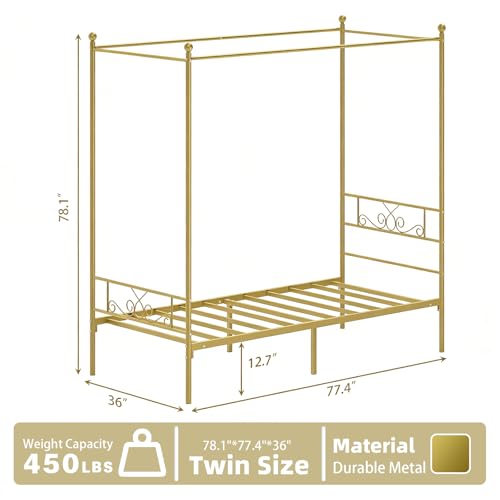
“Suit for anyone who needs to move frequently or wants to upgrade their current one (The middle backbone can be. 4.5 stars from 1,303 Amazon reviews signal consistent reliability.”
See Today’s Price →What we like
- 4-poster canopy design adds height and visual drama to a guest or kids bedroom
- 12.7-inch underbed clearance accommodates standard storage bins and rolling drawers
- Twin size appropriate for children, teens, or spare rooms needing a statement piece
Watch out for
- European canopy style is visually dominant — requires designing a room around the frame
- Twin sizing limits resale versatility compared to full or queen platform frames
Read Full Analysis
Suit for anyone who needs to move frequently or wants to upgrade their current one (The middle backbone can be Assembly required — budget 30-60 minutes for initial setup Color and style options may be limited compared to premium furniture brands

“The Amira's button-tufted headboard reaches high enough to serve as back support while reading in bed — a practical detail at $156.23 that most budget frames miss. The sturdy slat system eliminates…”
See Today’s Price →What we like
- Full upholstered headboard provides a plush backrest for reading or watching TV in bed
- Tufted button design adds mid-century modern texture without extra hardware or assembly
- Available in multiple fabric colors to coordinate with existing bedroom decor
Watch out for
- Upholstered surface collects pet hair and lint — requires periodic lint rolling or vacuuming
- Fabric headboard susceptible to staining from body oils over time without regular cleaning
Read Full Analysis
The Modway Amira is the aesthetic and functional step-up in this comparison at $163.78 — $44 above the WeeHom canopy frame and $66 above the Zinus platform. What the Amira adds that no other frame on this page provides: a full upholstered headboard with button-tufted detailing that reaches high enough to function as genuine back support for reading or watching TV in bed, not just a decorative panel positioned below a comfortable leaning height. The button-tufted mid-century modern design adds texture and visual interest without additional hardware, accessories, or wall mounting required. Available in multiple fabric colors, the frame adapts to existing bedroom decor rather than requiring paint or bedding adjustments to coordinate. The sturdy slat system eliminates the box spring requirement, keeping the total bed build cost comparable to other frames on this page despite the higher frame price. The upholstered surface is the practical trade-off: fabric collects pet hair and lint in a way that metal or wood frames do not, requiring periodic lint rolling or vacuuming. Over time, body oils can mark the headboard fabric near pillow height without regular cleaning. For households with pets or young children, the upholstered surface demands more maintenance than sealed metal alternatives. For adults who want an aesthetically complete bedroom setup with functional headboard support at a mid-range price, the Modway Amira justifies its position as the premium option in this comparison.
Frequently Asked Questions
What is the maximum slat spacing for a foam mattress?
Do I need a box spring with a platform bed frame?
What size bed frame do I need for my room?
How important is center support on a bed frame?
What weight capacity should a bed frame have?
Why does my bed frame squeak and how do I fix it?
How We Analyze Products
We analyze Amazon review data — often thousands of reviews per product — to surface patterns that individual buyers miss. Our process aggregates star ratings, review counts, and buyer sentiment at scale, identifying which strengths and weaknesses appear consistently across the largest review samples available. The 269,974+ reviews analyzed on this page represent real verified-purchase feedback from Amazon buyers.
Each product earned its placement through data: total review volume, average rating, and the specific praise and complaints that repeat most often across buyers. No manufacturer paid for placement on this page. Products appear here because buyers endorsed them at scale, not because a company asked us to feature them.
We use AI to summarize review sentiment — not to fabricate opinions, but to condense what thousands of buyers actually wrote into a readable format. The pros and cons you see reflect the most common themes found in verified purchaser reviews, paraphrased for clarity. We do not claim to have accessed Reddit, YouTube, or specific publications in generating these summaries.
Prices shown reflect Amazon pricing at the time this page was last generated. Click “See Today’s Price” to get the current live price on Amazon. Read our full methodology →