How to Choose a Bookshelf in 2026: Buyer's Guide
For most home libraries of 50 to 200 books, a 72-inch tall 5-shelf unit in a 30 to 36 inch width comfortably holds 150 to 200 standard paperbacks and hardcovers. Prioritize shelf thickness (at least 3/4 inch for spans over 24 inches), adjustable shelf heights, and mandatory wall anchoring for any bookshelf over 48 inches tall.
How to Choose a Bookshelf Buying Guide
 Photo by SHVETS production / Pexels
The most overlooked bookshelf specification is load capacity — specifically per-shelf load capacity, not total unit load. Thin shelves over wide spans sag under book weight within months. A full shelf of hardcovers across a 36-inch span weighs 30 to 50 pounds. Most quality bookshelves specify per-shelf weight capacity of 50 to 75 pounds. Shelves rated under 30 pounds per shelf are problematic for large-format or hardcover books over any span longer than 24 inches.
Dimensions: Height, Width, and Depth
Bookshelf height ranges from 36-inch low units (suitable as room dividers or below windows) to 84-inch tall units that approach ceiling height. Standard shelf spacing of 11 to 12 inches accommodates most paperbacks and standard hardcovers. Oversized art books, cookbooks, and large-format volumes require shelf spacing of 13 to 15 inches — verify the shelf height is adjustable or that the specific shelf spacing accommodates your largest books before purchasing. Width determines total book capacity: a 30-inch wide unit holds approximately 25 to 35 books per shelf depending on book thickness, so a 5-shelf unit holds 125 to 175 books at capacity. Depth is typically 10 to 12 inches for standard bookshelves, sufficient for one row of books with a small decorative space in front. Double-row storage (books shelved in two depths) requires 16 to 18 inch deep shelves. Our best bookshelves covers top models by capacity and build quality. For workshop storage, see workshop shelving.
Shelf Material and Sag Resistance

Shelf material determines sag resistance over time under book load. MDF (medium density fiberboard) is the most common material and performs adequately at 3/4 inch thickness for spans up to 30 inches. Spans over 30 inches with MDF at 3/4 inch will sag noticeably within 1 to 2 years under full book load. Solid wood shelves resist sag significantly better due to grain structure. Engineered wood with edge banding looks similar to solid wood but has MDF performance characteristics. Particleboard (a cheaper engineered wood) is the weakest option and is not appropriate for heavy book loads at any span. A center support leg or brace between shelves reduces effective span and prevents sag in wide units — look for this feature on bookshelves wider than 36 inches. Adjustable shelf pin holes allow you to reposition shelves to accommodate different book heights, which is a practical feature for mixed collections.
Wall Anchoring and Safety
Any bookshelf over 48 inches tall must be anchored to the wall. Unsecured tall bookshelves are a tip-over hazard and cause fatal injuries to children annually. Most bookshelves include a wall mounting bracket but provide minimal hardware or instructions. The correct anchoring method: locate wall studs using a stud finder, drill into studs (not just drywall), and use screws at least 2.5 inches long. If stud locations do not align with the bookshelf mounting bracket, use drywall anchors rated for the expected load. Anti-tip straps (available separately for $5 to $15) connect the bookshelf top to the wall and are the simplest retrofitted solution. Anchor bookshelves in earthquake-prone regions regardless of height. Never store heavy items on upper shelves of an unsecured bookshelf — the top-heavy loading dramatically increases tip-over risk. Wall-mounted floating shelves (anchored directly to wall studs without freestanding legs) eliminate tip-over risk entirely but require more precise installation.
Freestanding vs. Built-In vs. Floating Shelves
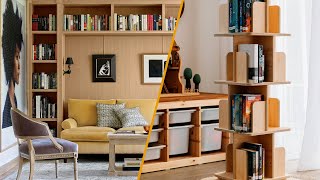
Freestanding bookshelves are movable, require no installation skill, and are appropriate for renters. Quality varies from flat-pack budget units ($50 to $150) to solid wood furniture pieces ($300 to $800). Built-in bookshelves are floor-to-ceiling units custom-fitted to the room that become part of the architecture — they maximize storage capacity, look professionally finished, and add home value but require carpentry skill or hiring a contractor ($500 to $3,000+ depending on complexity). Floating shelves mount directly to the wall without legs and provide a clean, minimal look while freeing floor space. They hold lighter loads than freestanding units unless anchored to studs, and are more appropriate for decorative display than heavy book storage. IKEA BILLY is the most sold bookshelf system globally and performs well with proper wall anchoring and the optional height extension units. Our adjustable metal shelving guide covers industrial shelving for high-load storage needs.
Styling and Display Integration

Modern bookshelf styling integrates books with decorative objects, plants, and art in a curated arrangement rather than purely maximizing book storage. This requires thinking about the bookshelf as display furniture rather than pure storage. Open-back bookshelves allow wall color or wallpaper to show through as a backdrop. Closed-back units provide a clean neutral surface. Glass-front display cases protect books and collectibles from dust but reduce accessibility. For a styled look, vary book orientation (some horizontal stacks, some vertical rows), mix book sizes, and intersperse with objects at different heights. For pure storage capacity, pack shelves fully and use the space efficiently. Decide before purchasing which approach you want since open-back shelves optimized for display are different products from deep fully enclosed units optimized for storage. See our small space furniture guide for complementary furniture sizing in compact rooms.
At a Glance
| # | Product | Award | Price |
|---|
How We Analyze Products
We analyze Amazon review data — often thousands of reviews per product — to surface patterns that individual buyers miss. Our process aggregates star ratings, review counts, and buyer sentiment at scale, identifying which strengths and weaknesses appear consistently across the largest review samples available.
Each product earned its placement through data: total review volume, average rating, and the specific praise and complaints that repeat most often across buyers. No manufacturer paid for placement on this page. Products appear here because buyers endorsed them at scale, not because a company asked us to feature them.
We use AI to summarize review sentiment — not to fabricate opinions, but to condense what thousands of buyers actually wrote into a readable format. The pros and cons you see reflect the most common themes found in verified purchaser reviews, paraphrased for clarity. We do not claim to have accessed Reddit, YouTube, or specific publications in generating these summaries.
Prices shown reflect Amazon pricing at the time this page was last generated. Click “See Today’s Price” to get the current live price on Amazon. Read our full methodology →