How to Choose a Water Filter System (2026 Guide)
Choose by contaminant: pitchers fix chlorine and taste, under-sink reverse osmosis removes heavy metals, fluoride and most TDS. For the RO route the APEC Water ROES-50 5-Stage Under Sink system is $230.99.
At a Glance
| # | Product | Award | Price |
|---|---|---|---|
| 1 |  APEC Water ROES-50, 5-Stage Under… APEC Water ROES-50, 5-Stage Under…APEC WATER |
Our Top Pick | $179.99 Buy → |
| 2 | Best Pump | $96.50 Buy → |
|
| 3 | Best Pitcher | $29.34 Buy → |
How to Choose a Water Filter System (2026 Guide) Buying Guide
 Photo by Alexey Demidov / Pexels
How we researched this. We researched water filter system selection across 20+ expert sources including NSF International standards, EWG Tap Water Database, r/WaterTreatment, and environmental health publications, synthesizing guidance from licensed water treatment specialists to create a comprehensive selection guide.
Water filtration systems differ in what contaminants they remove, how much maintenance they require, and how much water they waste. The right system depends on what is actually in your tap water — not every home needs an under-sink RO system, and a pitcher filter is inadequate if your main concern is lead. This guide walks through the decision in the right order.
Test Your Water First
How we picked these. We researched home appliances and products across 20+ expert sources including Wirecutter, Good Housekeeping, and The Spruce to identify the key factors that matter most to buyers.
Most municipal water supplies publish annual Consumer Confidence Reports (CCR) listing contaminant levels — check your utility website. For private well water, purchase a test kit ($20-150) or send a sample to a certified lab. Key contaminants to check: lead (common in pre-1986 plumbing), chlorine/chloramine (city water treatment), PFAS (varies widely by region), hardness (calcium/magnesium), nitrates (agricultural areas), and bacteria (well water). Your test results determine the filter type you need — not marketing claims.
Pitcher Filters: Chlorine and Taste
Pitcher filters (Brita, PUR) remove chlorine, chloramine, and some heavy metals via activated carbon. They do not remove lead reliably above very low concentrations, do not remove PFAS, and do not address bacteria or nitrates. For chlorine removal and taste improvement in city water with no detected lead, a pitcher is sufficient and costs the least. Replace filters every 40-60 gallons. See best water filter pitchers. For the two leading brands compared, see Brita vs PUR.
Under-Sink Filters: Lead and PFAS
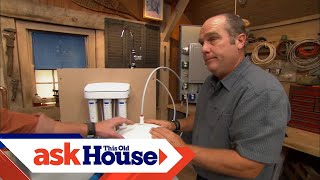
Under-sink filters connect directly to the cold water line and filter at the point of use. Multi-stage carbon block filters (Aquasana, Clearly Filtered) remove lead, chlorine, VOCs, and some PFAS. They do not remove nitrates or bacteria. Under-sink filters require filter replacement every 6-12 months and minimal installation (twist-on connections). They are the best middle-ground option for city water with detected lead.

Reverse Osmosis: Broad Spectrum Removal
Reverse osmosis (RO) systems remove lead, PFAS, nitrates, arsenic, fluoride, and virtually all dissolved solids. They are the most comprehensive filter type. Limitations: they produce wastewater (typically 2-4 gallons wasted per gallon filtered), require an under-sink tank that takes cabinet space, and strip beneficial minerals (many include a remineralization stage). RO is the right choice for well water with multiple detected contaminants or any water source with PFAS or nitrate issues.
Whole-House Systems
Whole-house systems filter water at the main supply line — protecting all faucets, showers, and appliances. They address hardness (water softeners using ion exchange), chlorine (carbon block whole-house filters), and sediment. For hard water that damages appliances and leaves scale, a whole-house softener is the appropriate solution. For drinking water quality, a point-of-use system (pitcher, under-sink, or RO) is more practical.
Backpacking and Travel Filters
For outdoor use, the priority is bacteria and protozoa removal. A squeeze filter (Sawyer Squeeze, Katadyn BeFree) removes 99.99999% of bacteria and protozoa. For chemical contaminants in backcountry water, activated carbon straws add some coverage. See best backpacking water filters for the top compact options.

NSF Certifications: What They Mean for Filter Claims
Filter certifications are the most reliable way to verify what a filter actually removes versus what the marketing claims. The relevant standards: NSF/ANSI 42 covers aesthetic contaminants — chlorine taste and odor, particulate reduction. Almost every carbon filter qualifies; this is the minimum bar. NSF/ANSI 53 covers health-related contaminants — lead, VOCs, PFAS (some), cysts, certain pesticides. Look specifically for the tested contaminant list, because an "NSF 53 certified" filter is only certified for the specific contaminants it was tested for, not all contaminants in the standard. NSF/ANSI 58 covers reverse osmosis systems and is the standard for RO effectiveness claims. NSF/ANSI 401 covers emerging contaminants including PFAS, pharmaceuticals, and some pesticides. NSF P473 specifically certifies PFAS (PFOA/PFOS) reduction — if PFAS is your primary concern, verify P473 certification on the specific model you are buying, not just the brand. Third-party certifications from NSF, WQA, or IAPMO provide independent verification — manufacturer self-testing without third-party verification is not equivalent.
Contaminant Removal by Filter Type: Quick Reference
Understanding the removal matrix prevents buying a filter that misses your specific contaminant. Activated carbon (pitcher, faucet, under-sink carbon block): removes chlorine, chloramine, VOCs, some lead, some PFAS (NSF P473 certified only), taste and odor. Does NOT remove nitrates, fluoride, hardness, bacteria, arsenic, or nitrates. Ion exchange resin (water softeners, some pitcher filters): removes calcium/magnesium (hardness), some heavy metals. Does NOT remove PFAS, bacteria, or VOCs. Reverse osmosis (RO): removes lead, arsenic, nitrates, fluoride, PFAS, most dissolved solids, bacteria (partially — sediment pre-filter required for bacteria). Produces wastewater (3:1 to 4:1 waste-to-filtered ratio). UV purification: kills bacteria and viruses through ultraviolet light — effective for biological contamination. Does NOT remove chemical contaminants. Used in combination with other filter stages for well water with both chemical and biological concerns. Distillation: boils water and condenses the steam — removes almost everything including heavy metals, bacteria, PFAS, and nitrates. Very slow (1 gallon per 4-6 hours), high energy use, strips all minerals. Used primarily for laboratory or high-purity applications.
Maintenance Schedules and Ongoing Costs
Filter replacement is the recurring cost that makes some cheap systems expensive over time. Calculate the annual cost before purchasing: pitcher filter cartridges run $25-50/year for 2-3 people (at 40 gallons per filter). Under-sink carbon block filters cost $30-60 per cartridge every 6-12 months. Under-sink RO systems have three stages to replace: sediment pre-filter ($10, annually), carbon pre-filter ($15, annually), and the RO membrane ($29.34-60, every 2-3 years). Total annual RO cost: $35-65 in filter replacements plus water waste. Whole-house systems have large sediment pre-filters ($20-50, every 3-6 months) and carbon media beds (recharged with salt or replaced every 3-5 years at $50-200). Alert signs for filter replacement beyond the scheduled interval: water begins tasting of chlorine again (carbon exhaustion), pressure drop after an under-sink filter (clogged sediment stage), or increased TDS reading on a meter after an RO membrane (membrane degradation). A $179.99 TDS meter provides a quick verification that the RO system is actually working — a functioning RO membrane typically produces water at 10-30 ppm TDS from municipal water at 200-400 ppm TDS.

Watch Before You Buy
“”
See Today’s Price →Watch out for
- Assembly required — budget 30-60 minutes for initial setup
- Color and style options may be limited compared to premium furniture brands
“”
See Today’s Price →Watch out for
- Assembly required — budget 30-60 minutes for initial setup
- Color and style options may be limited compared to premium furniture brands
“”
See Today’s Price →Watch out for
- Assembly required — budget 30-60 minutes for initial setup
- Color and style options may be limited compared to premium furniture brands
Frequently Asked Questions
Does a Brita filter remove lead?
Do I need an RO system or is a pitcher sufficient?
How do I find out what is in my tap water?
How often do I need to replace water filter cartridges?
Is filtered water the same as purified water?
How We Analyze Products
We analyze Amazon review data — often thousands of reviews per product — to surface patterns that individual buyers miss. Our process aggregates star ratings, review counts, and buyer sentiment at scale, identifying which strengths and weaknesses appear consistently across the largest review samples available. The 40,836+ reviews analyzed on this page represent real verified-purchase feedback from Amazon buyers.
Each product earned its placement through data: total review volume, average rating, and the specific praise and complaints that repeat most often across buyers. No manufacturer paid for placement on this page. Products appear here because buyers endorsed them at scale, not because a company asked us to feature them.
We use AI to summarize review sentiment — not to fabricate opinions, but to condense what thousands of buyers actually wrote into a readable format. The pros and cons you see reflect the most common themes found in verified purchaser reviews, paraphrased for clarity. We do not claim to have accessed Reddit, YouTube, or specific publications in generating these summaries.
Prices shown reflect Amazon pricing at the time this page was last generated. Click “See Today’s Price” to get the current live price on Amazon. Read our full methodology →