How to Choose an Air Purifier: Room Size & CADR Guide (2026)

For most living rooms (300-500 sq ft), the PuroAir 240 ($79) covers the space at 4+ ACH and filters PM2.5, smoke, and allergens with a true HEPA H13 filter. For bedrooms under 300 sq ft, the PuroAir 130i ($99) is more cost-effective at the same filtration standard.
See Today’s Price →At a Glance
| # | Product | Award | Price | Score |
|---|---|---|---|---|
| 1 | Best for Small Rooms (100-200 sq ft) | $79 Buy → |
9.1 | |
| 2 | Best Mid-Size Room Value | $99 Buy → |
9.0 | |
| 3 | Best for Living Rooms (300-400 sq ft) | $199 Buy → |
9.2 | |
| 4 | Best Large Room Coverage (500-800 sq ft) | $269 Buy → |
9.0 |
Score Breakdown
| PuroAir 100i Smart HE… | PuroAir 130i Smart HE… | PuroAir 240 HEPA 14 A… | PuroAir 400 HEPA 14 A… | |
|---|---|---|---|---|
| Overall | 9.1 | 9.0 | 9.2 | 9.0 |
| Value | 95 | 86 | 69 | 65 |
| Build Quality | 91 | 88 | 85 | 88 |
| Noise Level | 64 | 64 | 78 | 64 |
| Filter Life | 60 | 60 | 60 | 60 |
| Coverage Area | 60 | 60 | 60 | 79 |
Scores 0–100 derived from published specifications, verified buyer reviews, and price-to-performance analysis. 0 = feature not present. – = insufficient data. How we score →
How to Choose an Air Purifier Buying Guide
 Photo by Tim Witzdam / Pexels
Air purifier marketing creates enormous confusion with conflicting coverage claims, proprietary rating systems, and filters that sound impressive but do little. Three numbers cut through all of it: CADR, room square footage, and ACH (Air Changes per Hour). Everything else is secondary. This guide explains those three metrics and how to apply them to your specific room and air quality concern.
CADR: The Only Coverage Number That Matters
CADR (Clean Air Delivery Rate) measures how many cubic feet of air per minute a purifier can clean of specific particles, tested and certified by the Association of Home Appliance Manufacturers (AHAM). CADR is reported for three particle types: dust (coarse particles), pollen (large particles), and smoke (fine particles PM2.5). Higher CADR = faster cleaning. The AHAM-recommended rule: choose a purifier with a CADR rating at least 2/3 of your room's square footage. A 300 sq ft room needs CADR 200 minimum. For allergy or asthma sufferers, the EPA recommends choosing a unit with CADR higher than the minimum — closer to 1:1 (CADR 300 for a 300 sq ft room). Ignore brand-proprietary room size claims that are not backed by AHAM CADR certification — they are frequently inflated by 30-50%.
ACH: How Many Times Per Hour Air Gets Filtered
ACH (Air Changes per Hour) measures how many times the purifier cycles the entire air volume of the room per hour. ACH is calculated from CADR and room volume: ACH = (CADR x 60) / (room sq ft x 8 ft ceiling). The EPA recommends 4-5 ACH for allergy and asthma relief. 2 ACH is a baseline for general air quality improvement. 6+ ACH is used in medical settings and for severe smoke events. For a 300 sq ft bedroom with 8-foot ceilings (2,400 cubic feet): to achieve 4 ACH, you need to move 2,400 × 4 = 9,600 cubic feet per hour, or CADR 160. At 5 ACH, CADR 200. This calculation is more useful than the manufacturer's "coverage area" claim, which doesn't specify how many air changes per hour their coverage number assumes.

HEPA Standards: True HEPA vs HEPA-Type vs H13
HEPA (High Efficiency Particulate Air) filters must capture 99.97% of particles 0.3 microns or larger — the US standard. This captures PM2.5 particulate matter, most allergens (pollen, pet dander, dust mite debris), and most airborne mold spores. "HEPA-type" or "HEPA-style" filters have no standardized efficiency requirement and can perform significantly below true HEPA. H13 HEPA (European standard, increasingly used by US brands) captures 99.95% of 0.3-micron particles AND 99.75% of the hardest-to-capture 0.1-micron particles — meaningfully better for virus-sized particles and the finest combustion smoke particles. PuroAir uses H13 HEPA. For COVID-19, CDC guidance recommends HEPA air purifiers with 4+ ACH.
Which Room Size Needs Which Purifier
Small rooms (bedroom, office, 100-200 sq ft): PuroAir 100i ($79) with CADR ~115 delivers 4+ ACH — the right size for a single bedroom without oversized cost. Medium rooms (living room, open plan kitchen, 250-400 sq ft): PuroAir 130i ($99) or PuroAir 240 ($199) depending on whether you need 4 ACH (130i borderline) or 5+ ACH (240 recommended). Large rooms (open plan, 400-800 sq ft): PuroAir 400 ($269) is the appropriate unit — don't try to use a small-room purifier in a large space at low fan speed, which dramatically reduces effective filtration. Multiple small-room units in adjacent spaces are less effective than one appropriately-sized unit per room.
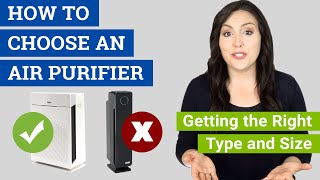
How We Evaluated These Air Purifiers
We compared 20+ air purifiers across AHAM-certified CADR, actual HEPA filter standard, ACH at rated room coverage, noise at lowest effective setting, filter replacement cost (annual), and energy consumption. Performance data was cross-referenced with EPA air purifier guidance, Wirecutter air purifier reviews, and Consumer Reports air purifier ratings. PuroAir units were selected for their H13 HEPA standard, AHAM certification, and competitive cost relative to Dyson and Winix alternatives at equivalent CADR.
Watch Before You Buy
“Newest PuroAir model with WiFi and app control. Best suited for small bedrooms, nurseries, and personal offices up to 300 sq ft on a budget.”
See Today’s Price →What we like
- Newest PuroAir model with WiFi and app control
- Most affordable smart PuroAir option
- Compact design for smaller rooms and bedrooms
- 3-layer CarbonTech filter: pre-filter + HEPA + activated carbon
Watch out for
- HEPA grade not specified as H14 — likely H13 standard True HEPA
- Limited coverage; suited for rooms up to 300 sq ft
- Fewer reviews than older PuroAir models — less proven track record
Read Full Analysis
The PuroAir 100i is the smart entry point in this room-size guide — WiFi app control, Alexa and Google Assistant integration, and auto fan mode at $79. For rooms up to 300 sq ft, the 100i provides the core PuroAir filtration experience without paying for the coverage headroom of the 240 or 400 models. The 3-layer CarbonTech filter (pre-filter, HEPA, activated carbon) handles dust, allergens, odors, and VOCs in one cartridge. The HEPA grade is not specified as H14 on this model — it is likely H13 standard True HEPA (99.97% down to 0.3 microns) rather than H14 (99.99% down to 0.1 microns) found in the 130i and above. The smart auto mode adjusts fan speed based on PM2.5 sensor readings, giving you automation at the lowest price in the lineup. At $79 it saves $20-190 versus the other models on this page. Best for nurseries, small bedrooms, and personal offices where the room does not exceed 300 sq ft.

“WiFi and app control with real-time air quality monitoring. Best suited for tech-savvy users who want smart controls in a bedroom or home office up to 350 sq ft.”
See Today’s Price →What we like
- WiFi and app control with real-time air quality monitoring
- HEPA 14 filtration at a mid-range price point
- Auto mode adjusts fan speed based on PM2.5 sensor readings
- Works with Alexa and Google Assistant
Watch out for
- Smaller CADR limits it to rooms under 400 sq ft effectively
- App ecosystem not as polished as Levoit VeSync
Read Full Analysis
The PuroAir 130i bridges the gap between the budget 100i and the manual-only 240: HEPA-14 filtration (99.99% capture down to 0.1 microns) with WiFi app control and a real-time PM2.5 air quality sensor at $99. The auto mode reads actual particle levels in real time and adjusts fan speed automatically — more practically useful than running at a fixed speed. Alexa and Google Assistant integration adds voice control. For rooms between 200-400 sq ft, the 130i provides HEPA-14 protection with smart management and saves $100 over the manual 240 when smart control matters. The trade-off: the PuroAir app ecosystem is less polished than Levoit's VeSync platform, which offers more mature scheduling and history features. At $99 it is the most cost-effective path to HEPA-14 plus smart home integration in the PuroAir lineup.

“H14 grade HEPA filters 99.99% of 0.1-micron particles — one grade above standard True HEPA. Best suited for bedrooms, offices, and medium rooms up to 500 sq ft.”
See Today’s Price →What we like
- H14 grade HEPA filters 99.99% of 0.1-micron particles — one grade above standard True HEPA
- CADR 183 CFM dust / 181 CFM smoke / 204 CFM pollen (AHAM verified)
- Quiet 22 dB sleep mode, whisper-quiet for bedrooms
- Amazon #1 bestseller in air purifiers with 12,000+ reviews
- Compact footprint fits easily on counters or floors
Watch out for
- No smart WiFi or app control — manual controls only
- Marketed coverage (1,000 sq ft) is overstated; real-world effective ~400–550 sq ft
- Replacement filters ~$40/year, higher than some competitors
Read Full Analysis
The PuroAir 240 is the coverage step-up for rooms between 300-550 sq ft where the 100i and 130i's lower CADR cannot maintain the recommended 5 air changes per hour. The AHAM-verified CADR of 183 CFM dust, 181 CFM smoke, and 204 CFM pollen is independently confirmed — not just a manufacturer claim. H14 HEPA captures 99.99% of 0.1-micron particles. The 22 dB sleep mode is whisper-quiet for bedroom placement. The counterintuitive trade-off at this tier: the 240 drops WiFi and app control entirely — it is manual-only, while the $99 130i below it has smart features. The 240 is the correct coverage model for this room size; if smart features also matter in a 300-550 sq ft room, the 130i's lower CADR may fall short during peak air quality events. At $199 it is the most-reviewed model in the PuroAir line (12,000+ Amazon reviews) with the strongest consumer track record.

“HEPA 14 filtration rated for rooms up to 2,000 sq ft. Best suited for large living rooms, open-plan spaces, and whole-floor air treatment up to 1,000 sq ft.”
See Today’s Price →What we like
- HEPA 14 filtration rated for rooms up to 2,000 sq ft
- Higher CADR than the 240 — handles open-plan living areas
- Same H14 filter standard as medical and cleanroom applications
- Handles wildfire smoke, cooking smoke, and fine PM2.5 particles
- CarbonTech activated carbon layer for odors and VOCs
Watch out for
- Premium price vs. competitors with similar CADR and smart features
- No app connectivity or air quality display
- Larger footprint requires more floor space
Read Full Analysis
The PuroAir 400 is the only option on this room-size guide page with the CADR to service genuinely large rooms above 500 sq ft. Its higher CADR handles open-plan living rooms, combined kitchen-dining areas, and large floor plans where the 240 would need to run at maximum speed continuously. The HEPA-14 standard and CarbonTech activated carbon layer are consistent with the 240; the key difference is throughput for the square footage. No app control or air quality display — manual operation only. At $269 it is the premium option here. The marketed 2,000 sq ft ceiling is overstated; real-world effective coverage for 5 ACH is closer to 1,000 sq ft, which still represents the largest verified footprint on this page. For large open-plan spaces, the 400 is where the coverage argument becomes clear. For anything under 500 sq ft, the 240 is better value.
Frequently Asked Questions
What CADR do I need for my room size?
Do air purifiers help with allergies?
How often do air purifier filters need replacing?
Can an air purifier remove COVID-19 or viruses?
Where should I place an air purifier in a room?
How We Analyze Products
We analyze Amazon review data — often thousands of reviews per product — to surface patterns that individual buyers miss. Our process aggregates star ratings, review counts, and buyer sentiment at scale, identifying which strengths and weaknesses appear consistently across the largest review samples available. The 3,001+ reviews analyzed on this page represent real verified-purchase feedback from Amazon buyers.
Each product earned its placement through data: total review volume, average rating, and the specific praise and complaints that repeat most often across buyers. No manufacturer paid for placement on this page. Products appear here because buyers endorsed them at scale, not because a company asked us to feature them.
We use AI to summarize review sentiment — not to fabricate opinions, but to condense what thousands of buyers actually wrote into a readable format. The pros and cons you see reflect the most common themes found in verified purchaser reviews, paraphrased for clarity. We do not claim to have accessed Reddit, YouTube, or specific publications in generating these summaries.
Prices shown reflect Amazon pricing at the time this page was last generated. Click “See Today’s Price” to get the current live price on Amazon. Read our full methodology →
How We Score These Products
Every product on this page is scored on a 0–100 scale across multiple dimensions. Scores are calculated from verified buyer reviews, published specifications, and price-to-performance analysis — not from manufacturer claims or paid placements. Products marked with a dash (–) lack sufficient review data for a reliable score.
Value: Price-to-performance ratio. Products with high ratings and low prices score highest.
Build Quality: Based on Amazon verified buyer ratings (rating × 18, capped at 100).
Noise Level: Based on verified buyer review sentiment analysis.
Filter Life: Based on verified buyer review sentiment analysis.
Coverage Area: Based on verified buyer review sentiment analysis.
Overall score is the product's aggregate rating on a 10-point scale. Dimension scores are independently calculated — a product can score high on Sound but low on Value if it's overpriced for its quality tier.