How to Choose an Air Purifier in 2026: Buyer's Guide
For most bedrooms and living rooms, a HEPA air purifier rated for at least 1.5x your room square footage will handle dust, pollen, pet dander, and most allergens. Match the CADR number to your room size, not just the manufacturer coverage claim. Carbon filters are needed for odors and smoke but do not replace HEPA for particles.
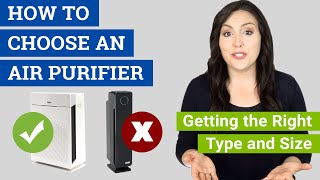
How to Choose an Air Purifier Buying Guide
 Photo by Tim Witzdam / Pexels
The single most common mistake when buying an air purifier is relying on the manufacturer coverage area claim without checking the CADR (Clean Air Delivery Rate) behind it. Coverage claims are calculated at one air change per hour, which is insufficient for allergy and asthma relief. Most experts recommend 4 to 5 air changes per hour for meaningful air quality improvement. This means you need a purifier rated for at least 2 to 3 times your actual room size, or a purifier with a CADR that delivers the recommended changes at your ceiling height.
Understanding CADR and Room Coverage
CADR is measured in cubic feet per minute and is the most reliable specification for comparing purifiers. It is tested independently by AHAM (Association of Home Appliance Manufacturers) and reported separately for dust, pollen, and smoke. A purifier with a CADR of 200 for smoke can clean a 200 square foot room of smoke at approximately 5 air changes per hour. To find the right CADR for your room, multiply your room square footage by your ceiling height in feet to get cubic feet, then divide by 12 (minutes in an air change cycle) to find the minimum CADR for one air change per minute. For allergy relief, aim for a CADR equal to two thirds of your room square footage as a simple rule. Our best air purifiers guide ranks models by actual CADR per dollar. See also best air purifiers for allergies for HEPA-focused picks.
Filter Types: HEPA, Activated Carbon, UV, and Ionizers

True HEPA filters capture 99.97 percent of particles 0.3 microns and larger, which includes most allergens, dust, pollen, mold spores, and most airborne bacteria. A purifier labeled "HEPA-type" or "HEPA-style" does not meet this standard and should be avoided for allergy and asthma applications. Activated carbon filters adsorb gases, volatile organic compounds (VOCs), and odors. They do not capture particles but are essential for smoke, cooking odors, and chemical odors from new furniture or paint. Most quality purifiers combine a true HEPA filter with a carbon pre-filter layer. UV-C light and ionizer features are secondary and in some cases counterproductive: ionizers can produce ozone, which is itself a respiratory irritant. Stick to true HEPA plus carbon for most homes. See our best bedroom air purifiers for sleep-optimized picks.
Noise Level and Bedroom Use
Air purifier noise is measured in decibels at the highest and lowest fan speeds. Most purifiers have a "sleep" or low mode that runs at 25 to 35 dB — similar to a whisper or quiet library. High fan speeds can reach 50 to 65 dB, which is noticeable during work or conversation. For bedroom use, the sleep mode decibel rating matters more than the high-speed rating, since you will run the purifier on low overnight. Look for sleep mode noise below 30 dB for minimal disruption. Models with automatic sensors adjust fan speed based on detected particle levels, reducing noise during clean periods without requiring manual adjustment. Our air purifier for bedroom guide prioritizes low-noise models specifically tested in sleep environments.
Running Costs: Energy and Filter Replacement
Air purifiers run continuously, so energy consumption and filter replacement costs add up significantly over time. A 45-watt purifier running 24 hours a day costs approximately $4 to $6 per month in electricity at average US rates. Energy Star certified models typically use 40 percent less power at equivalent performance. Filter costs are often more significant than energy. Replacement HEPA filters run $20 to $60 per set and need replacement every 6 to 12 months depending on air quality. Before buying a purifier, look up the replacement filter cost and availability. Some brands (Levoit, Winix) sell affordable replacement filters widely. Others (certain Dyson models) charge $60 to $90 per filter set. Calculate the 3-year total cost including filters and electricity before comparing purifier prices. Our best air purifiers under $100 analyzes total cost of ownership per model.
Pets, Smoke, and Specialized Use Cases
Pet dander and hair require a pre-filter that can be vacuumed or washed to extend HEPA filter life. Without a washable pre-filter, pet hair clogs the HEPA layer rapidly and increases replacement costs. For wildfire smoke or heavy cooking smoke, prioritize activated carbon layer thickness — a thin carbon mesh is insufficient for heavy smoke. Models designed for smoke typically use granular activated carbon beds that are 1 to 2 inches thick rather than a thin impregnated felt layer. For mold concerns, a true HEPA filter captures mold spores effectively, but an air purifier alone does not address the moisture source causing mold growth. Our best air purifiers for pets and best air purifiers for smoke guides cover these specific use cases with tested recommendations.
At a Glance
| # | Product | Award | Price |
|---|
How We Analyze Products
We analyze Amazon review data — often thousands of reviews per product — to surface patterns that individual buyers miss. Our process aggregates star ratings, review counts, and buyer sentiment at scale, identifying which strengths and weaknesses appear consistently across the largest review samples available.
Each product earned its placement through data: total review volume, average rating, and the specific praise and complaints that repeat most often across buyers. No manufacturer paid for placement on this page. Products appear here because buyers endorsed them at scale, not because a company asked us to feature them.
We use AI to summarize review sentiment — not to fabricate opinions, but to condense what thousands of buyers actually wrote into a readable format. The pros and cons you see reflect the most common themes found in verified purchaser reviews, paraphrased for clarity. We do not claim to have accessed Reddit, YouTube, or specific publications in generating these summaries.
Prices shown reflect Amazon pricing at the time this page was last generated. Click “See Today’s Price” to get the current live price on Amazon. Read our full methodology →