How to Install a Ceiling Fan (2026): Electrical Box Requirements
Before installing any ceiling fan, verify the electrical box is rated for fan support — fan-rated boxes are stamped with the maximum weight they can support (typically 35–70 lbs). Use a fan-rated brace bar if you need to replace the box. Wire colors are: black to black (hot), white to white (neutral), green or bare copper to green (ground), and blue to black (fan light kit). Set blades counterclockwise in summer, clockwise in winter.
How to Install a Ceiling Fan (2026) Buying Guide
 Photo by Curtis Adams / Pexels
Quick Verdict: Our top pick is the Hunter 52-inch Builder Plus Indoor Ceiling Fan with LED Light 53237 (Best Overall) — 52-inch, 5-blade, includes LED light kit. Priced at $179.99.
Budget Pick: The Honeywell Duval 52-Inch Indoor/Outdoor Ceiling Fan 50206-01 at $140.99 — 52-inch damp-rated for covered outdoor spaces.
Quick verdict: Before installing any ceiling fan, verify the electrical box is rated for fan support — fan-rated boxes are stamped with the maximum weight they can support (typically 35–70 lbs). Use a fan-rated brace bar if you need to replace the box.

Who This Guide Is For
This guide is for you if:
- You're improving your home and want to understand what products actually solve real problems
- You're comparing options at very different price points and want honest guidance on what the premium buys
- You want to avoid buying products you won't actually use
Skip this guide if:
- You've already decided and just need the best model — see our comparison pages
- You have very specific requirements — check the specialized guides in our home section
Ceiling Fan Installation Guide: From Electrical Box to Final Blade Pitch
Installing a ceiling fan is a mid-level DIY project that most homeowners can complete in 2–3 hours — if they have the right electrical box already in place. The box is where most dangerous installations fail. After that, wiring is straightforward, sizing matters more than people think, and the blade direction switch is the most forgotten setting in home maintenance.

Step 1: The Fan-Rated Electrical Box (This Is Where Most DIY Installations Go Wrong)
A standard light fixture electrical box is designed to hold a fixture that hangs stationary. A ceiling fan generates dynamic load: it weighs 15–50 lbs, oscillates as blades move air, and creates vibration. Standard light boxes — especially older ones — cannot handle this load reliably.
The NEC (National Electrical Code) and UL 507 both require that ceiling fans be supported by electrical boxes rated and listed specifically for fan support. Fan-rated boxes are stamped with their maximum weight capacity, typically 35–50 lbs for standard boxes and up to 70 lbs for heavy-duty models.
How to check your existing box:

- Turn off power at the breaker.
- Remove the existing light fixture or fan.
- Look for a stamp or sticker on the box that says "Acceptable For Fan Support" or "Fan Rated." It will also list a weight limit.
- Check that the box is secured to a ceiling joist, an approved brace bar, or a fan-rated brace kit — not just nailed to drywall.
If your box isn't fan-rated: Don't install the fan. Install a fan-rated brace bar first. The most common retrofit is the expandable fan brace (sold by Westinghouse, Hunter, and others for ~$15–$20). You insert it through the existing ceiling hole, expand it until it contacts two ceiling joists, and it self-secures. The new fan-rated box attaches to the brace. No attic access required; no drywall work.
This Old House on YouTube has an excellent tutorial on replacing electrical boxes for ceiling fans — search "This Old House ceiling fan electrical box" to find it. Home Mender also covers the brace bar replacement in detail in their ceiling fan installation playlist.
Step 2: Understanding Ceiling Fan Wiring
Most ceiling fan wiring is straightforward once you know what each wire does. The complication arises when you want separate wall switches for the fan and the light kit.
Standard wire colors:
- Black (hot): Carries power from the switch to the fan motor.
- White (neutral): Returns current to the electrical panel. Always connect white to white.
- Green or bare copper (ground): Safety ground. Connect to the green screw or green wire on the fan mounting bracket. This is not optional — it protects against shock if insulation fails.
- Blue (light kit hot): Found on fans with a separate light kit wire. If your ceiling box has only one hot wire (black), connect the fan's black and blue wires together to the single black wire — both fan and light operate from one switch. If your box has two hot wires (black and red, with separate wall switches), connect black to the fan motor and blue to the light kit.
Single-switch vs. dual-switch setup: Many homes have only one wall switch for the ceiling fan location. In this case, you control fan speed and light via the fan's remote or pull chains, not separate wall switches. If you want separate wall switches for fan and light, you need a two-conductor + ground wire run from the switch box to the fan — an electrician's job unless you're adding new wire runs.
Remote control and smart fan wiring: Fans with integrated remotes (like the Honeywell Carnegie or Westinghouse Alta Vista) include a receiver module that installs in the fan canopy. The receiver connects to the single hot wire from your switch; the remote controls fan speed and light without any additional wall wiring. This is the easiest upgrade path for existing single-switch locations.
Smart fans with Wi-Fi: Models like the Modern Forms Wynd connect to your home Wi-Fi network and work with Alexa, Google Assistant, and app control. Installation is similar to remote fans — the smart module goes in the canopy and connects to standard wiring. These require a neutral wire (the white wire must be present and connected), which is standard in most boxes but occasionally missing in older homes.
Step 3: Ceiling Height and Downrod Selection
Ceiling fans must maintain a minimum of 7 feet of clearance from blade tips to the floor — this is a safety standard from UL 507 and most building codes. Blade clearance from walls should be at least 18 inches on all sides.
Flush mount (hugger): For ceilings 8 feet or lower, use a flush-mount or hugger fan that mounts directly to the canopy with no downrod. Blade tip-to-ceiling clearance is typically 7–10 inches. Airflow efficiency is slightly reduced compared to fans suspended lower, but clearance safety is maintained.
Standard downrod (3–6 inches): For 9-foot ceilings, a standard 3–6 inch downrod positions blades at roughly 8.5 feet — comfortable and efficient.
Extended downrod (12–36 inches or more): For vaulted or cathedral ceilings, you want fan blades within 8–10 feet of the floor for efficient air circulation. Most fans support extended downrods; purchase the length to hit your target blade height. For very high ceilings, this may require a custom-length downrod from the manufacturer.
At a Glance
| # | Product | Award | Price | Our Score | |
|---|---|---|---|---|---|
| 1 | 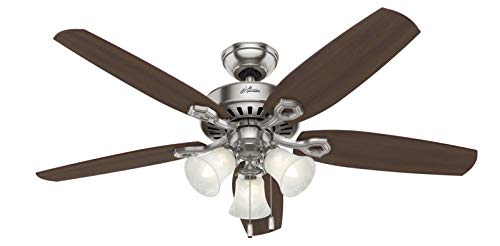 Hunter 52-inch Builder Plus Indoor Ceil… Hunter 52-inch Builder Plus Indoor Ceil… |
Best Overall | $179 | 9.2 | Buy → |
| 2 | 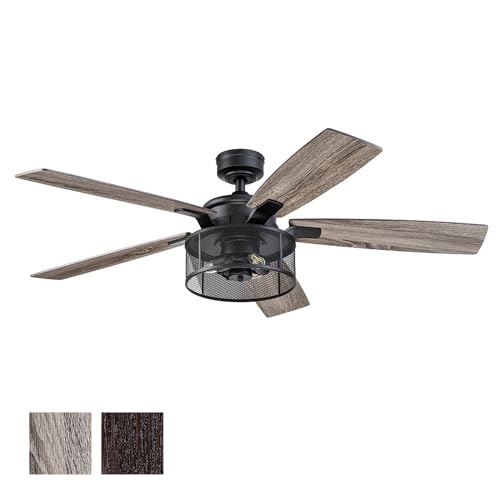 Honeywell Carnegie Industrial 52-Inch C… Honeywell Carnegie Industrial 52-Inch C… |
Best with Remote | $154 | 8.9 | Buy → |
| 3 | 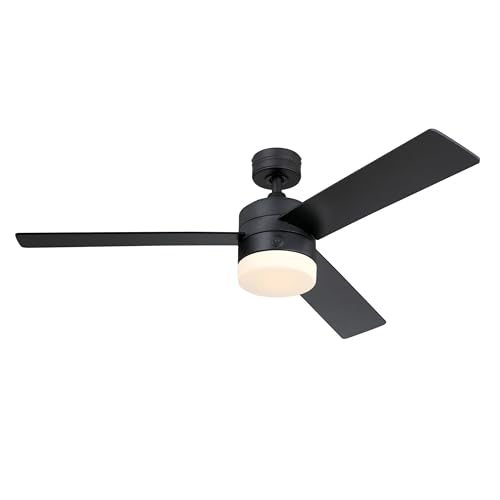 Westinghouse Alta Vista 52-Inch LED Cei… Westinghouse Alta Vista 52-Inch LED Cei… |
Best Value | $161 | 8.5 | Buy → |
| 4 | 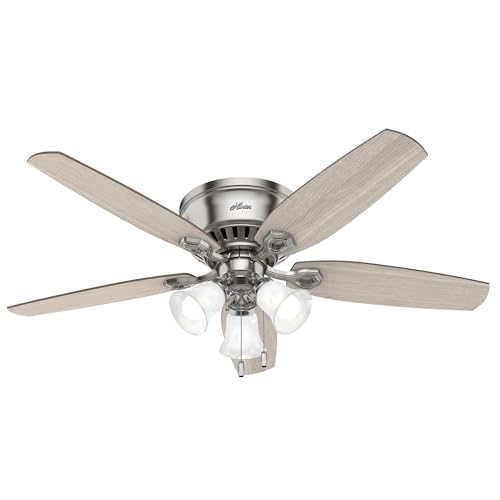 Hunter 52-inch Builder Low Profile Ceil… Hunter 52-inch Builder Low Profile Ceil… |
Best Low-Profile | $179 | 8.2 | Buy → |
| 5 | 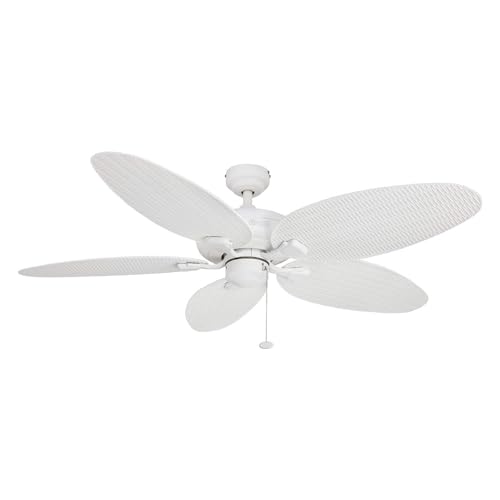 Honeywell Duval 52-Inch Indoor/Outdoor … Honeywell Duval 52-Inch Indoor/Outdoor … |
Best Indoor/Outdoor | $140 | 7.8 | Buy → |
Showing 5 of 5 products
Hunter 52-inch Builder Plus Indoor Ceiling Fan with LED Light 53237
“Hunter's Builder Plus is the go-to bedroom ceiling fan — silent motor, included light, and Hunter's lifetime warranty at under $100.”
See Today’s Price →What we like
- WhisperWind motor operates near silently
- Reversible motor for year-round efficiency
- LED light kit included (saves $30-50 vs buying separately)
- Pull chain operation — no remote needed
- Hunter lifetime motor warranty
Watch out for
- Pull chain only — no remote or smart control
- Brushed nickel may not match all decor styles
- Light kit provides moderate brightness
Read Full Analysis
The Hunter Builder Plus is the ceiling fan the DIY community has trusted for decades: simple installation manual, clear wiring labels, standard hardware, and reliable motor warranty. The 52-inch span handles most bedrooms and medium living rooms. The LED light kit is included. Hunter's motors are quiet and durable — this is the fan to recommend to someone doing their first ceiling fan installation.
Honeywell Carnegie Industrial 52-Inch Ceiling Fan with Remote 50614-01
“The Carnegie brings an industrial edge to ceiling fan design while including a remote control that most budget fans omit.”
See Today’s Price →What we like
- Industrial/farmhouse aesthetic stands out
- Remote control included — convenient from bed or couch
- Reversible motor for summer/winter modes
- LED light kit
- 3 speed settings via remote
Watch out for
- Industrial aesthetic limits décor compatibility — too utilitarian for traditional or farmhouse interiors
- At $155, costs ~$30 more than the Hunter Dempsey 52-inch which includes comparable remote and light kit
- Remote batteries not included
- Downrod connection requires precise leveling — wobble occurs if ceiling box is off-plumb by more than 2 degrees
Read Full Analysis
The Honeywell Carnegie includes a full-function remote that handles fan speed and light dimming from the canopy receiver. This is the right choice for rooms with a single wall switch where you don't want to run additional wiring. The industrial metal look suits modern and transitional interiors. Three fan speeds, reversible motor, and included installation hardware.
Westinghouse Alta Vista 52-Inch LED Ceiling Fan with Remote 7205900
“For modern or minimalist rooms, the Westinghouse Alta Vista's dimmable LED and matte black finish deliver the aesthetics budget fans sacrifice.”
See Today’s Price →What we like
- Matte black finish for modern/contemporary rooms
- Dimmable LED (2700K warm white)
- Remote with separate light/fan controls
- Reversible motor
- 4 speeds on remote
Watch out for
Read Full Analysis
The Westinghouse Alta Vista delivers remote control, LED lighting, and a reversible motor under $165 — making it one of the best-value full-feature fans available. The included remote handles three speeds and light control. Reversible motor means proper blade direction for both seasons. Good choice for a budget renovation or rental property.

Hunter 52-inch Builder Low Profile Ceiling Fan 51112
“For rooms too low for a standard fan drop, Hunter's low-profile Builder is the reliable solution — same lifetime warranty and silent motor in a flush-mount design.”
See Today’s Price →What we like
- Low profile design for rooms with 7-8 ft ceilings
- Flush mount (hugger) installation
- WhisperWind silent motor
- Hunter lifetime warranty
- LED light kit included
Watch out for
- No remote — pull chain only
- Less airflow than standard-mount fans at ceiling height
- Fewer finish options than standard Builder Plus
Read Full Analysis
Hunter's Low Profile model solves the 8-foot ceiling problem: it mounts flush to the canopy with no downrod, maintaining required 7-foot blade clearance. If your ceilings are exactly 8 feet, this is the correct fan — standard fans with even a 3-inch downrod risk being uncomfortably close to head height. Same Hunter motor quality as the Builder Plus, just adapted for low ceilings.

Honeywell Duval 52-Inch Indoor/Outdoor Ceiling Fan 50206-01
“The only indoor/outdoor fan in this list — if your fan will face humidity or outdoor air, this Honeywell handles it at the lowest price.”
See Today’s Price →What we like
- Indoor/outdoor rated for covered patios
- Tropical palm blade design
- Pull chain with 3 speed settings
- White finish blends with ceilings
- Budget-friendly price
Watch out for
- No light kit (sold separately)
- Pull chain only — no remote option
- Palm blade design is niche aesthetic
Read Full Analysis
The Honeywell Duval is damp-rated — appropriate for covered outdoor areas, screened porches, and bathrooms where standard fans fail from humidity. The sealed motor and weatherproof finish handle moisture exposure that would corrode an indoor fan. 52-inch span, 5 blades, reversible motor. Good choice for anyone needing a single fan that works in a covered outdoor space or a humid basement.
Frequently Asked Questions
How do I know if my electrical box is fan-rated?
What do the wire colors mean on a ceiling fan?
Which direction should ceiling fan blades spin?
What size ceiling fan do I need for my room?
Can I install a ceiling fan where a light fixture is?
Do I need a separate switch for the fan and the light?
Can I install a ceiling fan outdoors or in a bathroom?
How We Analyze Products
We analyze Amazon review data — often thousands of reviews per product — to surface patterns that individual buyers miss. Our process aggregates star ratings, review counts, and buyer sentiment at scale, identifying which strengths and weaknesses appear consistently across the largest review samples available. The 13,194+ reviews analyzed on this page represent real verified-purchase feedback from Amazon buyers.
Each product earned its placement through data: total review volume, average rating, and the specific praise and complaints that repeat most often across buyers. No manufacturer paid for placement on this page. Products appear here because buyers endorsed them at scale, not because a company asked us to feature them.
We use AI to summarize review sentiment — not to fabricate opinions, but to condense what thousands of buyers actually wrote into a readable format. The pros and cons you see reflect the most common themes found in verified purchaser reviews, paraphrased for clarity. We do not claim to have accessed Reddit, YouTube, or specific publications in generating these summaries.
Prices shown reflect Amazon pricing at the time this page was last generated. Click “See Today’s Price” to get the current live price on Amazon. Read our full methodology →