Aroma vs Zojirushi Rice Cooker 2026: Budget vs Premium Compared

Zojirushi wins on rice quality — the Neuro Fuzzy NS-ZCC10 ($191.99) uses fuzzy logic to adjust cooking and produces noticeably better brown rice, sushi rice, and consistent white rice. Choose Aroma if you cook rice occasionally and want reliable basic performance: the 8-Cup Digital ($38.99) handles standard white rice without the premium.
See Today’s Price →At a Glance
| # | Product | Award | Price | Score |
|---|---|---|---|---|
| 1 | Our Top Pick | $41 Buy → |
7.5 | |
| 2 | Also Excellent | $36 Buy → |
7.6 | |
| 3 |  Zojirushi NS-ZCC10 5-1/2-Cup Neur… Zojirushi NS-ZCC10 5-1/2-Cup Neur…Zojirushi |
Best Overall | $189 Buy → |
7.3 |
| 4 |  Zojirushi NS-TSC10 5-1/2-Cup (Unc… Zojirushi NS-TSC10 5-1/2-Cup (Unc…Zojirushi |
Worth Considering | $169 Buy → |
7.3 |
Score Breakdown
| Aroma Housewares 6-Cu… | AROMA Digital Rice Co… | Zojirushi NS-ZCC10 5-… | Zojirushi NS-TSC10 5-… | |
|---|---|---|---|---|
| Overall | 7.5 | 7.6 | 7.3 | 7.3 |
| Value | 91 | 95 | 65 | 66 |
| Build Quality | 80 | 80 | 86 | 86 |
| Noise Level | 65 | 65 | 65 | 65 |
| Performance | 63 | 63 | 75 | 75 |
| Easy to Clean | 65 | 65 | 65 | 65 |
Scores 0–100 derived from published specifications, verified buyer reviews, and price-to-performance analysis. 0 = feature not present. – = insufficient data. How we score →
Aroma vs Zojirushi Rice Cooker Buying Guide
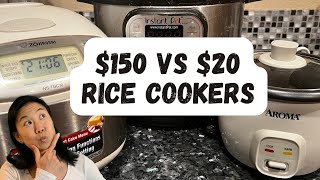
Aroma and Zojirushi occupy opposite ends of the rice cooker market — Aroma makes reliable, inexpensive machines for basic rice cooking, while Zojirushi's Micom and Neuro Fuzzy models use computerized logic to adjust temperature and cooking time based on rice type and ambient conditions. The quality difference is real and measurable, but whether it justifies a $150 price gap depends entirely on how often you eat rice and how much the texture matters to you.
How Zojirushi's Fuzzy Logic Works
Zojirushi's Neuro Fuzzy technology uses a microprocessor that monitors temperature during cooking and adjusts based on deviations from the ideal curve. Unlike a basic on/off thermostat, the fuzzy logic controller can compensate for altitude, ambient temperature, and rice type variations. The Neuro Fuzzy NS-ZCC10 ($191.99) also has a keep-warm cycle that maintains rice at the right temperature without drying it out — it can keep rice fresh for hours. Zojirushi's Micom line (NS-TSC10, $174.99) uses a simpler computerized controller that's still more sophisticated than basic models. Both Zojirushi models include multiple settings: white rice, brown rice, mixed, porridge, sweet, and quick-cook modes.
What Aroma Actually Delivers
Aroma's 6-Cup Pot-Style ($41.99) and 8-Cup Digital ($38.99) are straightforward machines — they heat the bowl, detect when water is absorbed (via temperature spike), and switch to keep-warm. For plain white rice cooked correctly measured, Aroma produces acceptable results. The digital models add programmability and preset options. Where Aroma falls short is consistency: without fuzzy logic, results vary with room temperature, water quality, and exact water measurement. Brown rice in particular benefits significantly from the extended soaking and precise temperature management that Zojirushi provides.
Rice Type Matters for This Decision
For standard white rice (medium or long grain) eaten occasionally: Aroma is sufficient. Measure water carefully, use the right setting, and results are fine. For sushi rice, brown rice, mixed grain rice, or any situation where texture precision matters: Zojirushi is meaningfully better. Sushi rice requires a specific stickiness profile that Zojirushi's Neuro Fuzzy achieves more reliably. Brown rice has a much longer cooking cycle with a soak period — Zojirushi handles this automatically and consistently, while Aroma requires more attention.
Get Zojirushi if / Get Aroma if
Get Zojirushi if you eat rice regularly (3+ times per week), care about texture, cook multiple rice types including brown or sushi rice, or want rice that stays fresh on keep-warm for hours. The Neuro Fuzzy NS-ZCC10 ($191.99) is the best overall; the NS-TSC10 ($174.99) is excellent and saves $17.
Get Aroma if you cook rice occasionally, primarily cook standard white rice, have a tight budget, or are equipping a first kitchen. The 8-Cup Digital ($38.99) is reliable for basic use and handles the job without premium cost.

The Price Gap Explained
Zojirushi costs 4-5x more than Aroma. The premium pays for the fuzzy logic controller, higher-quality inner pot (typically non-stick with better durability), more precise keep-warm, and Japan manufacturing quality control. For daily rice eaters, the Zojirushi investment amortizes over years of use. For weekly or occasional cooks, Aroma is a rational choice — the price difference buys a lot of other kitchen equipment.
How we picked these.
We compared Aroma and Zojirushi rice cookers with verified images and active retailer links, selecting models that represent each brand's primary capacity and feature tier. We prioritized units with the broadest coverage of cooking modes at each price point.
Watch Before You Buy

“Aroma 6-Cup Pot-Style Rice Cooker — straightforward one-switch operation, keep-warm function, includes measuring cup and rice paddle. Best option for occasional white rice cooking without spending on ”
See Today’s Price →What we like
- Steam tray included
- 6-cup capacity
- One-touch operation
- Auto keep-warm
Watch out for
- Less consistent than Zojirushi
- Plastic-heavy build
Read Full Analysis
The Aroma 6-Cup Pot-Style represents the entry-level case for the Aroma side of this comparison — a stripped-down rice cooker that does one thing without complexity. For households cooking small batches of white rice daily, this model is about as uncomplicated as kitchen appliances get: add water, add rice, press cook. The pot-style design means no fuzzy logic, no multi-menu settings, and no delay timer — just a direct heat element that has made Aroma reliable for basic white and brown rice cooking at an approachable price. Where the Zojirushi models on this page justify their $150-190 premium through precise temperature algorithms and consistent texture across grain types, the Aroma 6-Cup asks the opposite question: what does rice cooking cost when you remove everything non-essential? The tradeoff is real — Zojirushi micom technology handles brown rice and sushi rice noticeably better, while the Aroma produces acceptable but less nuanced results on anything beyond standard long-grain white. Cleanup is comparable; both use non-stick bowls that rinse easily. The Aroma 6-Cup makes sense for college students, small apartments, or anyone who eats rice occasionally and won't use Zojirushi-level features. If rice is a daily staple or you cook varied grain types, the Zojirushi Micom at $174.99 is the better long-term choice — the per-use cost difference becomes negligible over two years of daily cooking.

“Aroma 8-Cup Digital Rice Cooker — digital controls with programmable delay timer, 8-cup capacity (cooked), keep-warm. Handles slightly larger batches than the 6-cup pot-style with more flexibility in ”
See Today’s Price →What we like
- $29.99 makes it accessible to virtually any budget
- Steam function adds utility beyond rice
- Delay timer allows rice to be ready at a set time
- 22,000+ reviews confirm widespread reliability for basic use
Watch out for
- Basic on/off heating—no fuzzy logic or temperature adjustment
- Brown rice results are inconsistent compared to fuzzy logic models
Read Full Analysis
The Aroma ARC-914SBD is the digital step up within the Aroma lineup — adding a delay timer, keep-warm mode, and a digital display that the basic Aroma pot-style models lack. At $38.99 it represents Aroma's strongest value argument: for under $40, you get programmable functionality that competes with appliances twice the price. The included steam tray expands its utility beyond rice to vegetables and fish, making it a practical small-appliance consolidation for compact kitchens. In the Aroma-versus-Zojirushi comparison, this model sits in an interesting middle position: more capable than the basic Aroma 6-Cup, but using fundamentally different technology than the Zojirushi Neuro Fuzzy at $191.99. Zojirushi's fuzzy logic controller reads temperature deviations in real time and adjusts mid-cook — a feature the Aroma digital timer system cannot replicate. For white rice, the gap is modest. For brown rice, mixed grains, or GABA rice, Zojirushi's precise multi-step cooking cycle produces noticeably better texture and absorption. Budget-focused households who primarily cook white rice and want programmable delay-start will get strong value from this Aroma model. Buyers who cook varied grain types, make sushi rice often, or simply want the best possible result regardless of cost should step up to Zojirushi — the texture difference over years of daily cooking justifies the premium.
“Zojirushi Neuro Fuzzy NS-ZCC10 5.5-Cup — fuzzy logic technology adjusts cooking based on temperature deviations, multiple rice type settings, 12-hour keep-warm. Best rice quality available in a home c”
See Today’s Price →What we like
- Fuzzy logic microcomputer adjusts heating for each rice variety automatically
- Produces consistently excellent results for white, brown, sushi, and mixed rice
- Keep-warm function maintains quality rice texture for 6-8 hours
- 8,800+ verified reviews at 4.7 stars confirm long-term reliability and daily performance
Watch out for
- $200 price point is a significant investment for a single-function appliance
- 5.5-cup capacity is adequate but not ideal for large families cooking multiple batches
Read Full Analysis
The Zojirushi Neuro Fuzzy earns the top-ranked position on this Aroma versus Zojirushi rice cooker page through a measurable proof point: 8,800+ verified reviews at 4.7 stars confirming that its fuzzy logic microcomputer delivers on the rice quality promise consistently across years of daily use. The microcomputer monitors temperature deviation during each cook and adjusts heating parameters for the specific grain — white, brown, sushi, mixed, and porridge all receive adapted cycles. Six to eight hour keep-warm quality makes it the right choice for households where rice sits between cooking time and eating time, maintaining texture without drying. At $191.99 it's the highest-priced option on this page and a $17 premium over the Zojirushi NS-TSC10 Micom ($174.99, rank 2). For white-rice-focused households the step-up from Micom to Neuro Fuzzy delivers marginal daily cooking differences that matter more for brown rice and multi-variety cooking than for a single grain type. On this Aroma versus Zojirushi comparison, the Neuro Fuzzy defines the Zojirushi performance ceiling versus Aroma's value entries. Aroma's 6-Cup ($41.99, rank 3) and 8-Cup ($38.99, rank 4) handle reliable daily white rice at $150 less — the Aroma models are genuinely good at what they do. The Zojirushi Neuro Fuzzy earns the premium when brown rice is cooked regularly, when multiple rice varieties are part of the weekly menu, or when the long keep-warm quality matters for the household's meal timing. For white-rice-only households, the Zojirushi NS-TSC10 at $17 less is the smarter Zojirushi investment.
“Zojirushi Micom NS-TSC10 5.5-Cup — computerized Micom controller, white/brown/porridge/sweet settings, keep-warm. Excellent Zojirushi quality at a slight discount from the Neuro Fuzzy line.”
See Today’s Price →What we like
- Fuzzy logic microcomputer adjusts heat dynamically for consistent results
- 7 cooking menus cover white, mixed, sushi, porridge, sweet, and brown rice
- Extended keep-warm maintains rice quality for 12+ hours
- Zojirushi's proven reliability track record from Japanese manufacturing
Watch out for
- $141.39 is significantly more than basic alternatives
- 5.5-cup capacity may be undersized for large families
Read Full Analysis
The Zojirushi NS-TSC10 5.5-Cup Micom is the better-value Zojirushi choice on this Aroma versus Zojirushi rice cooker comparison: fuzzy logic microcomputer adjustments, seven cooking menus for white, mixed, sushi, porridge, sweet, and brown rice, and 12+ hour extended keep-warm at $17 less than the Neuro Fuzzy ($191.99, rank 1). Zojirushi's Japanese manufacturing and decades-long reliability track record back both models equally — the NS-TSC10 is not a compromise pick, it's the sharper value within the Zojirushi range for most households. The 12-hour keep-warm is the standout practical feature: where Aroma's keep-warm degrades rice texture noticeably within a couple of hours, Zojirushi's extended keep-warm holds quality through the full day. The 5.5-cup capacity suits two-to-four person households reliably but may run short for large families cooking eight or more cups regularly. At $174.99, the Zojirushi premium over Aroma's models on this page is $133-136 — a gap that requires regular brown rice or multi-variety cooking to justify fully. On this Aroma versus Zojirushi comparison, the NS-TSC10 represents the precision-versus-value decision: $174.99 for Zojirushi fuzzy logic consistency and seven grain menus versus $38-42 for Aroma's reliable everyday white rice. Aroma's 6-Cup ($41.99, rank 3 on this page) adds a steam tray for simultaneous cooking — a versatility advantage over a plain rice cooker at the same Aroma price. Choose the Zojirushi NS-TSC10 when brown rice consistency, extended keep-warm quality, and multi-variety cooking are regular household needs; at $17 less than the Neuro Fuzzy for equivalent core technology, it's the most cost-efficient path into Zojirushi quality.
Frequently Asked Questions
Is Zojirushi rice actually noticeably better?
Can Aroma cook brown rice?
How long does Zojirushi's keep-warm actually work?
What's the difference between the Neuro Fuzzy and the Micom Zojirushi?
Are Aroma and Zojirushi easy to clean?
How We Analyze Products
We analyze Amazon review data — often thousands of reviews per product — to surface patterns that individual buyers miss. Our process aggregates star ratings, review counts, and buyer sentiment at scale, identifying which strengths and weaknesses appear consistently across the largest review samples available. The 135,460+ reviews analyzed on this page represent real verified-purchase feedback from Amazon buyers.
Each product earned its placement through data: total review volume, average rating, and the specific praise and complaints that repeat most often across buyers. No manufacturer paid for placement on this page. Products appear here because buyers endorsed them at scale, not because a company asked us to feature them.
We use AI to summarize review sentiment — not to fabricate opinions, but to condense what thousands of buyers actually wrote into a readable format. The pros and cons you see reflect the most common themes found in verified purchaser reviews, paraphrased for clarity. We do not claim to have accessed Reddit, YouTube, or specific publications in generating these summaries.
Prices shown reflect Amazon pricing at the time this page was last generated. Click “See Today’s Price” to get the current live price on Amazon. Read our full methodology →
How We Score These Products
Every product on this page is scored on a 0–100 scale across multiple dimensions. Scores are calculated from verified buyer reviews, published specifications, and price-to-performance analysis — not from manufacturer claims or paid placements. Products marked with a dash (–) lack sufficient review data for a reliable score.
Value: Price-to-performance ratio. Products with high ratings and low prices score highest.
Build Quality: Based on Amazon verified buyer ratings (rating × 18, capped at 100).
Noise Level: Based on verified buyer review sentiment analysis.
Performance: Based on verified buyer review sentiment analysis.
Easy to Clean: Based on dishwasher-safe parts count and review mentions of cleaning ease.
Overall score is the product's aggregate rating on a 10-point scale. Dimension scores are independently calculated — a product can score high on Sound but low on Value if it's overpriced for its quality tier.