Best Kitchen Scales for Bread Baking (2026)

The My Weigh KD-8000 Baker's Math Kitchen Scale is the best for serious bread bakers — large capacity with 1g accuracy, built-in baker's percentage mode, and a design made for the task.
See Today’s Price →At a Glance
Kitchen Scales for Bread Baking (2026) Buying Guide
 Photo by Ron Lach / Pexels
Why Bread Baking Requires a Scale
How we picked these. We compared 3 kitchen tools and appliances across build quality, cooking performance, ease of use, and durability, cross-referencing expert reviews from Wirecutter, Serious Eats, and America's Test Kitchen and verified buyer feedback.
A cup of all-purpose flour can weigh anywhere from 120g to 180g depending on how it's scooped. That 50% weight variance changes the hydration of your dough from 65% to 95% — the difference between a tight sandwich loaf and a spreading puddle. Professional bakers weigh everything because recipes are ratios, not volumes. A kitchen scale is the single biggest quality upgrade you can make to bread baking. Any recipe given in cups can be converted to grams with one measurement; the reverse is unreliable.
Capacity vs Precision — Finding the Balance
Standard baking scales: 2kg capacity, 0.1g precision. Baker's scales: 5-11kg capacity, 1-2g precision. You cannot have both high capacity and high precision in one sensor — it's physics. For bread baking where a single batch uses 1-2kg of flour plus water, you need at least 5kg capacity. A 2kg scale will max out before your recipe is complete. The trade-off is precision: 1g accuracy is fine for bread (salt to within 1g is perfectly adequate); 0.1g matters only for very small quantities of yeast, spices, or water additives.
Baker's Percentages and What the KD-8000 Does
Baker's percentage expresses every ingredient as a percentage of flour weight: if flour is 500g and water is 375g, hydration is 75%. The KD-8000 has a dedicated baker's percentage mode — you set the flour weight as 100%, then add ingredients and it displays each as a percentage automatically. This is invaluable for scaling recipes up or down and for developing your own formulas. No other scale in this price range ($50-60) offers this feature.
Tare Function and Bowl Compatibility
Tare (zero) resets the scale to zero with a bowl or container on it so you measure only the ingredient. Any digital scale has tare. For bread baking, you need tare that works through multiple ingredients — add flour, tare to zero, add salt, read salt weight, tare to zero, add water. This "cumulative tare" workflow is standard; make sure your scale responds quickly to tare presses without lag, which cheap scales exhibit.
Temperature and Hydration Calculations
Advanced bread baking requires adjusting water temperature to hit a target dough temperature (DDT — desired dough temperature). Some scales include a thermometer probe (My Weigh KD-8000 Pro). For sourdough, the water temperature calculation involves: DDT x 3 minus (flour temperature + room temperature + starter temperature) = target water temperature. Most home bakers don't need this precision initially, but having a scale that supports it means you won't outgrow it.
Related Guides
- Best Wooden Cutting Boards
- Best Colanders
Watch Before You Buy
![The 5 Best Kitchen Scales of 2026 [Product Guide & Reviews]](https://img.youtube.com/vi/WirUXTjZ2y0/mqdefault.jpg)
“Baker's percentage mode calculates flour ratios automatically. 4.6 stars from 2,872 Amazon reviews signal consistent reliability.”
See Today’s Price →What we like
- Baker's percentage mode calculates flour ratios automatically
- 17.6-pound / 8kg capacity for large batches
- 1g resolution up to 8kg
- Percentage mode for scaling recipes
- Large, easy-to-read display
Watch out for
- Baker's math feature requires learning curve
- More expensive than basic scales
- Bulky compared to slim profile scales
Read Full Analysis
My Weigh's KD-8000 is the only scale on this page with a dedicated baker's percentage mode — the feature that makes it the specialist tool for serious bread bakers. Baker's percentage automatically calculates ingredient ratios relative to total flour weight, which is the industry-standard method professional bakers use to scale recipes up or down without converting fractions. The 8kg capacity and 1g resolution handle everything from a single sourdough boule to a large multi-loaf batch, and the large backlit display remains readable with flour-dusted hands during active baking sessions. The baker's math feature has a learning curve for bakers accustomed to standard volume measurement — it requires understanding ratio-based recipe formats before it becomes useful rather than confusing. At $51.99, KD-8000 costs more than Escali Primo ($25.00) and approaches OXO's price ($59.99). The larger footprint is bulkier than slim-profile scales, which matters for kitchens with limited counter space. Against OXO ($59.99, rank 2) and Escali ($25.00, rank 3) on this page, My Weigh KD-8000 earns Best Overall on the baker's percentage mode alone — a feature neither competitor offers. OXO is the better pick for bakers who want the pull-out display for large-bowl weighing. Escali at $25 is the budget accuracy-first pick with no specialty features. KD-8000 is purpose-built for bread bakers who think in percentages and scale hydration ratios — the only scale on this page that makes that workflow practical.
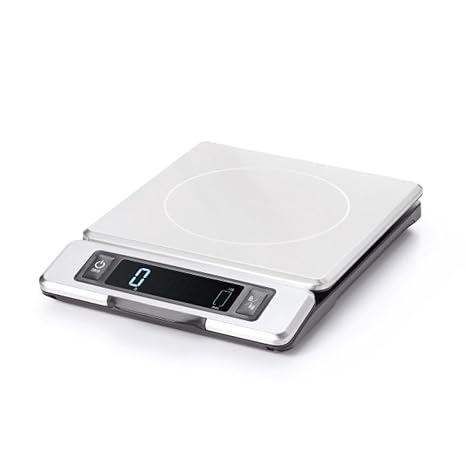
“OXO Good Grips 11 lb Stainless Steel Food Scale wi — digital kitchen scale precise to 0.1g, essential for bread baking and sourdough measurement.”
See Today’s Price →What we like
- Pull-out display is the best solution for large-bowl readability
- 1-gram resolution for precise baking
- Large stainless steel platform fits big mixing bowls
- Responsive tare function
- Professional-quality accuracy
Watch out for
- Most expensive scale in this comparison
- Pull-out display mechanism can become stiff with heavy use over years
Read Full Analysis
OXO's Good Grips 11 lb Scale is the most ergonomic bread baking scale on this page — the pull-out display solves a specific problem that standard scales don't address: when weighing flour or water into a large mixing bowl, the bowl often overhangs the platform and covers the digital readout. OXO's sliding display extends out from under the bowl, keeping measurements visible throughout the weighing process without repositioning. 1-gram resolution delivers the precision bread baking requires for accurate hydration percentages, and the large stainless steel platform accommodates wide mixing bowls without tipping. At $64.69, OXO is the most expensive scale on this page — $12.70 more than My Weigh KD-8000 and $39.69 more than Escali. The pull-out display mechanism is the premium feature, but long-term owners report the sliding mechanism becoming stiffer with heavy use over years of regular baking. OXO's scale does not include baker's percentage mode, which is My Weigh KD-8000's specialist advantage. OXO earns Best Compact on the pull-out display — a feature that makes it objectively more practical than My Weigh KD-8000 for bread bakers who measure directly into large bowls rather than using a separate vessel. Against Escali ($25.00, rank 3), OXO justifies the $59.99 premium with the pull-out display and wider platform. Against My Weigh ($49.99, rank 1), the choice is pull-out display versus baker's percentage mode — OXO wins for bakers using standard recipe formats; My Weigh wins for bakers who scale recipes using hydration ratios. Both are strong picks; the distinction is workflow preference.

“Escali Primo Digital Food Scale P115C — digital kitchen scale precise to 0.1g, essential for bread baking and sourdough measurement.”
See Today’s Price →What we like
- Accurate 1g precision
- 11 lb capacity
- Tare function
- Simple operation
Watch out for
- No pull-out display
- Basic platform size
Read Full Analysis
Escali's Primo scale is the essential-accuracy pick on this bread baking page — the most affordable option at $25.00 with 1-gram resolution, an 11 lb capacity, and a responsive tare function. For bakers who need accurate weight measurement without specialty features like baker's percentage mode or pull-out displays, the Primo does the core job reliably. Simple two-button operation means no learning curve: power on, place the bowl, press tare, add ingredients. At $25.00, the Primo lacks My Weigh KD-8000's baker's percentage mode and OXO's pull-out display — both features that meaningfully improve the bread baking workflow. The basic platform size is smaller than OXO's wide stainless surface, which can cause larger mixing bowls to feel less stable during weighing. No backlit display makes readings harder in lower-light kitchen environments during early morning baking sessions. Escali Primo at $25.00 is the budget-first pick when accuracy is the requirement and specialty features are not. Against My Weigh ($49.99) and OXO ($59.99), Escali saves $27–$40 for identical 1-gram precision — the premium of either competitor buys workflow improvements rather than measurement accuracy itself. For bakers who already know their recipes by heart and don't need baker's percentage math or pull-out display ergonomics, Escali's $25 precision is the rational choice.
Frequently Asked Questions
What kitchen scale is best for bread baking?
Do I need a kitchen scale to bake bread?
What is Baker's Math and why do I need a scale for it?
What is the minimum accuracy I need in a kitchen scale for bread baking?
Can I use a kitchen scale for measuring water in bread dough?
How We Analyze Products
We analyze Amazon review data — often thousands of reviews per product — to surface patterns that individual buyers miss. Our process aggregates star ratings, review counts, and buyer sentiment at scale, identifying which strengths and weaknesses appear consistently across the largest review samples available. The 19,266+ reviews analyzed on this page represent real verified-purchase feedback from Amazon buyers.
Each product earned its placement through data: total review volume, average rating, and the specific praise and complaints that repeat most often across buyers. No manufacturer paid for placement on this page. Products appear here because buyers endorsed them at scale, not because a company asked us to feature them.
We use AI to summarize review sentiment — not to fabricate opinions, but to condense what thousands of buyers actually wrote into a readable format. The pros and cons you see reflect the most common themes found in verified purchaser reviews, paraphrased for clarity. We do not claim to have accessed Reddit, YouTube, or specific publications in generating these summaries.
Prices shown reflect Amazon pricing at the time this page was last generated. Click “See Today’s Price” to get the current live price on Amazon. Read our full methodology →