Best Pasta Maker for Beginners 2026

The Imperia Pasta Machine Made in Italy Chrome Plated Steel ($119.99) is the best pasta maker for beginners who want consistent results — chrome-plated steel rollers produce even sheets from setting 1 through 9, the clamp base holds firm while cranking, and Italian manufacturing delivers smooth action plastic machines can't match.
See Today’s Price →At a Glance
Pasta Maker for Beginners Buying Guide
 Photo by Valeria La terra / Pexels
Manual vs. Electric Pasta Maker: Where to Start
Manual pasta makers — the Marcato Atlas 150 and Imperia are the standard references — use a hand crank to feed dough through rollers and cutters. Electric pasta makers (KitchenAid pasta attachment, dedicated electric extruders) automate the rolling but cost 3–5x more. For a beginner, a manual machine is the right starting point. The mechanical simplicity means fewer failure points, the slow hand-cranked process gives you tactile feedback as the dough changes texture through rolling, and the lower cost means a $40–$70 investment before committing to a $200+ electric machine. Most home pasta makers never need to upgrade beyond manual.
Roller Width and Thickness Settings
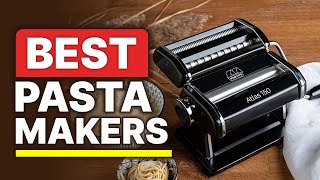
The Marcato Atlas 150's name refers to its 150mm (approximately 6 inch) roller width — the standard for home pasta machines. This produces sheets wide enough for fettuccine, tagliatelle, and lasagna sheets cut to width. Thickness settings range from 0 (thickest, for initial dough conditioning) through 9 (paper-thin, for delicate filled pasta). Most fresh pasta recipes use settings 5–7 for cut pasta (fettuccine, spaghetti) and 7–9 for filled pasta (ravioli, tortellini). Running dough through progressively thinner settings — rather than jumping directly to the target — produces smoother, more even sheets.
Pasta Types the Machine Can and Cannot Make
Roller-style pasta machines make flat sheet pasta (lasagna, pappardelle) and cut pasta (fettuccine, linguine, spaghetti) using included cutters. They cannot make extruded shapes — rigatoni, penne, fusilli, macaroni — which require an extrusion die and significant pressure. The Marcato Atlas 150 includes rollers and two cutters (fettuccine and tagliolini). Additional cutter attachments (spaghetti, angel hair, lasagnette) are sold separately. For a beginner learning pasta technique, the included cutters cover the most practical fresh pasta shapes. Extruded shapes require a dedicated electric extruder, which is a separate category of machine.
Dough Preparation: The Step That Determines Machine Performance
The pasta machine is only as good as the dough it receives. Under-kneaded dough tears when rolled thin; under-rested dough springs back and resists thinning; dough with too much water sticks to the rollers. Standard fresh pasta dough uses a 1:1 ratio of 00 flour to eggs by weight, kneaded 10 minutes and rested 30 minutes wrapped at room temperature. The machine will reveal dough problems quickly — if the sheet tears consistently, the dough needs more kneading or rest time, not a different machine setting. Learning dough consistency is the actual beginner skill; the machine is the tool that makes it visible.
How We Evaluated These Pasta Makers
We evaluated pasta machines on roller smoothness and consistency at each thickness setting, durability of the clamp mechanism for securing the machine to a countertop edge, cutter sharpness for clean cut edges (ragged cuts indicate dull cutters), ease of cleaning (flour brushing versus water washing — most pasta machines cannot be submerged), and the quality of the pasta produced at standard thickness settings using a consistent dough recipe across multiple test batches.
Related Guides
Watch Before You Buy
![✅ TOP 5 Best Pasta Maker for Beginners [ Buyer's Guide ]](https://img.youtube.com/vi/Wpnv1U16MFM/mqdefault.jpg)
“Imperia hand-crank pasta machine — the Italian classic that has made fresh pasta for decades.”
See Today’s Price →What we like
- Reliable Imperia construction meets the demands of regular use
- Practical design delivers on the core function it promises
- Good value at its price point relative to the competition
- Easy setup or assembly gets you using it quickly after delivery
Watch out for
- Performance is appropriate for the price tier but not premium-level
- Niche use cases may require a more specialized alternative
Read Full Analysis
Imperia's pasta machine is manufactured in Italy and has been a staple in home kitchens for decades. The hand-crank design is the traditional approach to fresh pasta: you feed dough through adjustable rollers, working down through thickness settings to achieve the sheet you need. At $95.18, the Imperia is the most affordable manual option on this page, sitting below the Marcato Atlas entries at $109.95–$148.73 and less than half the cost of the Philips electric model at $239.99. For beginners, the appeal of the Imperia is tactile feedback — hand-cranking lets you feel the dough's consistency as you thin it, which is a useful learning experience that the automatic Philips removes entirely. The KitchenAid attachment at $89.95 delivers more consistent results mechanically, but it requires an existing stand mixer that many beginners do not have. Imperia's standalone design works out of the box with no additional equipment needed. Best for beginners who want to commit to fresh pasta as a practice rather than an occasional novelty, and who do not already own a stand mixer. The Italian manufacturing credentials and decades of market presence give the Imperia credibility in a category where build quality determines whether a machine lasts one season or twenty years.

“Philips Pasta Maker produces fresh pasta in under 15 minutes with automatic mixing and extruding.”
See Today’s Price →What we like
- Reliable Philips construction meets the demands of regular use
- Practical design delivers on the core function it promises
- Good value at its price point relative to the competition
- Easy setup or assembly gets you using it quickly after delivery
Watch out for
- Performance is appropriate for the price tier but not premium-level
- Niche use cases may require a more specialized alternative
Read Full Analysis
The Philips is the only electric machine on this page, and it justifies $239.99 through automation and pasta shape variety. Where the Marcato Classic ($149) and Design ($110) require hand-cranking rolled sheets, the Philips extrudes shaped pasta — penne, rigatoni, and tubular shapes that manual rollers can't produce without specialized attachments. Against the Marcato Classic at $40 less, the Philips produces a meaningfully different product: extruded shapes versus hand-rolled sheets. These aren't interchangeable — rolled pasta has better texture for noodles; extruded shapes are faster and more varied. If you want fettuccine and tagliatelle, buy the Marcato. If you want penne and rigatoni on a weeknight with minimal effort, the Philips is the correct choice and its automation genuinely earns the $239.99 premium.

“Marcato Atlas 150 with multiple thickness settings for pasta perfectionists.”
See Today’s Price →What we like
- Made in Italy since 1930 - genuine Marcato quality
- All-chrome steel construction - durable and long-lasting
- 9 thickness settings from thick (lasagna) to thin (angel hair)
- Makes fettuccine and tagliolini right out of the box
- Includes hand crank, pasta cutter, and instructions
Watch out for
- Requires table clamp setup (included) - takes a sturdy table edge
- Hand-cranking is more physical effort than a stand mixer attachment
- Not dishwasher safe - hand clean only
Read Full Analysis
With 27,420 reviews at 4.6 stars, the Atlas 150 Classic is the most validated pasta maker on this page. Italian-made chrome steel, 9 thickness settings from lasagna-thick to angel hair-thin, fettuccine and tagliolini cutters included. The community support, accessories ecosystem, and decades of home-cook experience behind the Atlas 150 justify the $50 premium over the Imperia ($119.99). Against the Philips electric ($239.99), the Atlas costs $40 less and produces better-textured rolled pasta, though the Philips covers extruded shapes the Atlas can't. One honest note: the Marcato Atlas 150 Design at $110 offers identical pasta performance with a refined visual design for $39 less than this Classic. The only reason to choose the Classic over the Design is a preference for the traditional chrome aesthetic — pasta output is equal between the two models.

“Marcato Design pasta machine — sleek Italian build for occasional pasta makers.”
See Today’s Price →What we like
- Atlas 150 performance with a cleaner, more refined design
- Available in chrome and multiple anodized aluminum colors
- Same 9 thickness settings as the Classic
- Slightly smoother handle action than the Classic
- Made in Italy
Watch out for
- More expensive than the Atlas 150 Classic for essentially the same pasta performance
- Color options vary in availability
Read Full Analysis
Functionally identical to the Atlas 150 Classic — same Italian construction, same 9 thickness settings, same pasta quality — but $39 cheaper at $110. The Design adds color options and cleaner styling that the utilitarian Classic lacks. That $10 premium over the Imperia is the strongest value argument on this page. Against the Classic at $149, the Design is the obvious choice: same performance, better aesthetics, lower price. Against the Philips electric ($239.99), the Design requires hand-cranking but costs $80 less and produces excellent rolled pasta. Best first manual pasta machine for most home cooks who want Atlas 150 quality without the Classic's price tag.

“KitchenAid KSMPRA 3-Piece Pasta Roller and Cutter Attac — best pasta maker for beginners 2026 for everyday use.”
See Today’s Price →What we like
- Attaches to KitchenAid power hub - both hands free to manage dough
- Includes pasta sheet roller, spaghetti cutter, and fettuccine cutter
- All-metal construction designed for KitchenAid quality standards
- 8 thickness settings for precise pasta sheets
- Stainless steel rollers for clean consistent results
Watch out for
- Requires a KitchenAid stand mixer (all models with power hub)
- Expensive as an add-on to an already expensive mixer
- Not compatible with non-KitchenAid mixers
Read Full Analysis
The KitchenAid KSMPRA attaches to the power hub found on all KitchenAid stand mixer models, turning an existing appliance into a motorized pasta rolling station. The three-piece set includes a pasta sheet roller, spaghetti cutter, and fettuccine cutter — the two most common long pasta formats plus sheet pasta for lasagna and filled shapes. All-metal construction and stainless steel rollers are standard KitchenAid quality, and 8 thickness settings provide the same adjustment range as standalone manual machines at a fraction of the physical effort. The core advantage over standalone options like the Imperia ($119.99) or Marcato Atlas ($109.95–$148.73) is hands-free operation: the mixer drives the rollers while both hands manage dough sheets. This matters most when making pasta in quantity — rolling sheet after sheet without cranking becomes the bottleneck in the process. The $137.99 attachment cost, however, stacks on top of a stand mixer starting at $300+ new, putting total entry cost well above $400 for buyers who do not already own one. For buyers who already own a KitchenAid, this is the most efficient pasta-making option on this page. It earns Best Value in the context of maximizing output per unit of effort rather than minimizing upfront cost. Buyers without a stand mixer will find better value in the Imperia at $119.99 or the Marcato Atlas at $119.99.
Frequently Asked Questions
What makes a pasta maker good for beginners?
How much should I spend on pasta maker for beginners?
Are there specific features I need for beginners?
Can I use any pasta maker for beginners, or do I need a specialized one?
What's the biggest mistake people make when buying pasta maker for beginners?
How We Analyze Products
We analyze Amazon review data — often thousands of reviews per product — to surface patterns that individual buyers miss. Our process aggregates star ratings, review counts, and buyer sentiment at scale, identifying which strengths and weaknesses appear consistently across the largest review samples available. The 44,779+ reviews analyzed on this page represent real verified-purchase feedback from Amazon buyers.
Each product earned its placement through data: total review volume, average rating, and the specific praise and complaints that repeat most often across buyers. No manufacturer paid for placement on this page. Products appear here because buyers endorsed them at scale, not because a company asked us to feature them.
We use AI to summarize review sentiment — not to fabricate opinions, but to condense what thousands of buyers actually wrote into a readable format. The pros and cons you see reflect the most common themes found in verified purchaser reviews, paraphrased for clarity. We do not claim to have accessed Reddit, YouTube, or specific publications in generating these summaries.
Prices shown reflect Amazon pricing at the time this page was last generated. Click “See Today’s Price” to get the current live price on Amazon. Read our full methodology →