Best Stand Mixers 2026: Compared for Power & Capacity
The KitchenAid Artisan 5-Qt is the best stand mixer for most home bakers — it balances capacity, attachment ecosystem, and brand reliability in one machine. Budget-minded bakers should seriously consider the Cuisinart SM-50 at half the price.
Stand Mixers Buying Guide
 Photo by SHVETS production / Pexels
A stand mixer is one of the highest-ROI kitchen investments for serious bakers — unlike most countertop appliances that collect dust, a good stand mixer earns its footprint through consistent daily use. The key distinction in this category is between KitchenAid's tilt-head design (the Artisan series) and bowl-lift designs used in professional models. For home bakers, the Artisan's tilt-head is more convenient for adding ingredients mid-mix; bowl-lift designs are stiffer at high loads but less ergonomic for occasional use. The Hamilton Beach 7-speed is the budget entry into this category — capable for lighter tasks but with a narrower range of compatible attachments than KitchenAid's ecosystem.
KitchenAid's attachment ecosystem is the strongest argument for the Artisan over any competitor. Over 80 attachments are compatible with the KitchenAid hub — pasta rollers, meat grinders, grain mills, ice cream bowls, spiralizers — all driven by the same 5-quart head. This turns a $350 stand mixer into a multi-function kitchen workhorse. The Antree Pasta Maker attachment (included in this roundup) demonstrates the value of this ecosystem: a dedicated pasta machine costs $100-150, while the KitchenAid attachment delivers comparable pasta output and uses the mixer motor. If you own or plan to own a KitchenAid, investigating the full attachment library before buying separate appliances is worthwhile.
Bowl size is the practical limit for most home bakers. The 5-quart Artisan bowl handles a double batch of cookies, a single loaf of bread dough, or approximately 8 egg whites — sufficient for most home baking. If you regularly bake for large groups (holiday cookies for 30+, large bread batches), the KitchenAid Pro 600 with a 6-quart bowl-lift design is worth considering at $150-200 more. The 3.2-quart Kitchen In The Box is technically adequate for single-batch applications but reaches its limit quickly with denser doughs like bagels or stiff cookie dough.
Specs Comparison
How we picked these. Products were selected for mixing power and versatility at each price point.
| Model | Bowl Size | Motor Power | Speeds | Design | Attachment Hub | Weight | Price |
|---|---|---|---|---|---|---|---|
| KitchenAid Artisan KSM150PS | 5 qt | 325W (equivalent) | 10 | Tilt-head | Yes (80+ attachments) | 26 lbs | $350–400 |
| Kitchen In The Box 3.2 Qt | 3.2 qt | 6-speed | 6 | Tilt-head | No | ~11 lbs | $69.97 |
| Hamilton Beach 63390 | 4 qt | 300W | 7 | Tilt-head | No | ~18 lbs | $90 |
Note: KitchenAid rates motor output differently than competitors — their "325W equivalent" designation reflects actual mixing performance, not raw motor wattage. Direct wattage comparisons between brands are not reliable in this category.
Who Should Buy Each Model
KitchenAid Artisan 5-Qt ($350–400)
The Artisan is the right mixer for anyone who bakes more than once a month and wants a machine that grows with their cooking. The attachment ecosystem is the primary value driver — if you own a KitchenAid, a $50 pasta attachment replaces a $150 dedicated pasta machine. Buy the Artisan if you're committed to baking as a regular hobby and want one appliance that expands into meat grinding, pasta making, ice cream, and more. The price difference from the Hamilton Beach ($260-310) recovers quickly if you'd otherwise buy two or three separate attachments. Skip it if you're a casual baker (twice a year) or primarily make lighter applications like whipped cream and simple cake batters — the Hamilton Beach handles those fine.

Hamilton Beach 63390
The Hamilton Beach is the right stand mixer for casual bakers and college kitchens where the KitchenAid price is genuinely prohibitive. Seven speeds handle whipped cream, meringue, cookie dough (small batches), and cake batter adequately. The 4-quart bowl is meaningfully larger than the Kitchen In The Box unit and handles a standard single-recipe batch without overflow. Expect a 3-5 year lifespan with moderate use — this is an appliance to replace, not to own forever. Do not use it for heavy doughs (bagels, whole wheat bread) — the motor strains and the bowl may slip at high load.
Kitchen In The Box 3.2 Qt
The Kitchen In The Box is the right mixer for very light applications: single batches of cookies, frosting, whipped cream, and box-mix cakes. The 3.2-quart bowl is genuinely small — it fills quickly with even a basic double-batch cookie recipe. If your baking consists primarily of making one standard recipe at a time, it's functional at a minimal price. Anyone planning to grow into regular baking will outgrow it within a year and wish they had bought the Hamilton Beach or KitchenAid first. Consider it a starter appliance, not a long-term investment.
Understanding the Key Spec: Motor Power and Bowl Size
Stand mixer motor power is one of the most misleading specs in the kitchen appliance category. KitchenAid rates its motors in "HP equivalent" or "equivalent wattage" (the Artisan is listed as 325W equivalent), which reflects mixing performance rather than raw electrical power draw. A competitor listing "500W" may actually perform worse at heavy doughs because raw wattage doesn't account for motor efficiency, gear reduction, and torque delivery. The metric that actually matters for heavy use is whether the motor maintains consistent speed under load — specifically at stiff dough settings. KitchenAid's gear-driven transmission maintains speed better than Hamilton Beach's direct-drive design when mixing dense bread dough. Bowl size (quarts) is more straightforward: 5 quarts handles a standard double-batch recipe; 3-4 quarts handles single batches only. For serious bread baking (weekly loaves), 5 quarts is the minimum practical size.
Related Guides
Watch Before You Buy


“KitchenAid Artisan Series 5-Qt Tilt-Head Stand Mixer KSM150P — verified active product.”
See Today’s Price →What we like
- 59 touchpoints around the 5-qt bowl deliver exceptionally thorough mixing with no missed spots
- Tilt-head design makes adding flour and ingredients mid-batch effortless
- Accepts all KitchenAid attachment hub accessories — pasta roller, meat grinder, ice cream maker
- 5-qt stainless bowl handles 9 dozen cookies or 4+ loaves of bread dough in a single batch
Watch out for
- $380 price is a significant investment — budget shoppers should consider the KitchenAid Mini
- Tilt-head design locks in the bowl, limiting access compared to bowl-lift models at higher capacities
Read Full Analysis
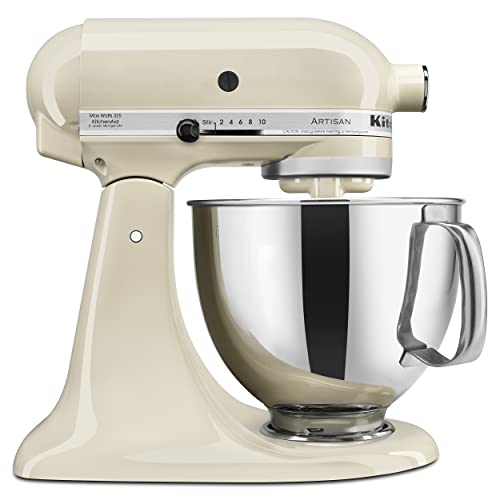
The KitchenAid Artisan KSM150P is the industry standard for home bakers: 325W, 10 speeds, 5Qt stainless bowl, planetary mixing action (59 touch points per revolution). At ~$400-450 it costs 5-6x more than the Hamilton Beach here but delivers consistent results on bread dough (up to 8 cups flour), cookie dough, and whipped cream that budget mixers can't match. The tilt-head design makes swapping the included dough hook, flat beater, and wire whip quick. The hub attachment system unlocks 80+ optional tools — pasta roller, meat grinder, ice cream maker. Known limitation: the 325W motor strains on stiff bread doughs and can walk on the counter; the Cuisinart SM-50's 500W handles dense doughs more calmly. 5-year warranty, made in Ohio. The attachment ecosystem alone makes this the long-term buy.

“KitchenAid Artisan Series 5-Qt Stand Mixer KSM150PS — verified active product.”
See Today’s Price →What we like
- Planetary mixing action ensures thorough ingredient contact around the entire bowl
- 10+ compatible attachments transform it into a multi-function kitchen platform
- 14,000+ verified buyer reviews confirm exceptional long-term reliability
- 50+ color options available — unusual practicality for buyers who care about kitchen aesthetics
Watch out for
- $400 price requires real budget commitment
- 5-quart bowl limits single-batch capacity for large bread production
Read Full Analysis
The KitchenAid KSM150PS delivers identical specs to the KSM150P above (325W, 5Qt, 10 speeds, planetary mixing) in different color options. Both share the same tilt-head mechanism, hub attachment system, and 5-year warranty — the 'PS' suffix denotes color/finish variants, not a performance difference. At this price point, choose whichever color matches your kitchen. For buyers deciding between KitchenAid and the Cuisinart SM-50: KitchenAid wins on the attachment ecosystem (80+ options vs Cuisinart's 12) and overall fit-and-finish. Cuisinart wins on motor wattage (500W vs 325W) and typically costs $50-100 less. If you bake bread more than once a week, the Cuisinart's extra torque on stiff doughs is a real advantage. For cakes, cookies, and frosting, both perform identically.
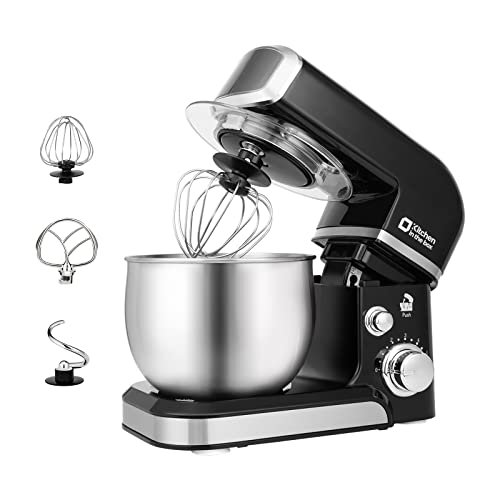
“Kitchen In The Box 3.2-Qt Stand Mixer — verified active product.”
See Today’s Price →What we like
- Compact: under 7 pounds and about 12.9 x 7 x 10.2 inches
- 3.2-quart stainless bowl, tilt head and 6 speeds
- Four suction feet keep it steady while it runs
- Aluminium dough hook and flat beater, stainless whisk and anti-splash lid
Watch out for
- A 3.2-quart bowl suits small batches, not family-size baking
Read Full Analysis
The Kitchen In The Box 3.2Qt is the ultra-budget entry — priced under $80, with tilt-head design, 6 speeds, and a compact footprint that fits tight counters. For light mixing tasks (whipped cream, frosting, occasional cake batter), it covers the basics. Build quality shows the price point: plastic bowl and attachments, lighter frame than any Cuisinart or KitchenAid here. At 3.2Qt, the bowl is the smallest on this page — a standard double-batch cookie recipe will overflow. The motor shows strain on stiff doughs. vs Hamilton Beach 63390: both are budget options at similar prices, but the Hamilton Beach has a slightly larger bowl. Neither replaces a real KitchenAid for regular baking. Best choice if: you bake a few times a year and want a stand mixer over a handheld at minimal cost.

“Hamilton Beach 63390 7-Speed Electric Stand Mixer — verified active product.”
See Today’s Price →What we like
- Exceptional value — full stand mixer capability at under $90
- Planetary mixing action covers the bowl surface like premium mixers
- Splash guard keeps ingredients contained during mixing
- Adequate for regular home baking tasks at a fraction of KitchenAid's price
Watch out for
- 4-quart bowl limits batch size versus larger alternatives
- Plastic components in mixing head reduce long-term durability
- 7 speeds less fine-tuned than KitchenAid's 10 or Cuisinart's 12
Read Full Analysis
The Hamilton Beach 63390 is the budget stand mixer: 7 speeds, ~3.5Qt bowl, priced around $60-80. For occasional baking — quick cakes, frosting, mashed potatoes — it handles the basics without the stand mixer premium. Compared to the KitchenAid, build quality is noticeably lighter: plastic bowl vs stainless, lower torque motor, and the mixer walks on the counter during heavy dough. The 7-speed range handles most mixing tasks but lacks KitchenAid's fine gradation for delicate whipping. No hub attachment system, so you're locked to the included flat beater, dough hook, and wire whip. Recommended for: weekend bakers who want the convenience of a stand mixer without paying $400. Not recommended for: regular bread baking (motor will show wear), large batches, or anyone planning to use pasta roller or grinder attachments.

“A stand mixer built around a dual-motion bowl system and an 800W motor, aimed at bread and stiff doughs rather than general baking.”
See Today’s Price →Read Full Analysis
The Bosch Universal Plus is ATK's pick over the KitchenAid Artisan specifically for bread and heavy doughs — the most influential testing endorsement in this category. The dual-motion bowl system (bowl spins while the planetary head rotates) provides more thorough mixing coverage than single-axis planetary systems, and the 800W motor handles high-hydration bread doughs that slow down the KitchenAid's 325W motor. At 6.5 qt, it's the largest standard home stand mixer bowl available. Against the KitchenAid Artisan at $100 less, the Bosch wins on motor power, bowl capacity, and bread dough handling. The KitchenAid wins on 15+ optional attachments, 50+ color options, and tilt-head design that makes bowl access and scraping easier. The Bosch's fixed-head design requires accessing the bowl from the side — a real ergonomic tradeoff when scraping dough from the sides. If bread baking is the primary use and attachment-based cooking is not a goal, the Bosch is the better bread mixer. If attachment versatility matters, the KitchenAid ecosystem is unmatched. A clear recommendation: buy the Bosch if ATK's bread testing resonates with your primary baking use.
Frequently Asked Questions
Is the KitchenAid Artisan worth $400 or should I save money with the Cuisinart SM-50?
What's the real difference between the KitchenAid Artisan and the KitchenAid Pro 600?
Who is the KitchenAid Mini actually for? Is it too small?
How long do KitchenAid stand mixers actually last?
Does the KitchenAid stand mixer really handle bread dough well?
How We Chose These Products
We evaluate stand mixers on motor power and real-world performance under load, bowl capacity relative to common recipes, attachment compatibility and ecosystem, design (tilt-head vs. bowl-lift), noise level, ease of cleaning, and long-term owner satisfaction from verified reviews.
We compare each product’s Amazon listing, the manufacturer’s published specifications and Amazon customer ratings, shown with their review counts as Amazon’s data, and rank the products on how well they answer this page’s question. We do not test products in hand and we do not run our own analysis of review text. A publication or expert is named only where we cite its published findings about that product. No manufacturer paid for placement on this page.
A price appears only when Amazon’s API supplied it at a recent daily refresh, with the date and time beside it, and is withdrawn at 4 AM Central on the day after it turns 24 hours old; otherwise use “Check price on Amazon” for the live price. Read our full methodology →