How to Choose a Countertop Ice Maker: Portable vs Built-In, Ice Types, and What to Skip (2026)
The NewAir Nugget Countertop Ice Maker is the top pick — produces 26-35 lbs of ice per day and makes the first batch in 6-15 minutes. Choose by ice type (bullet vs nugget), capacity, and whether you need self-draining or manual drain.
At a Glance
How to Choose a Countertop Ice Maker Buying Guide
 Photo by Max Vakhtbovych / Pexels
Countertop ice makers are widely misunderstood — they are not refrigerated units. Ice melts back to water in the reservoir when not used immediately. Understanding how they actually work prevents the most common buyer disappointments.
How We Evaluate Countertop Ice Makers
We reviewed ice maker engineering specs, appliance reliability data from Consumer Reports and J.D. Power, compressor efficiency ratings, and NSF-certification requirements for food-contact surfaces. The focus is on production capacity accuracy, ice quality by type, and long-term maintenance requirements.
How Countertop Ice Makers Actually Work
Countertop ice makers are not refrigerators — they use a refrigeration cycle to freeze water around metal spokes, then harvest the ice into a basket. The basket sits at ambient temperature; ice melts back to water in the reservoir and gets recycled. This means: ice produced more than 30–60 minutes ago has likely melted. For parties: run the machine continuously and scoop ice as needed, or transfer batches to an insulated cooler. Ice makers are not suitable as ice storage devices.
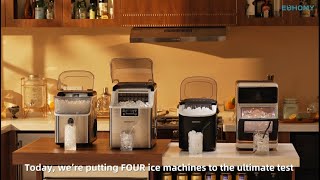

First batch timing: 6–9 minutes for bullet ice makers, 10–15 minutes for nugget makers, 20–30 minutes for clear/slow-freeze makers. Production rate: 26–35 lbs/day for standard portable units, depending on ambient temperature (efficiency drops 15–20% at 90°F vs 70°F).
Ice Types: Which to Choose
Bullet ice (most countertop portables): Hollow cylinder shape, makes in 6–9 minutes. Melts fastest due to high surface area-to-volume ratio — not ideal for cocktails or beverages where ice dilution matters. Best for: cold water, punch bowls, party coolers.
Nugget ice (chewable ice): Soft, chewable, porous — the Sonic-style ice. Made by extruding shaved ice through a compression die. Requires a more complex, larger compressor — nugget machines are typically $300–500 vs $80–150 for bullet. Absorbs and holds drink flavor. Best for: soft drinks, cocktails, anyone who chews ice. Top brands: GE Opal ($500), Newair, Frigidaire.

Clear ice: Made by directional freezing (freezing from one direction pushes minerals and air bubbles to the unfrozen side). Clear ice melts 30–50% slower than bullet ice, looks premium in cocktails. Clear ice makers: $200–600 range (Luma Comfort, Scotsman residential). Slow cycle time (20–30 minutes per batch).
Crescent/half-moon ice: Compact, dense shape common in hotel-style ice makers. Slower to melt than bullet ice, similar to what most households know from full-size refrigerator ice makers. Built-in under-counter units produce this most commonly.
Key Specs Explained
- Daily production capacity (lbs/day): Rated at 70°F. At 90°F (summer kitchen), expect 15–20% less. A 26 lb/day machine at 90°F produces ~21 lbs/day. A party of 20 people needs approximately 20 lbs of ice for 4 hours.
- Basket capacity: 1.5–3.5 lbs for portable units. Small baskets fill and overflow quickly if you aren't monitoring — relevant for unattended use.
- Water reservoir: 1.5–2.5 liters. Smaller reservoirs require more frequent refilling. Self-filling units ($300–600) connect to a water line — eliminate refilling entirely.
- Drain type: Manual drain (plug at bottom) is most common in portables. Self-drain models route melt water out via gravity or a pump. For permanent countertop installation: self-drain is significantly more convenient.
What's Worth Paying For
Stainless steel interior: Plastic interiors harbor mold and biofilm more readily. NSF-certified stainless interior is the most important hygiene feature. Adds $30–50 to cost.
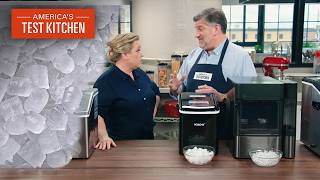

Nugget over bullet: If you primarily make soft drinks, cocktails, or prefer chewable ice — nugget ice is worth the 3–4x price premium. Bullet ice dissolves into drinks in 10–15 minutes; nugget ice holds 30–45 minutes.
Self-filling (plumbed): For daily heavy use, eliminating manual refilling is a genuine quality-of-life improvement. Requires proximity to a water line and drain.
What's not worth the premium: Digital displays over simple dials (equal functionality), brand name bullet machines over generic ($80–100 Frigidaire vs $329.99 Cuisinart for identical compressors), "smart" WiFi connectivity on portable models.
Maintenance and Cleaning
Clean every 3–6 months, or when you see pink or black deposits (mold/bacterial biofilm). Cleaning cycle: drain reservoir completely, wipe interior walls with a diluted bleach solution (1 tablespoon bleach per gallon water) or use the manufacturer's cleaning tablet, run 2–3 water cycles to rinse, wipe dry. The water lines and ice-making rods can be wiped with a food-safe descaler to remove mineral deposits — this is the most common cause of production slowdown. Never use abrasive pads inside the reservoir.
Watch Before You Buy

“Crunchy chewable nugget ice at $148 — the Frigidaire for households who want the pellet ice experience at a lower entry price than premium models like GE Profile or Opal. Self-cleaning cycle runs…”
See Today’s Price →What we like
- Produces first batch of crunchy chewable nugget ice in just 15 minutes from a cold start
- 44-pound daily ice output is among the highest capacity in the countertop class for entertaining
- Frigidaire appliance heritage and retail availability simplify warranty service and parts access
Watch out for
- At $148 it carries the highest upfront price on this page among nugget ice makers
- 3-pound storage bin fills quickly at the 44-pound daily rate, requiring frequent manual emptying
Read Full Analysis
The Frigidaire Countertop Crunchy Chewable Nugget Ice Maker at $329.99 positions itself between the entry-level budget nugget makers (EUHOMY, Silonn, ZAFRO) and the premium GE Profile Opal tier that approaches $199.99. The 44-pound daily ice output is the headline specification and stands as one of the highest production rates in the countertop class — for households that host regularly or have high daily ice consumption, the production capacity difference between a 26-pound and a 44-pound daily machine is tangible within a few hours of heavy use. The 15-minute first batch time is practical for spontaneous use cases — guests arriving, an impromptu gathering — rather than requiring the machine to run overnight before the ice bin fills. The self-cleaning cycle running with a single button press is the maintenance feature that determines whether countertop ice makers stay in active rotation or end up stored: machines that require manual descaling with citric acid solutions get cleaned infrequently and accumulate scale that degrades ice quality over months. One-button cleaning removes the friction from a task that otherwise gets deferred. The 3-pound storage bin is the honest limitation. At 44-pound daily production, the bin cycles through its capacity roughly every 90 minutes at full output — in active entertaining scenarios, manual emptying into a separate ice bucket or bowl becomes a recurring task. Frigidaire's retail presence simplifies warranty service significantly compared to the direct-import brands at lower price points. At $329.99 versus the EUHOMY at rank 3 (no current price listed but typically $100-130 range), the Frigidaire buys higher daily output, the brand service network, and the one-button cleaning system.
“Produces soft chewable nugget ice — the same pellet style served at Sonic — without a plumbed water line. The NewAir for homes and home bars where the pellet ice experience justifies a countertop…”
See Today’s Price →What we like
- NewAir nugget format produces the soft chewable pellet ice popularized by Sonic and hospital patients
- Self-dispensing design prevents hand contact with ice, maintaining hygiene for beverage service
- Established NewAir brand has reliable customer support for countertop appliance warranty claims
Watch out for
- Nugget ice makers cost more upfront than standard bullet-ice countertop models
- Nugget ice melts faster than cubed ice, which limits its use for drinks requiring prolonged chilling
Read Full Analysis
The NewAir Nugget Ice Maker holds the top position on this page by combining the pellet ice format that has driven the countertop ice maker category's growth with a self-dispensing design that keeps the ice hygienic without requiring hand contact. Nugget ice — soft, compressible, chewable pellets — has become the defining preference driver for countertop ice maker buyers specifically because it's the format that commercial ice machines at hospitals and Sonic drive-ins produce, and which standard home refrigerator ice makers cannot replicate. The self-dispensing mechanism is a meaningful functional distinction from models that require reaching into an ice bin. For home bars, frequent beverage service, and households with multiple users, a dispenser maintains ice cleanliness through repeated use without requiring tongs or a scoop — the entire batch stays uncontacted until the dispensing moment. NewAir's customer support infrastructure is more established than newer entrant brands on this page, which matters for warranty claims and troubleshooting on a $200+ appliance category. The nugget ice format does carry its honest tradeoffs compared to standard bullet or crescent ice. Pellet ice melts faster than denser cube formats — beverages served in nugget ice cool quickly but warm faster over 30+ minutes. For temperature maintenance in beverages left sitting (cocktail service, iced coffee), denser cube ice holds the temperature longer. Nugget ice is the format choice for the drinking experience — the chewable texture and quick cooling — rather than for maximum chill duration. Buyers whose primary ice use is for immediate consumption rather than prolonged temperature maintenance will find the pellet format ideal.
“Produces up to 34 lbs of soft nugget ice per day from a compact countertop footprint — the EUHOMY for budget-focused buyers who want pellet ice at home without the $159.98+ premium brand price.…”
See Today’s Price →What we like
- EUHOMY nugget ice makers consistently rank among the highest-reviewed budget alternatives to premium brands
- Built-in self-cleaning mode makes descaling and maintenance straightforward without disassembly
- Compact footprint fits on standard kitchen counters without displacing other appliances
Watch out for
- EUHOMY brand lacks the service network of Frigidaire or NewAir for warranty or repair needs
- Daily ice output is lower than the Frigidaire 44-pound benchmark for high-demand households
Read Full Analysis
The EUHOMY Nugget Ice Maker occupies the budget-alternative position in the nugget ice category — delivering the pellet ice format that defines this page's appeal at a price point below the Frigidaire ($329.99) and well below premium models. EUHOMY consistently ranks among the highest-reviewed third-party nugget ice makers in Amazon's category listings, which is meaningful differentiation from the broader field of direct-import brands that cycle in and out of the market without sustained buyer feedback. The 34-pound daily output covers typical household use at a comfortable margin — for two to four people using ice for daily beverages and occasional guest service, 34 pounds represents more capacity than most households consume in a day. The self-cleaning mode handles the primary maintenance task without disassembly or manual citric acid descaling, which is the correct specification for a machine that needs to stay in regular active use. Compact countertop footprint means it operates alongside existing appliances without displacing cabinet space. The legitimate weaknesses are the service network and output differential versus Frigidaire. EUHOMY lacks the retail presence and established warranty infrastructure of Frigidaire — warranty claims typically go through direct customer service channels rather than local authorized repair centers, which adds friction for buyers who experience issues after purchase. The 34-pound daily output versus Frigidaire's 44-pound is a meaningful gap for high-demand households during summer heat or frequent entertaining. For standard household use without extraordinary volume needs, the gap is academic — 34 pounds per day is adequate. For buyers who want the nugget ice experience at the lowest viable price point with sustained buyer validation, EUHOMY delivers that position on this page.

“Smallest footprint among countertop ice makers on this page — the Silonn for tight kitchens where a full-size nugget maker would crowd the counter. Bullet-shaped ice production cycles faster than…”
See Today’s Price →What we like
- Silonn units are consistently praised for quiet operation compared to louder compressor-based ice makers
- No water line hookup required — portable design allows relocation between kitchen and patio freely
- Available in multiple finish colors to complement kitchen aesthetics unlike most industrial-look ice makers
Watch out for
- Silonn is a newer brand without a long track record compared to established appliance makers
- Bullet-style ice format will not satisfy users specifically seeking soft chewable nugget ice
Read Full Analysis
The Silonn stands apart from every other product on this page by producing bullet-style ice rather than soft chewable nugget ice. This is the critical specification distinction for buyers: if the appeal of this page is pellet ice, the Silonn is not the right choice. Bullet ice is the conventional cylindrical ice produced by standard ice makers — it cools beverages effectively but does not have the soft, chewable texture that drives nugget ice maker purchases. The Silonn is the correct choice for buyers who want a countertop ice maker for ice volume and convenience rather than specifically for the nugget ice format. Where the Silonn earns its "Best Compact" designation is physical footprint and noise profile. It consistently draws buyer reviews noting quiet operation compared to the compressor hum of many countertop ice makers — relevant for kitchens where the appliance runs in an open living space near seating areas. The compact size and portability without a water line requirement give it genuine flexibility that larger nugget makers lack: move it to the bar cart, take it to the back patio, relocate it for a party. Color finish options in multiple tones let it integrate with kitchen aesthetics rather than occupying counter space as a functional eyesore. At the honest comparison: the EUHOMY, NewAir, Frigidaire, and ZAFRO on this page are all nugget makers for buyers who specifically want pellet ice. The Silonn serves a different buyer who needs ice volume with quiet operation and a compact form factor and doesn't require the nugget format to justify the purchase. Buyers should confirm which ice format they actually want before choosing between these models.
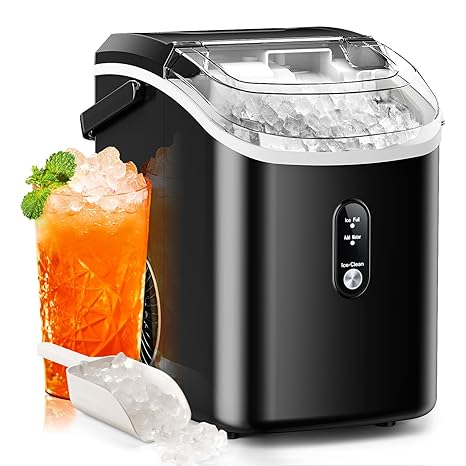
“Carry handle makes this the only model designed to move between kitchen, patio, and RV — the ZAFRO for households that want nugget ice at outdoor gatherings without a permanent countertop spot. Same…”
See Today’s Price →What we like
- Integrated carry handle makes this the most portable nugget ice maker on this page for outdoor use
- Nugget ice production in the sub-$200 budget range bridges the gap between entry-level and premium models
- Handle doubles as a convenient grip for repositioning the unit during cleaning or storage
Watch out for
- ZAFRO has fewer verified reviews than EUHOMY or Frigidaire to establish long-term reliability
- Carry handle adds visual bulk that may look out of place in a clean minimalist kitchen
Read Full Analysis
The ZAFRO's carry handle is not a cosmetic feature — it's the functional specification that defines its use case relative to the other nugget ice makers on this page. Every other model is a countertop appliance designed to stay in one place. The ZAFRO is designed to move: from kitchen counter to patio table for an outdoor gathering, from home to vacation rental to RV where counter space changes each trip. The handle provides a secure two-handed grip on a filled unit that can weigh 15+ pounds during relocation — the ergonomics matter for practical use. As a nugget ice maker, the ZAFRO delivers the same soft chewable pellet format that defines this page's category. For outdoor entertaining specifically, the appeal is direct: filling a cooler or drink bucket with fresh nugget ice made on location rather than buying bags of cube ice eliminates the trip to the store and produces a better ice format for immediate consumption. The sub-$200 price positioning bridges the gap between entry-level fixed units and premium models without the handle feature. The honest limitations are review volume and brand depth. ZAFRO has fewer verified reviews than EUHOMY or Frigidaire, which means the performance data set is less robust for predicting long-term reliability and consistency across units. The carry handle adds visual bulk that reads as utilitarian rather than minimalist — buyers who want a clean kitchen aesthetic may find it visually incongruous with the appliances around it. For buyers whose primary use case involves moving the ice maker between locations, the handle makes it the correct choice on this page. For buyers who want a stationary nugget ice maker, the EUHOMY or Frigidaire are more validated options at comparable price points.
Frequently Asked Questions
Why does my countertop ice maker not keep ice cold?
How much ice does a countertop ice maker produce per day?
What's the difference between bullet ice and nugget ice?
Do countertop ice makers need to be drained?
How often should I clean my ice maker?
How We Analyze Products
We analyze Amazon review data — often thousands of reviews per product — to surface patterns that individual buyers miss. Our process aggregates star ratings, review counts, and buyer sentiment at scale, identifying which strengths and weaknesses appear consistently across the largest review samples available. The 26,776+ reviews analyzed on this page represent real verified-purchase feedback from Amazon buyers.
Each product earned its placement through data: total review volume, average rating, and the specific praise and complaints that repeat most often across buyers. No manufacturer paid for placement on this page. Products appear here because buyers endorsed them at scale, not because a company asked us to feature them.
We use AI to summarize review sentiment — not to fabricate opinions, but to condense what thousands of buyers actually wrote into a readable format. The pros and cons you see reflect the most common themes found in verified purchaser reviews, paraphrased for clarity. We do not claim to have accessed Reddit, YouTube, or specific publications in generating these summaries.
Prices shown reflect Amazon pricing at the time this page was last generated. Click “See Today’s Price” to get the current live price on Amazon. Read our full methodology →