How to Choose a Food Dehydrator: Tray Size, Temperature, and Budget Guide (2026)
For occasional use (herbs, fruit): stackable 5-tray dehydrator ($40–$70, Nesco FD-75A). For regular jerky: box-style rear-fan unit with 10+ sq ft tray space ($100–$180, Excalibur 9-tray). Key spec: dehydrator must reach 155–165°F for meat safety — many cheap units max at 145°F. Stackable units require tray rotation; box-style does not.
At a Glance
| # | Product | Award | Price |
|---|---|---|---|
| 1 | Our Top Pick | $80.51 Buy → |
|
| 2 | 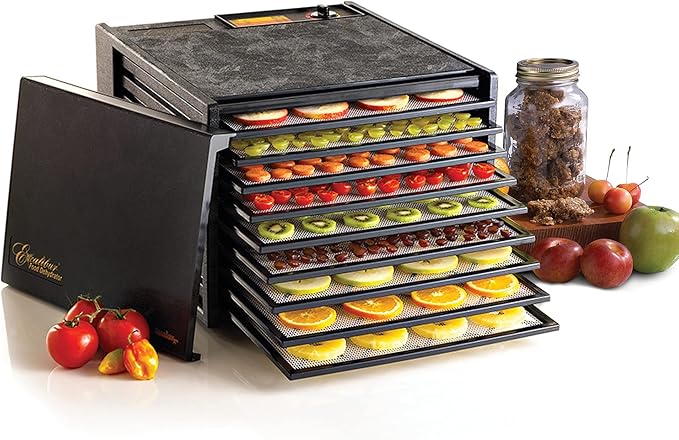 Excalibur Electric Food Dehydrato… Excalibur Electric Food Dehydrato…Excalibur |
Our Top Pick | $179.99 Buy → |
| 3 | Best Mid-Range | Check current price on Amazon Buy → |
|
| 4 |  Hamilton Beach Digital Food Dehyd… Hamilton Beach Digital Food Dehyd…Hamilton Beach |
Best Digital | $43.49 Buy → |
| 5 | Best Spacious | $159.99 Buy → |
How to Choose a Food Dehydrator Buying Guide
 Photo by Denys Gromov / Pexels
Food dehydrators split cleanly into two types with different use cases. Getting the type wrong means either under-buying (cheap stackable for someone who makes 5 lbs of jerky a week) or over-buying (expensive Excalibur for someone who dries herbs twice a year). The honest first question: what are you actually dehydrating, and how much at once?
Stackable vs Box-Style: The Architecture Difference
Stackable dehydrators (Nesco, Presto): Circular trays stack vertically, fan and heating element in the top or bottom. Can add trays as needed (some models expandable to 30 trays). Cheaper, more compact storage, but uneven airflow — trays near the fan dry faster than trays at the far end. Must rotate trays mid-cycle for even results. Price: $40–$100.
Box-style dehydrators with rear fan (Excalibur, BioChef): Rectangular unit, fan at rear, horizontal airflow across all trays simultaneously. Even drying across all trays — no rotation needed. Fixed tray count (typically 5, 9, or 10 trays). Larger footprint but more consistent results. Price: $100–$350.
When stackable is fine: Herbs, fruit leather, banana chips, dried vegetables — items where some variation in drying time is acceptable. Also good for small batches (under 3 lbs total). The main advantage is price and compactness.
When box-style is necessary: Jerky at scale (needs consistent heat for food safety), anything requiring specific temperature precision, batches over 5 lbs, or regular use where tray rotation becomes annoying. The Excalibur 9-tray ($180–$230) is the standard recommendation for serious dehydrating.
Temperature Range: The Food Safety Critical Spec
Temperature range is the most important spec — not tray count or wattage.
Jerky (beef, turkey, chicken): USDA recommends heating meat to 160°F internally before or during drying. Your dehydrator must reach at least 155–165°F. Many cheap dehydrators max out at 145°F — insufficient for meat safety. The workaround is pre-heating meat in an oven to 160°F before dehydrating, but this adds a step most people skip. If you plan to make jerky, verify the max temperature is 155°F+.
Fruit and vegetables: 125–135°F is optimal. Dries without cooking. Most dehydrators handle this range easily.
Herbs and spices: 95–115°F. Low heat preserves volatile oils and color. Not all cheap dehydrators can go this low — some have a minimum of 125°F, which cooks herbs rather than drying them.
Yogurt and fermented foods: 95–110°F. Same low-temp requirement as herbs.
Ideal range for versatility: 95°F to 165°F. Units in this range handle everything. The Excalibur and Cosori models cover this range; many budget stackables do not.


Tray Area and Batch Capacity
Manufacturers advertise tray count, but usable tray area is what matters:
5-tray stackable: Approximately 8 sq ft of tray space. Fits about 2–3 lbs of sliced meat or fruit per batch. Adequate for occasional use. Most 5-tray Nesco units have 14-inch diameter circular trays.
5-tray box-style: Approximately 8 sq ft but with even airflow. Excalibur 5-tray (~$179.99) is the entry-level serious dehydrator.
9-tray box-style: Approximately 15 sq ft. The standard for regular jerky makers — fits 6–8 lbs of sliced meat per batch. Excalibur 9-tray ($180–$230) is the most commonly recommended food dehydrator by homesteaders and jerky enthusiasts.
Commercial-style (10+ trays): For small businesses or large families doing serious preservation. $250+.
Practical check: Measure a pound of thinly sliced beef or fruit spread in a single layer — it requires about 1–1.5 sq ft of tray space. A 5-tray unit gives you about 8 sq ft, meaning roughly 5–6 lbs of produce per batch assuming good coverage.
Wattage and Operating Cost
Dehydrators run for 4–24 hours per batch — operating cost matters more than most appliances.
Typical wattage: Small stackable: 300–400W. Mid-size box-style: 500–600W. Large commercial: 800–1,000W.
Operating cost estimate: At 12 cents per kWh (US average): a 500W dehydrator running 12 hours costs about 72 cents. Running every weekend: $3/month or $37/year. Not a meaningful expense — don't let wattage comparisons drive your decision.
Timer feature ($20–$40 premium): Worth it for long runs. Set it and go to bed. Excalibur 9-tray with digital timer ($179.99) vs. analog ($180) — the timer is genuinely useful for overnight jerky runs.

Top Picks by Budget
Under $70 (occasional/herb/fruit): Nesco FD-75A ($50–$65) — 600W, expandable to 30 trays, 95–160°F range, reliable brand since 1978. Good for herbs, fruit, and occasional vegetable chips. Weak for jerky due to uneven airflow.
$100–$150 (step-up versatility): Cosori Premium Food Dehydrator ($80–$110) — box-style rear fan, 6 stainless trays, 95–165°F digital, timer included. Competes with Excalibur 5-tray at lower price.
$180–$250 (serious use): Excalibur 9-tray ($180–$230) — 15 sq ft, rear fan, 105–165°F, 26-hour timer on digital version. The long-term recommendation for regular jerky and large batch preservation. See our best vacuum sealers to pair with your dehydrator for extending shelf life, and food storage containers for storing your finished product. For meat thermometers to verify internal temp, see best meat thermometers.
Watch Before You Buy

“700-watt adjustable thermostat handles everything from herbs to jerky at correct temperatures. 4.6 stars from 13,749 Amazon reviews signal consistent reliability.”
See Today’s Price →What we like
- 700-watt adjustable thermostat handles everything from herbs to jerky at correct temperatures
- Expandable up to 12 trays as dehydrating volume increases
- Top-mounted fan circulates air evenly without flavor transfer between trays
Watch out for
- Fan is noticeably loud compared to quieter rear-mounted fan dehydrators
- Plastic trays can warp slightly at maximum temperature settings
- Opaque exterior makes it impossible to check food progress without opening
Read Full Analysis
The NESCO FD-75A Snackmaster Pro earns its 4.6-star rating across 13,749 Amazon reviews through two characteristics that matter most in a food dehydrator: consistent temperature control and even airflow. The 700-watt adjustable thermostat — ranging from roughly 95°F for delicate herbs to 160°F for safe jerky production — covers the full temperature spectrum that different foods require. The top-mounted fan blows air down through stacked trays uniformly, a configuration that prevents flavor transfer between trays (garlic won't scent your apple rings) and eliminates the need to rotate trays mid-cycle. At $89.99 it sits well below the Excalibur 9-tray and COSORI ($139.97) options on this page, and the expandable tray system lets you add capacity as needed rather than buying up front. The two consistent criticisms are noise — the fan is louder than rear-mounted alternatives — and tray durability at maximum heat settings, where plastic can warp slightly over repeated high-temperature cycles. For users focused on jerky, dried fruit, and herb preservation without spending over $100, the FD-75A is the most proven value on this list.
“Nine removable mesh trays with 15 square feet of drying space and a rear-mounted fan for even horizontal airflow — the Excalibur for serious dehydrators making large batches of jerky, fruit leather…”
See Today’s Price →Watch out for
- Hand-wash recommended for some parts to extend coating or surface lifespan
- Counter space commitment may be challenging in very small kitchens

“Precise temperature control ensures even drying across all trays. 4.7 stars from 21,155 Amazon reviews signal consistent reliability.”
See Today’s Price →What we like
- 600W heating element and 6 full trays processes larger batches of jerky, fruit, and vegetables quickly
- COSORI's digital touchscreen with 6 preset modes removes the guesswork for common dehydrating tasks
- Drip tray and dishwasher-safe stainless trays simplify cleanup after sticky dehydrating sessions
- $140 includes the temperature precision and digital control that NESCO and entry-level models lack
Watch out for
- 6-tray stainless configuration is the most expensive COSORI option on the page
- Larger body footprint than the 5-tray COSORI requires more dedicated counter or shelf space
Read Full Analysis
Easy to use, digital controls, quiet, versatile beyond jerky — great for families, cited by outdoorlife and thespruceeats Precise temperature control ensures even drying across all trays Dehydrating cycles take 6–12 hours, so plan ahead Footprint is sizable — needs dedicated counter space
“Digital timer and temperature display on a vertical-stack dehydrator — the Hamilton Beach for home dehydrators who want precise settings without manual dial guessing. Five trays handle…”
See Today’s Price →Watch out for
- Hand-wash recommended for some parts to extend coating or surface lifespan
- Counter space commitment may be challenging in very small kitchens

“Six stainless steel trays with precise temperature control from 95-167°F — the Ivation for dehydrating producers who need more surface area than consumer models without the cost of a full commercial…”
See Today’s Price →Watch out for
- Hand-wash recommended for some parts to extend coating or surface lifespan
- Counter space commitment may be challenging in very small kitchens
Frequently Asked Questions
What temperature do I need for making beef jerky?
Stackable vs box dehydrator: which is better?
How many trays do I need?
Can I dehydrate meat in a regular oven?
How long does dehydrated food last?
What is the best food dehydrator for beginners?
How We Analyze Products
We analyze Amazon review data — often thousands of reviews per product — to surface patterns that individual buyers miss. Our process aggregates star ratings, review counts, and buyer sentiment at scale, identifying which strengths and weaknesses appear consistently across the largest review samples available. The 44,844+ reviews analyzed on this page represent real verified-purchase feedback from Amazon buyers.
Each product earned its placement through data: total review volume, average rating, and the specific praise and complaints that repeat most often across buyers. No manufacturer paid for placement on this page. Products appear here because buyers endorsed them at scale, not because a company asked us to feature them.
We use AI to summarize review sentiment — not to fabricate opinions, but to condense what thousands of buyers actually wrote into a readable format. The pros and cons you see reflect the most common themes found in verified purchaser reviews, paraphrased for clarity. We do not claim to have accessed Reddit, YouTube, or specific publications in generating these summaries.
Prices shown reflect Amazon pricing at the time this page was last generated. Click “See Today’s Price” to get the current live price on Amazon. Read our full methodology →