How to Choose a Knife Set in 2026: Buyer's Guide
For most home cooks, a 5 to 7 piece set with a full-tang German steel chef knife, bread knife, and utility knife covers 90 percent of kitchen tasks. You do not need a 15-piece block. Japanese steel is sharper but more brittle; German steel is more forgiving for everyday abuse.
How to Choose a Knife Set Buying Guide
 Photo by Newman Photographs / Pexels
Most knife sets are sold by piece count, but piece count is almost meaningless as a buying criterion. A 15-piece block at $60 filled with stamped thin-steel knives is worse in every measurable way than a 5-piece set at $150 with forged full-tang blades. What matters is blade steel quality, construction method, handle fit, and whether the specific knives included match how you actually cook.
How Many Knives Do You Actually Need?
The core three knives that handle nearly every kitchen task are a chef knife (8 inch), a bread knife (serrated), and a paring knife. A utility knife fills the gap between chef and paring. Beyond that, additional knives are nice but not essential. A boning knife matters if you break down whole chickens regularly. A slicing knife matters if you carve roasts. A Santoku is useful if you prefer a lighter blade for vegetable prep. If a set includes steak knives, a honing rod, kitchen shears, and a block, verify that the actual cutting knives in the set are quality before counting those extras as value. See our best chef knives guide for individual blade recommendations and our best knife sets under $100 for budget-friendly full sets.
Blade Steel: German vs. Japanese

German steel (used by Wusthof, Henckels, and most mid-range sets) is typically 56 to 58 HRC on the Rockwell hardness scale. It holds an edge reasonably well, can be resharpened on a standard honing rod, and tolerates some lateral stress without chipping. It is the right choice for most home cooks who are not meticulous about sharpening and want a blade that works well even after minor abuse. Japanese steel is harder, typically 60 to 65 HRC, holds an edge longer between sharpenings, but is more brittle. Dropping a Japanese knife on a stone floor or hitting a frozen item can chip the blade. Japanese knives also typically require a whetstone rather than a pull-through sharpener. For most households, German steel gives the better value-to-maintenance ratio. For serious cooks who invest in knife care, Japanese steel is worth the premium.
Forged vs. Stamped Construction
Forged knives are shaped from a single bar of heated steel, which produces a denser grain structure, a bolster (the thick junction between blade and handle), and better balance. Stamped knives are cut from a sheet of rolled steel. Stamped knives can be excellent — many professional knives are stamped — but budget sets use thin stamped steel that flexes under pressure and dulls quickly. The bolster on a forged knife is not just cosmetic: it protects your index finger during pinch grip use and adds balance weight. When evaluating a set, look at the blade at the handle junction. A prominent bolster usually indicates forged construction.
Full Tang vs. Partial Tang
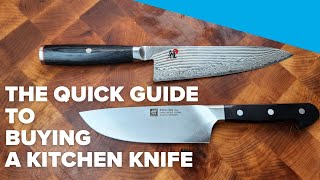
The tang is the portion of the blade steel that extends into the handle. A full tang runs the full length and width of the handle and is visible as steel between the two handle scales. Full tang construction is stronger, more balanced, and the industry standard for quality knives. Partial tang knives have the steel stopping partway into the handle, making them lighter but more prone to breaking under stress. Rat-tail tang knives have a narrow rod of steel inside the handle rather than the full blade profile. For a knife set you expect to use heavily over years, full tang is the right requirement. Check the heel of each knife before purchasing — you can see the tang steel between the handle pieces.
Handle Material and Ergonomics
Handle materials fall into three categories: synthetic (G10, Fibrox, polypropylene), wood composite, and natural wood. Synthetic handles are dishwasher-safe, non-porous, and often textured for grip when wet — ideal for busy kitchens. Natural wood handles look premium but require hand washing and dry storage to avoid cracking and bacteria harboring. G10 is a glass-fiber composite that is extremely durable and the preferred handle material for professional and hunting knives. Ergonomics matter more than material. Hold a knife (or at minimum watch video reviews of the handle shape) before committing to a set. Western-style handles tend to be wider and work well for larger hands. Japanese-style octagonal or D-shaped handles are thinner and suit smaller hands or cooks who prefer a lighter grip. See our best knives for cutting meat and best knives for vegetables for specific handle comparisons.
Block vs. Magnetic Strip vs. In-Drawer Storage

Knife blocks are convenient and keep blades covered, but many block slots are sized for the manufacturer's specific knives, limiting flexibility if you add knives from other brands later. Universal blocks with horizontal slots accommodate any blade width. Magnetic strips are space-efficient, allow air drying after washing, and let you see all knives at once — but require wall mounting. In-drawer knife trays protect blades during storage and keep knives accessible without countertop space. The block or storage included in a set is rarely a reason to buy or avoid it, but if you plan to expand your knife collection beyond the set, choose a storage system that accommodates a range of blade widths. A quality knife sharpener extends blade life significantly regardless of which storage you choose. Also consider a dedicated bread knife if the set does not include a quality serrated blade.
At a Glance
| # | Product | Award | Price |
|---|
How We Analyze Products
We analyze Amazon review data — often thousands of reviews per product — to surface patterns that individual buyers miss. Our process aggregates star ratings, review counts, and buyer sentiment at scale, identifying which strengths and weaknesses appear consistently across the largest review samples available.
Each product earned its placement through data: total review volume, average rating, and the specific praise and complaints that repeat most often across buyers. No manufacturer paid for placement on this page. Products appear here because buyers endorsed them at scale, not because a company asked us to feature them.
We use AI to summarize review sentiment — not to fabricate opinions, but to condense what thousands of buyers actually wrote into a readable format. The pros and cons you see reflect the most common themes found in verified purchaser reviews, paraphrased for clarity. We do not claim to have accessed Reddit, YouTube, or specific publications in generating these summaries.
Prices shown reflect Amazon pricing at the time this page was last generated. Click “See Today’s Price” to get the current live price on Amazon. Read our full methodology →