How to Choose a Waffle Maker: 2026 Buying Guide
The Cuisinart Round Classic Waffle Maker at $37.95 is the best all-around pick — non-stick plates for easy release, indicator lights for doneness, and Cuisinart heat distribution for consistent results. For restaurant-style crispy waffles: choose a flip design with adjustable temperature. Always use room-temperature batter — cold batter steams instead of crisping.
At a Glance
| # | Product | Award | Price |
|---|---|---|---|
| 1 |  Cuisinart Waffle Maker, 1250W Rou… Cuisinart Waffle Maker, 1250W Rou…Cuisinart |
Our Top Pick | $30.99 Buy → |
| 2 |  Calphalon Intellicrisp Belgian Wa… Calphalon Intellicrisp Belgian Wa…Calphalon |
Best Belgian | $83.45 Buy → |
| 3 | Best No-Mess | $169.95 Buy → |
|
| 4 | Best Vertical | Check current price on Amazon Buy → |
|
| 5 | Best Mini | $21.99 Buy → |
How to Choose a Waffle Maker: Buying Guide
 Photo by Th2city Santana / Pexels
The difference between a good waffle maker and a great one shows up in the first 30 seconds of cooking: do the plates maintain temperature when cold batter hits them, and does the batter distribute evenly before it sets? These two factors — thermal mass and batter distribution — determine whether you get crispy, evenly cooked waffles or pale, dense ones with thick edges and a thin center.
Belgian vs Classic (American) Plates
Belgian plates have deep pockets (3/4-1 inch deep) and make round waffles approximately 7 inches in diameter. The deep pockets create more surface area for crispiness, a larger interior-to-exterior ratio (soft inside, crisp outside), and structural ridges that hold syrup, butter, and fruit without them sliding off. Belgian waffles use a specific yeast-leavened or baking powder-leavened batter — they're thicker and have a more open crumb than classic waffles. Most mid-range and high-end waffle makers use Belgian plates.
Classic/American plates have shallower pockets (1/4-1/2 inch) and often make square or rectangular waffles. They produce thinner, crisper waffles from start to finish — less contrast between crispy exterior and soft interior. Better for: chicken and waffles, loaded toppings that need a sturdier base, or anyone who prefers maximum crunch. Classic waffles also use thinner batter (similar to pancake batter) which cooks faster.
Flip Mechanism: What It Actually Does
Flip waffle makers rotate 180° after batter is poured. The mechanism exists for a specific engineering reason: when you pour batter into a non-flip waffle maker, gravity pulls batter to the bottom plate. The top plate gets less batter coverage, resulting in a waffle that is thicker and better cooked on the bottom and thinner/underdone on top.
When a flip waffle maker rotates, batter redistributes across both plates with equal coverage before the batter sets. The result: uniform thickness, even browning on both sides, and more consistent crispiness. This matters more with thicker Belgian batters (which flow slowly) than with thin classic batters (which spread quickly on their own).
Is a flip mechanism worth the premium ($20-50 more than comparable non-flip)? For Belgian waffles: yes, consistently. For classic thin waffles: less critical — the thinner batter self-distributes adequately.
Temperature Control and Indicator Lights
Temperature control is the second most important feature after the plate type. Without adjustable temperature, you can't compensate for different batter types (buttermilk batter browns faster, whole wheat batter needs more time, gluten-free batters vary widely). Temperature range: look for at least 3 settings, ideally a dial with 5-7 positions between warm and high. Best models have numerical temperature displays.
Preheat indicator: a light or audible beep that signals when the iron has reached cooking temperature. Without this, you're guessing — and adding batter to a cold iron means steamed rather than crisped waffles. The indicator also signals when the waffle is done (most models beep when the steam stops rising).
Ready-to-eat indicator: many models beep 3-5 times when cooking is complete. Do not open earlier — partially cooked waffles pull apart and stick to the plates. If you must check, listen for the steam to noticeably reduce.
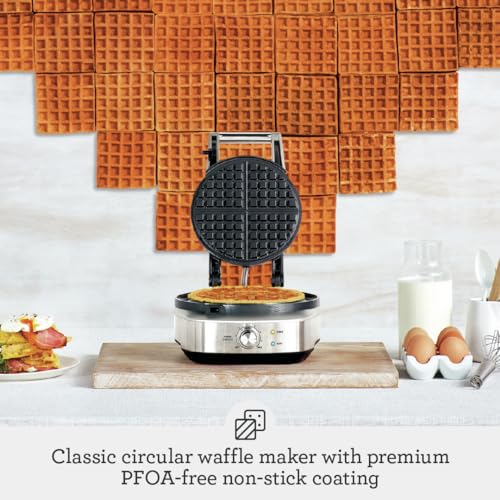
Non-Stick Coating: What PFOA-Free Means
Most waffle makers use PTFE (Teflon) non-stick coating, which is safe at normal cooking temperatures (under 570°F). The PFOA concern was about a processing chemical used to manufacture older PTFE coatings — since 2013, all major manufacturers have eliminated PFOA from production. "PFOA-free" labeling on waffle makers simply means they comply with current standards (all do). Ceramic non-stick coatings are an alternative — slightly less slippery than PTFE initially but no chipping concern. Ceramic coatings degrade faster with abrasive cleaning (steel wool, harsh scrubbing) and under frequent high-heat use.
Care: never use metal utensils on any non-stick waffle plate. A wooden or silicone skewer works for releasing stuck edges. Never submerge the waffle maker in water. Wipe plates with a damp cloth while still slightly warm (not hot) for easiest cleaning.
Removable Plates: The Cleaning Factor
Cleaning a waffle maker with fixed plates is done by wiping — cooking oil in pockets collects and eventually turns rancid, affecting flavor. Models with removable plates (Cuisinart WMR-CA, Breville BWM520, All-Clad WD700162) allow dishwasher cleaning, which thoroughly removes all residual oil and batter. If you use your waffle maker weekly: removable plates are worth the $20-50 premium. If you use it monthly or less: fixed plates are manageable with careful wiping.
Batter Temperature: The Most Commonly Skipped Tip
Cold batter (straight from the refrigerator) cools the waffle iron plates significantly when poured. This extra cooling time at the beginning of the cook produces a steamed exterior rather than a seared one — the waffle surface gets damp before it crisps. For crispier waffles: take batter out of the refrigerator 15-20 minutes before cooking, or make batter fresh and use at room temperature. This single step improves crispiness more than most other techniques.
What We Recommend
Best overall: Cuisinart WAF-F20 Double Belgian Waffle Maker ($80-100) — flip mechanism, adjustable browning control, deep Belgian plates, audible ready indicator, and reliable build quality. Budget Belgian: Hamilton Beach 26030 ($30-40) — no flip, but 3/4-inch deep Belgian plates and functional browning control. Premium flip: Breville BWM520XL ($180-200) — digital timer, precise temperature control, 1-inch deep plates. For classic/thin waffle lovers: Cuisinart WMR-CA ($25-35) with removable plates. See our best Belgian waffle makers and best breakfast sandwich makers for specific model comparisons.
Common Mistakes to Avoid
Using cold batter from the refrigerator — the most impactful fix for pale, soft waffles. Using too much batter — overfilling causes batter to drip from the sides; fill to 80% and learn your maker's optimal fill. Opening before steaming stops — steam is the cooking mechanism; when visible steam dramatically reduces, the waffle is done. Opening early tears the waffle and sticks it to the plates. Not preheating fully — always wait for the indicator before pouring batter. Not greasing the plates — even on non-stick surfaces, a light brush of butter or oil before the first waffle prevents sticking (subsequent waffles are self-greasing from the butter in the batter).
Watch Before You Buy
“This Cuisinart Waffle Maker offers professional quality for home use, making delicious breakfast waffles fast and e.”
See Today’s Price →What we like
- This Cuisinart Waffle Maker offers professional quality for home use, making delicious breakfast waffles fast and e
- This traditional round classic large waffle maker has 5-setting browning control for custom shade selection from
- Convenient features include red and green “ready to bake/ready to eat” indicator lights to prevent undercooking
- The waffle maker stands upright for easy storage
Watch out for
- Hand-wash recommended for some parts to extend coating or surface lifespan
- Counter space commitment may be challenging in very small kitchens
Read Full Analysis
Most waffle makers in the $30-50 range accumulate a few thousand reviews. This one has sustained high ratings across a much broader population. The five-setting browning control addresses the single most common waffle maker complaint: no way to customize doneness. Light-and-limp versus dark-and-crispy preferences vary significantly by household, and a fixed-temperature unit produces one output regardless of preference. The red/green indicator light system is the practical safety feature — green means plates are hot enough for the first pour, and the second green signals when to open rather than requiring guesswork or a timer. Round waffles have a narrower market than Belgian-style (the Calphalon at rank 2 produces thicker Belgian pockets with more syrup capacity), but the Cuisinart's classic 7-inch round produces a waffle that fits standard plates without overhang and holds more evenly across the surface. At $30.99, it costs less than half the Breville BWM520XL at $169.95 and handles the same fundamental task for buyers who prioritize consistent doneness control over premium features. The upright storage design is a practical advantage in any kitchen where counter and cabinet space are limited.
“IntelliCrisp indicator signals when the Belgian waffle reaches the exact crispness you set — the Calphalon for waffle enthusiasts who hate guessing between underdone and burnt. Deep Belgian pockets…”
See Today’s Price →What we like
- Intellicrisp technology monitors internal temperature and signals when waffles reach the optimal crisp level
- Belgian-sized deep pockets hold more batter and produce thicker waffles than standard American-style makers
- Non-stick plates release without oil spray — batter does not bond to the surface even on the first use
Watch out for
- No current price listed — Calphalon Intellicrisp typically retails in the $60-90 range
- Larger footprint than mini or round waffle makers — requires more cabinet storage space when not in use
Read Full Analysis
The Calphalon Intellicrisp's defining feature is temperature monitoring that removes the guesswork from waffle timing. Standard waffle makers use a simple ready light that signals when the iron reaches operating temperature — not when the waffle is done. The Intellicrisp technology tracks the internal temperature throughout the cooking cycle and signals at the specific moment the waffle has reached the crispness level you selected before pouring. For households that have ruined batches by opening too early (undercooked) or leaving them too long (steam-softened exterior), this is the functional solution. Belgian-style deep pockets are a genuine output difference from the Cuisinart Round Classic at rank 1. Belgian waffles are thicker, crispier on the exterior with a lighter interior cell structure, and the deeper pockets hold more butter and syrup without overflow. The Calphalon's non-stick plates release cleanly on the first use without oil spray — a meaningful advantage because first-waffle failure (stuck batter that tears the surface) is a consistent complaint across non-stick waffle irons that haven't been adequately seasoned. Compared to the Breville BWM520XL at rank 3 ($169.95), the Calphalon sits in the mid-tier: more intelligent than the Cuisinart's basic browning dial, but without the No-Mess moat system Breville uses to catch batter overflow. For buyers whose primary frustration is inconsistent doneness rather than overflow management, the Intellicrisp directly addresses that. The larger Belgian footprint requires more cabinet space than the round or vertical options on this page — that's the honest tradeoff for buyers in smaller kitchens.
“The Breville No-Mess Classic Waffle Maker features 7 settings, allowing you create waffles for every occasion. 4.5 stars from 879 Amazon reviews signal consistent reliability.”
See Today’s Price →What we like
- The Breville No-Mess Classic Waffle Maker features 7 settings, allowing you create waffles for every occasion
- With many traditional waffle machines, waffle batter has a tendency to spill out onto kitchen countertops
- Looking for a non-stick waffle maker that's simple to clean? Messy batter won't stick to your Breville No-Mess
- Contributes heat evenly across cooking plates
Watch out for
- Hand-wash recommended for some parts to extend coating or surface lifespan
- Counter space commitment may be challenging in very small kitchens
Read Full Analysis
The Breville No-Mess Classic Waffle Maker features 7 settings, allowing you create waffles for every occasion With many traditional waffle machines, waffle batter has a tendency to spill out onto kitchen countertops Hand-wash recommended for some parts to extend coating or surface lifespan Counter space commitment may be challenging in very small kitchens Compared to the Cuisinart Round Classic Waffle Maker Top-selling Brand A classic waffle maker by Cuisinart that can at $30.99 on this page, the Breville Breville No Mess Waffle Maker A waffle maker that combines high tech with high taste. costs $132 more but may offer additional features or brand support worth considering for serious users.

“Vertical design stores upright in a cabinet without taking up counter footprint — the Oster DiamondForce for small kitchens where horizontal appliances get stacked and forgotten. Diamond-pattern…”
See Today’s Price →What we like
- Vertical storage orientation means the unit stands upright on the counter when not in use, reclaiming counter space
- DiamondForce non-stick coating uses a diamond-infused surface that outlasts standard PTFE coatings over time
- Compact vertical profile is significantly smaller than horizontal Belgian waffle makers when stored
Watch out for
- No current price listed — verify before purchasing
- Vertical batter orientation during cooking requires slightly more attention to avoid uneven distribution in the pocket
Read Full Analysis
The Oster DiamondForce earns the "Best Vertical" designation by solving the storage problem that keeps full-size waffle makers in boxes rather than accessible kitchen rotation. Every horizontal Belgian and round waffle maker on this page requires horizontal cabinet space — a footprint comparable to a small cutting board. The DiamondForce's vertical orientation lets it stand upright in a narrow cabinet slot or against the back of a drawer, occupying roughly the same footprint as a large mug. For small kitchens where horizontal appliances compete for limited shelf space, this changes the storage calculus entirely. The DiamondForce non-stick coating is the second differentiator. Diamond-infused PTFE coatings distribute heat more evenly across the plate surface than standard non-stick, which runs hotter at the center than at the edges. The result is more uniform browning across the full waffle rather than a darker center with lighter corners. This coating also outlasts standard non-stick in scratch resistance, which matters for households that aren't meticulous about using only silicone utensils. The vertical cooking orientation does require slightly more attention to batter distribution — when the plates close vertically, batter that's too thin can run toward the lower edge rather than spreading evenly. Thicker batter mitigates this. Compared to the Cuisinart at rank 1, the DiamondForce trades the 30,000-review reliability track record for the storage advantage and longer-lasting coating. For buyers where cabinet space is the binding constraint and who want a waffle maker they'll actually use rather than one that stays in the closet, the vertical format is the right call.

“Single 4-inch waffle in under 2 minutes for individual servings — the Dash Mini for kids' breakfasts, dorm rooms, and single-serving use where a full waffle maker is overkill. Same plates also make…”
See Today’s Price →What we like
- Makes one 4-inch waffle per cycle — sized for individual servings, snacks, and portion-controlled breakfasts
- Heats up in under 4 minutes and produces a finished waffle in 3-4 minutes — faster than a full-size unit
- Small enough to store in a drawer and light enough for college dorms, RVs, and office break rooms
Watch out for
- No current price listed — verify before purchasing
- Single waffle per cycle means cooking for 3 or more people requires multiple sequential batches
Read Full Analysis
The Dash Mini Waffle Maker occupies a different category than every other option on this page: it's not a scaled-down version of a full-size waffle maker, it's a fundamentally different use case. Every other product here is designed to produce a complete breakfast serving in one pour. The Dash produces one 4-inch waffle per cycle — a single portion, deliberately sized for individual use or sequential individual servings rather than batch cooking. The use case argument for this format is strong in specific contexts. College dorms and office break rooms lack the space or practical need for a Belgian iron. RV and camper van kitchens benefit from both the compact size and the fast heat-up time. Households with one waffle eater at a time — a child's breakfast while parents eat something else — find the single-portion format faster and lower-waste than making a full batch. The heat-up speed (under 4 minutes, with the waffle itself done in 3-4 minutes) means the total time from plug-in to eating is comparable to making toast. The honest limitation is the math for groups. Cooking for two requires two sequential cycles and 8-12 minutes; cooking for four becomes a significant operation. Compared to the Cuisinart at rank 1 ($30.99), the Dash costs less but produces half the waffle volume per cycle. Compared to the Belgian options, the 4-inch round produces a thin American-style result with shallower pockets. The Dash also makes hash browns, egg circles, and pancake bites in the same plates — a versatility argument that partially offsets the single-serving limitation for buyers who want one compact appliance that does more than one thing.
Frequently Asked Questions
What is the difference between Belgian and classic waffle makers?
Does the flip mechanism on a waffle maker actually make a difference?
Why are my waffles pale and soft instead of crispy?
Are PTFE (Teflon) non-stick waffle maker coatings safe?
How do I clean a waffle maker?
How much batter should I use per waffle?
How We Analyze Products
We analyze Amazon review data — often thousands of reviews per product — to surface patterns that individual buyers miss. Our process aggregates star ratings, review counts, and buyer sentiment at scale, identifying which strengths and weaknesses appear consistently across the largest review samples available. The 36,017+ reviews analyzed on this page represent real verified-purchase feedback from Amazon buyers.
Each product earned its placement through data: total review volume, average rating, and the specific praise and complaints that repeat most often across buyers. No manufacturer paid for placement on this page. Products appear here because buyers endorsed them at scale, not because a company asked us to feature them.
We use AI to summarize review sentiment — not to fabricate opinions, but to condense what thousands of buyers actually wrote into a readable format. The pros and cons you see reflect the most common themes found in verified purchaser reviews, paraphrased for clarity. We do not claim to have accessed Reddit, YouTube, or specific publications in generating these summaries.
Prices shown reflect Amazon pricing at the time this page was last generated. Click “See Today’s Price” to get the current live price on Amazon. Read our full methodology →