How to Choose a Wine Cooler: Size, Temperature Zones, and Placement Guide (2026)
The Kalamera Dual-Zone Wine Cooler is the top pick for collectors who store both reds and whites — separate temperature zones (55°F reds, 45°F whites) prevent the compromise a single-zone unit forces. Compressor models work in any room temperature; thermoelectric fails when ambient exceeds 80°F.
At a Glance
| # | Product | Award | Price |
|---|---|---|---|
| 1 | Our Top Pick | $599.99 Buy → |
|
| 2 | Best Built-In | $463 Buy → |
|
| 3 |  Koolatron 6 Bottle Wine Fridge – … Koolatron 6 Bottle Wine Fridge – …Koolatron |
Best Compact | $197.73 Buy → |
| 4 | Best Tabletop | Check current price on Amazon Buy → |
How to Choose a Wine Cooler Buying Guide
 Photo by Nguyen Hong Quan / Pexels
Wine storage has one critical variable: temperature. Wine ages poorly above 70°F (oxidizes, cooks), and whites are unpleasant served at room temperature. A wine cooler solves this. The wrong one — especially a thermoelectric unit placed in a warm room — fails at the one job it was bought for.
The Temperature Rules for Wine
Understanding wine temperature requirements tells you exactly what cooler you need:
Long-term storage / aging (all wines): 55°F is the universal cellar temperature. Minimizes aging, preserves flavor compounds, works for reds and whites equally.
Serving temperature for reds: 60–68°F. "Room temperature" was coined when European rooms were 65°F, not modern 70–72°F climate-controlled interiors. Most reds are served too warm in American homes. Ideal: pull from the 55°F cooler 30 minutes before serving.
Serving temperature for whites and rosé: 45–55°F. Refrigerator temperature (38°F) is too cold — it mutes aromas. A dedicated wine cooler set to 50°F is better than your kitchen refrigerator for white wine.
Sparkling wine / Champagne: 40–50°F. The coldest of the serving temperatures. Most kitchen refrigerators work fine for short-term sparkling storage before serving.
Practical implication: If you drink mostly whites or mostly reds, a single-zone unit at 50–55°F handles both. If you store both types simultaneously for extended periods (weeks to months), a dual-zone unit lets you hold whites at 45°F and reds at 55°F simultaneously.
Thermoelectric vs Compressor: The Critical Difference
Thermoelectric wine coolers use the Peltier effect — electricity flows through a junction of two materials, creating a temperature differential. No moving parts, nearly silent, no vibration (vibration degrades wine over time).
The limitation: thermoelectric units can cool 15–20°F below ambient temperature. In a 70°F room they reach 50–55°F — adequate. In an 80°F summer kitchen they barely reach 60–65°F — not cold enough. If you live somewhere with hot summers or keep your kitchen warm, thermoelectric is unreliable.
Best for: Temperature-controlled rooms (year-round AC under 72°F), occasional wine storage, smaller collections.
Compressor wine coolers work like a mini-refrigerator — same technology as your kitchen fridge. Can cool to any temperature regardless of ambient. More powerful, more consistent, but produce slight vibration (not harmful for collections stored under 6 months) and make some noise. Use more energy than thermoelectric for the same capacity.
Best for: Garage placement, warm climates, serious collections, dual-zone requirements, bottles stored long-term.
Price difference: Thermoelectric 15-bottle: $70–$120. Compressor 15-bottle: $100–$150. The premium for compressor is modest at smaller sizes and worth it for reliability.


Bottle Capacity and Sizing
Wine cooler capacities are notoriously optimistic — they're measured with standard Bordeaux-shaped bottles in perfect alignment. Real-world capacity is 15–25% lower once you account for bottle shape variation and the desire to not Tetris every bottle in.
6–12 bottle: Countertop units ($60–$100). Fits under kitchen counter. Good for people who cycle through 1–2 cases per month and don't store long-term. Thermoelectric only at this size.
18–24 bottle: The most popular size ($100–$250). Fits in most kitchen spaces. Handles an active wine collection for a couple who drinks weekly.
30–50 bottle: Mid-range collector units ($653.68–$400). Typically compressor. Requires dedicated kitchen or living room space — 24 inches wide, 34 inches tall as a freestanding unit.
50+ bottle: Semi-serious collector territory ($400–$1,500). Built-in models (designed for under-counter installation) are common in this range. Requires proper ventilation clearance — check manufacturer specs, typically 2–3 inches on sides and rear.
Built-in vs freestanding: Built-in units have front-venting and can be installed flush under a counter. Freestanding units vent from the sides or rear and need clearance — don't install freestanding units flush with surrounding cabinetry or they'll overheat.
Single Zone vs Dual Zone
Single-zone units maintain one temperature throughout. Dual-zone units have two independently controlled compartments — typically upper and lower — each at a different temperature.
Single zone is sufficient for 90% of buyers: Set to 55°F and it stores and serves both reds (pull out 30 min before serving to warm slightly) and whites (chill further in kitchen fridge for 30 min before serving if you want it colder). The "I need perfect serving temperature on demand" problem is solved by a 30-minute adjustment period, not dual zones.
Dual zone is worth it if: You frequently serve wine immediately from the cooler without any adjustment period, maintain a serious collection of both reds and whites, or entertain regularly where optimal serving temperature matters to your guests.
Dual zone price premium: $50–$150 more than equivalent single-zone. The Kalamera 24-bottle dual-zone ($599.99) and NewAir 46-bottle dual-zone ($599.99) are the best value dual-zone options.

What We Recommend
Casual collector (under 24 bottles, temperature-controlled room): NutriChef 18-bottle thermoelectric ($90–$110) or Ivation 18-bottle ($100). Regular entertainer or warm climate: NewAir 23-bottle compressor ($150–$180) — reliable year-round without ambient temperature limitations. Dual-zone need: Kalamera 24-bottle dual-zone ($180–$220). Serious collection (40+ bottles): Wine Enthusiast Classic 46-bottle compressor ($300–$400). Pair with the right wine opener and wine accessories for the full setup. For general kitchen appliance comparisons, see best kitchen gadgets under $25.
Watch Before You Buy
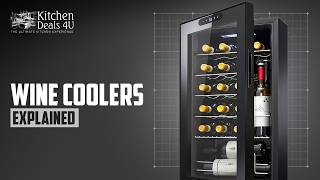
“Dual temperature zones maintain separate settings for reds (55-65°F) and whites (40-50°F) simultaneously — the Kalamera for wine households that store both varietals together. Built-in capable with…”
See Today’s Price →What we like
- Dual-zone cooling stores reds and whites simultaneously at their respective ideal temperatures
- Built-in design fits flush under kitchen counters for permanent installation without appliance footprint
- Touch control display with blue LED lighting provides precise temperature adjustments and monitoring
Watch out for
- Built-in installation requires accurate cabinet measurement and ventilation clearance planning
- Compressor dual-zone units generate more noise than thermoelectric single-zone alternatives
Read Full Analysis
The Kalamera Dual Zone Built-In is the right pick for households that regularly stock both red and white wine — the two independent temperature zones let you maintain reds at 55-65°F and whites at 40-50°F simultaneously without compromise. A single-zone unit forces you to pick one temperature, which means either your whites are slightly warm or your reds are slightly overcooled. The built-in front-ventilation design mounts flush under standard kitchen counters, eliminating the countertop footprint that freestanding coolers require and integrating cleanly with existing cabinetry. The compressor-driven cooling system delivers reliable performance across ambient temperature variation — more consistent than thermoelectric units when kitchen temperatures fluctuate. The trade-off is noise: compressor units generate an audible hum that thermoelectric units avoid. The touch display and blue LED lighting are functional rather than luxury features, providing precise readout and visibility without opening the door. Price is currently unavailable — check the current listing. Compare against the EdgeStar 6-inch option for smaller spaces; the Kalamera suits larger capacity needs with both temperature zones.
“”
See Today’s Price →What we like
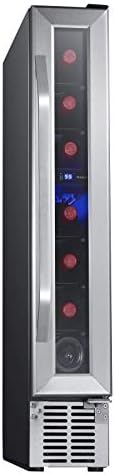
- 6-inch slim profile is the narrowest under-counter wine cooler available — fits gaps standard coolers cannot
- 7-bottle capacity suits casual wine drinkers keeping a small rotating selection at optimal temperature
- Built-in design integrates flush with cabinetry for a cleaner look than freestanding countertop units
Watch out for
- 7-bottle capacity is insufficient for households that entertain frequently or purchase by the case
- 6-inch width limits door swing clearance — check adjacent cabinet handles before installing
Read Full Analysis
The EdgeStar 6-inch model occupies a niche that no other wine cooler on this list fills: a 6-inch-wide profile designed specifically for the cabinet gaps and appliance alcoves that standard 12-15 inch coolers cannot fit. Installation in tight kitchen layouts — beside a dishwasher, under a peninsula, or in a bar cabinet with fixed spacing — is frequently where this unit becomes the only viable built-in option. The 7-bottle capacity is the natural constraint of a 6-inch design; it suits a household that keeps a small rotating selection at serving temperature rather than aging or storing a full case. The front-ventilation built-in design integrates flush with surrounding cabinetry for a cleaner installation than freestanding countertop alternatives. The critical measurement before purchasing is door swing clearance: a 6-inch-wide door with adjacent cabinet handles or drawer pulls can create interference that wider units avoid by opening further from the obstruction. For households with 8-15 bottle storage needs and a standard cabinet gap, the Colzer 15-inch option on this page offers more capacity within built-in constraints. The EdgeStar's value is spatial specificity — the narrowest built-in on the market.
“Thermoelectric 6-bottle cooler at $197.73 for apartment wine drinkers who want actively-drinking bottles at serving temperature without a full wine fridge — the Koolatron for countertop chilling.…”
See Today’s Price →What we like
- Thermoelectric cooling is virtually silent — no compressor vibration that could disturb wine sediment
- 6-bottle countertop format offers the smallest footprint wine cooler for apartments and small kitchens
- Low energy consumption makes daily operating cost negligible compared to compressor-based coolers
Watch out for
- Thermoelectric cooling is less effective in hot rooms — struggles to hold temperature in ambient heat above 80F
- 6-bottle limit serves only casual occasional wine drinkers — too small for any collection use case
Read Full Analysis
The Koolatron fills a specific role that the built-in options on this page cannot: a countertop thermoelectric cooler at $197.73 that apartment dwellers and renters can install without cabinetry modification. Thermoelectric cooling generates no compressor noise or vibration — the unit operates silently, and the absence of mechanical vibration is genuinely beneficial for wine because sustained vibration can disturb sediment in aged bottles. Energy draw is minimal compared to compressor alternatives. The critical limitation is ambient temperature sensitivity. Thermoelectric units maintain wine roughly 20-25°F below room temperature rather than a fixed absolute target — in a kitchen running 78-80°F in summer, the Koolatron may not get whites cold enough for serving. In climate-controlled spaces that stay at 70°F or below, performance is reliable. For casual wine drinkers keeping 2-4 bottles at serving temperature in an air-conditioned apartment, the Koolatron at $197.73 is the most accessible entry on this page. For actual wine preservation or year-round reliability across seasonal temperature variation, step up to a compressor-based option.

“Insulated stainless steel wine bucket at $19.99 that keeps an already-chilled bottle cold for 1-2 hours at the table — the Oggi for dinner parties and restaurant-style serving without an electric…”
See Today’s Price →What we like
- Stainless steel exterior is fingerprint-resistant and matches modern kitchen appliance finishes
- Ice-based countertop cooler requires no electricity for tableside service at parties or gatherings
- Compact form works as both a kitchen cooler and a serving vessel at the dinner table
Watch out for
- Non-refrigerated design does not maintain temperature independently — requires ice refilling throughout use
- Tabletop format only — not a temperature-controlled storage solution for aging or cellaring wine
Read Full Analysis
The Oggi at $21.99 is a fundamentally different product from every other cooler on this page: it is an insulated stainless steel wine bucket designed for tableside service, not active refrigeration. There is no thermoelectric element, no compressor, no temperature control — you fill it with ice, insert a pre-chilled bottle, and the insulated walls keep it cold for 1-2 hours during a dinner party or gathering. For that specific use case — restaurant-style bottle presentation at the table — it does exactly what it needs to do. The stainless steel exterior is fingerprint-resistant and pairs cleanly with modern kitchen aesthetics, and the form factor doubles as a serving vessel and a kitchen countertop cooler for bottles already at temperature. Where it fails compared to everything else on this page is independence: without ice, there is no cooling. It cannot maintain wine temperature storage between servings, cannot chill a warm bottle, and cannot serve as a long-term storage solution. At $21.99 the Oggi is the right purchase for occasional entertaining; it is not a wine cooler in the storage sense, but a serving accessory that does its job well.
Frequently Asked Questions
What temperature should a wine cooler be set to?
Thermoelectric vs compressor wine cooler: which is better?
Can I put a freestanding wine cooler in a cabinet?
Is a wine cooler worth it?
How long can wine stay in a wine cooler?
What is the difference between a wine cooler and a mini fridge?
How We Analyze Products
We analyze Amazon review data — often thousands of reviews per product — to surface patterns that individual buyers miss. Our process aggregates star ratings, review counts, and buyer sentiment at scale, identifying which strengths and weaknesses appear consistently across the largest review samples available. The 2,418+ reviews analyzed on this page represent real verified-purchase feedback from Amazon buyers.
Each product earned its placement through data: total review volume, average rating, and the specific praise and complaints that repeat most often across buyers. No manufacturer paid for placement on this page. Products appear here because buyers endorsed them at scale, not because a company asked us to feature them.
We use AI to summarize review sentiment — not to fabricate opinions, but to condense what thousands of buyers actually wrote into a readable format. The pros and cons you see reflect the most common themes found in verified purchaser reviews, paraphrased for clarity. We do not claim to have accessed Reddit, YouTube, or specific publications in generating these summaries.
Prices shown reflect Amazon pricing at the time this page was last generated. Click “See Today’s Price” to get the current live price on Amazon. Read our full methodology →