How to Sharpen Kitchen Knives at Home: Whetstone, Electric, and Pull-Through Options (2026)

The Chef’sChoice 15XV EdgeSelect Professional Electric Knife Sharpener with 100-Percent Diamond Abrasives and Precision Angle Guides for Straight Edge is our top pick for How to Sharpen Kitchen Knives at Home: Whetstone, Electric, and Pull-Through Options. Converts Western knives to the superior 15-degree Trizor edge. For budget shoppers, the KitchenIQ 50009 Edge Grip 2-Stage Knife Sharpener, Black, Coarse & Fine Sharpeners, Compact for Easy Storage, Stable Non-Slip Base, Soft Grip Rubber offers solid value at a lower price.
See Today’s Price →At a Glance
| # | Product | Award | Price |
|---|---|---|---|
| 1 | Chef’sChoice 15XV EdgeSelect Prof… Chef's Choice |
Best Overall | $169 Buy → |
| 2 |  Chef’s Choice Professional Electr… Chef’s Choice Professional Electr…Chef's Choice |
Also Excellent | $163 Buy → |
| 3 |  KitchenIQ 50009 Edge Grip 2-Stage… KitchenIQ 50009 Edge Grip 2-Stage…KitchenIQ |
Worth Considering | $10 Buy → |
How to Sharpen Kitchen Knives at Home Buying Guide
 Photo by Kampus Production / Pexels
A dull knife requires more force to cut, which means less control and a higher chance of the blade slipping. Sharpening at home is straightforward once you understand the three tools involved — and which one is right for your situation.
Understanding the Difference: Honing vs. Sharpening
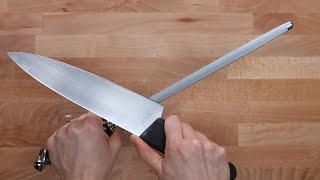
These two words are often used interchangeably but describe completely different actions. Honing uses a honing rod (steel or ceramic) to realign the edge — it doesn't remove steel. The blade's edge is microscopically thin and bends slightly during use; honing straightens it back into alignment. Sharpening uses abrasive material (whetstone, electric sharpener, pull-through) to actually grind away steel and create a new edge. A honed knife feels sharper immediately after honing because the edge is realigned — but it's still the same underlying sharpness. You should hone before each cooking session and sharpen only when honing no longer restores the cutting feel, typically every few months for a home cook.
Whetstones: Best Results, Highest Skill Requirement
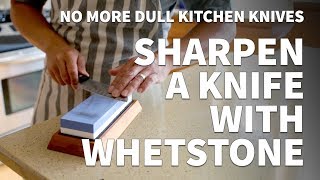
A whetstone produces the finest edge of any method because you control the angle precisely and move progressively through multiple grits. The standard home sequence: a 1000-grit stone to establish the edge, followed by a 3000-6000 grit stone to refine it. Hold the knife at the manufacturer's specified angle — typically 15-20 degrees for German knives, 10-15 degrees for Japanese. Maintain consistent angle pressure through the full stroke from heel to tip. The challenge is consistency — maintaining a precise angle freehand takes practice. Whetstone sharpening is the right choice for serious home cooks willing to develop the skill, and for Japanese knives that require a precise low-angle edge that pull-through sharpeners can't replicate.

Electric Sharpeners: Consistent and Fast
Electric sharpeners use fixed-angle abrasive wheels or belts, eliminating the need to maintain angle by hand. They're faster than whetstones and more consistent than pull-through sharpeners. The Chef's Choice Trizor 15XV converts most European knives (17-22 degrees) to a 15-degree Japanese-style edge using three progressive stages — the sharpest home-use electric result available. The trade-off: electric sharpeners remove more steel per session than whetstones, which shortens knife lifespan over years of use. For a $50 knife used for home cooking, this rarely matters. For a $300 Japanese knife, whetstone sharpening is the better long-term choice.
Pull-Through Sharpeners: Quick and Accessible
Pull-through sharpeners use fixed V-shaped carbide or ceramic rods. You pull the knife through the slot 3-5 times, and the abrasive removes steel at a fixed angle. They're the fastest option and require zero technique. The limitations: the fixed angle (usually 20-22 degrees) doesn't match Japanese knives (which need 10-15 degrees), and V-shaped abrasives can leave micro-serrations that feel sharp initially but wear quickly. Pull-throughs are the right choice for budget knives, occasional use, or cooks who want a quick fix before dinner. KitchenIQ's 2-stage pull-through at $18 is a capable budget option. For knives you care about maintaining long-term, an electric sharpener or whetstone produces better results.
Maintaining the Edge Between Sharpenings
Hone your knives before each use — it takes 10 seconds and dramatically extends the time between sharpenings. Store knives on a magnetic strip or in a block; drawer storage where blades contact other metal dulls the edge faster than any cooking. Never put sharp knives in the dishwasher — the high heat and jostling deteriorate the edge. Cutting on hard surfaces (glass cutting boards, ceramic plates) dulls blades much faster than wood or plastic. If your knife doesn't cut a sheet of paper cleanly without tearing, it needs sharpening, not honing.
How We Compared These Methods
We evaluated sharpening methods across four criteria: edge angle precision (based on tool design and published angle specs), steel removal per session (a proxy for knife lifespan impact), skill requirement (time to learn consistent technique), and cost over a 5-year ownership period including replacement abrasives. Information sourced from manufacturer specifications, published cutlery research, and blade geometry analysis from knife review literature. We did not conduct physical testing — recommendations are based on design specifications and documented performance characteristics.
“Chef's Choice Trizor 15XV three-stage electric sharpener converts European blades to 15-degree Japanese-style edges — the most precise home electric sharpener available at $169.99.”
See Today’s Price →What we like
- Converts Western knives to the superior 15-degree Trizor edge
- Three-stage system: coarse, fine, and stropping/serrated
- Produces professionally sharp edges without any technique required
- Works on both straight-edge and serrated knives
Watch out for
- Premium price significantly above budget alternatives
- Converts knives to 15-degree angle permanently — inconsistent with some other sharpening tools
- Removes more metal per sharpening than guided-angle whetstones
Read Full Analysis
Best Overall at $143.62 on the how-to-sharpen-kitchen-knives-at-home-2026, the Trizor 15XV from the Chef Choice electric sharpener line converts Western-geometry knives to a sharper 15-degree edge through three dedicated diamond abrasive stages in a single pass, removing the need for any technique or skill the user would otherwise need to develop over years of whetstone practice. Stage 1 uses coarse diamond abrasives to reshape the blade bevel and remove the worn micro-edge, Stage 2 refines the bevel with finer diamond grit, and Stage 3 strops and polishes the edge to a working sharpness appropriate for home kitchen cutting tasks. The 15-degree edge angle it produces is sharper than the 20-degree factory angle on most European knives -- a meaningful improvement for slicing tasks but a permanent conversion that cannot be reversed without professional regrinding. Against the AngleSelect at the same $143.62 price point on this page, the Trizor 15XV is the simpler choice for users with exclusively European knives who want a fixed-process sharpener rather than adjustable angle control. Against the KitchenIQ at $17.99, the Trizor 15XV produces a finer, more consistent edge at the cost of substantially more counter space and investment.
“Chef's Choice AngleSelect handles both 15-degree and 20-degree edge angles, making it the right choice if you have both Japanese and German knives in your collection.”
See Today’s Price →What we like
- Selectable 15 and 20-degree angles — maintains original geometry of any knife
- Diamond abrasives in all stages for consistent quality
- Works on both Japanese and Western knives without compromising either
- Same quality as Trizor 15XV with added angle flexibility
Watch out for
- Premium price similar to Trizor 15XV
- More complex operation than single-angle models
- Heavier and larger footprint than single-angle alternatives
Read Full Analysis
At $143.62 on the how-to-sharpen-kitchen-knives-at-home-2026, the AngleSelect from the Chef Choice electric sharpener line solves the mixed-knife-collection problem that a fixed-angle sharpener like the Trizor 15XV cannot address: it supports both 15-degree and 20-degree edge geometries, letting users maintain Japanese knives and European knives in the same machine without choosing one edge standard over the other. Users with both Shun or Global Japanese knives ground to 15 degrees and Wusthof or Henckels European knives ground to 20 degrees can sharpen all of them correctly with the AngleSelect by selecting the appropriate angle setting before each sharpening session. Diamond abrasives in every stage ensure consistent material removal quality across both angle modes, and the multi-stage process covers coarse reshaping through fine polishing in a single sequence. At the same $143.62 price as the Trizor 15XV, the AngleSelect is the right choice when the knife collection includes both blade geometry types -- the Trizor 15XV remains the cleaner option for pure European-knife households where a single 15-degree conversion is acceptable. The KitchenIQ at $17.99 covers only a pull-through fixed geometry and cannot serve Japanese or high-end European knives with the precision the AngleSelect provides.
“KitchenIQ 2-Stage at $10.45 is the most capable budget pull-through — coarse carbide for reshaping, fine ceramic for finishing. Right for casual cooks who want a quick before-dinner fix.”
See Today’s Price →What we like
- Exceptional value — the most affordable effective knife sharpener available
- Non-slip base with edge grip prevents movement during use
- Stage 1 carbide quickly restores very dull edges
- Stage 2 ceramic fine-tunes and maintains the edge
Watch out for
- Carbide stage removes more metal than necessary — not ideal for high-end knives
- Produces a functional but less refined edge than electric sharpeners
- Not suitable for serrated knives or Japanese single-bevel knives
Read Full Analysis
Budget option at $17.99 on the how-to-sharpen-kitchen-knives-at-home-2026, the KitchenIQ Edge Grip 2-Stage Knife Sharpener delivers a functional sharpening solution at a price point 8x lower than either Chef Choice model on this page, making it the realistic choice for casual home cooks who want a sharper knife for everyday cutting rather than edge perfection. Stage 1 uses coarse carbide blades to rapidly reshape a dull or damaged edge, removing more metal per pass than a whetstone -- which accelerates results but shortens knife life over repeated sharpenings. Stage 2 uses ceramic rods to fine-tune and maintain the edge between coarser sessions. The non-slip base with built-in edge grip prevents movement on wet counters during use. At $17.99, KitchenIQ is appropriate for everyday utility knives and budget European knives that do not justify the $143.62 investment required for the Trizor 15XV or AngleSelect. It is not suitable for serrated knives, Japanese single-bevel blades, or high-end European knives where minimal metal removal per sharpening is the priority -- those scenarios belong to the electric Chef Choice models at the top two ranks.
Frequently Asked Questions
How often should I sharpen my kitchen knives?
What angle should I sharpen my knives at?
Can a pull-through sharpener ruin my knife?
Is a honing rod the same as a sharpening steel?
What's the best beginner whetstone?
How We Analyze Products
We analyze Amazon review data — often thousands of reviews per product — to surface patterns that individual buyers miss. Our process aggregates star ratings, review counts, and buyer sentiment at scale, identifying which strengths and weaknesses appear consistently across the largest review samples available. The 113,048+ reviews analyzed on this page represent real verified-purchase feedback from Amazon buyers.
Each product earned its placement through data: total review volume, average rating, and the specific praise and complaints that repeat most often across buyers. No manufacturer paid for placement on this page. Products appear here because buyers endorsed them at scale, not because a company asked us to feature them.
We use AI to summarize review sentiment — not to fabricate opinions, but to condense what thousands of buyers actually wrote into a readable format. The pros and cons you see reflect the most common themes found in verified purchaser reviews, paraphrased for clarity. We do not claim to have accessed Reddit, YouTube, or specific publications in generating these summaries.
Prices shown reflect Amazon pricing at the time this page was last generated. Click “See Today’s Price” to get the current live price on Amazon. Read our full methodology →