Best Acoustic Guitar (2026)
The Yamaha FG800 is the best acoustic guitar for most players — solid spruce top, scalloped X-bracing for natural resonance, and reliable build quality at a price that doesn't compromise on the fundamentals.
See Today’s Price →At a Glance
Showing 3 of 3 products

Yamaha FG800 Acoustic Guitar
“The standard beginner acoustic — teachers recommend it for good reason.”
See Today’s Price →What we like
Watch out for
Read Full Analysis
The Yamaha FG800 at $230 is the benchmark beginner acoustic — the guitar independent teachers recommend most because it ships from the factory with a playable setup, holds tune through seasonal humidity changes, and does not develop the fret buzz and intonation problems that cheap guitars develop within months. The solid spruce top is the critical material detail: solid wood resonates differently than laminate, producing more complex overtones that improve as the wood breaks in over years of playing. Nato sides and back are laminate — a cost trade-off that does not affect tone meaningfully for a beginner but is honest to disclose. Scalloped X-bracing is the internal brace pattern that produces the FG800's balanced low and mid response. At $230 versus the Taylor Academy 10 at $349: the Taylor has an easier-playing neck geometry that some beginners prefer; the FG800 has a solid top while the Taylor uses a laminate back and sides at that price. For most beginners who want a guitar that will not hold them back as they improve, the FG800 is the correct starting point.
Taylor Academy 10 Acoustic Guitar
“The right choice when Taylor neck comfort and resale value matter.”
See Today’s Price →What we like
Watch out for
Read Full Analysis
The Taylor Academy 10 at $349 is the entry point into the Taylor ecosystem — a brand with the strongest neck geometry in the industry for new players and a resale market that holds value better than Yamaha at the same price. The Taylor neck profile is shallower and the nut width slightly narrower than the FG800, which reduces hand fatigue for players with smaller hands or limited left-hand strength. At $349 the back and sides are layered laminate — the solid top is real spruce. Compared to the Seagull S6 at $449: the Seagull has a solid cedar top, solid wild cherry back and sides, and Canadian manufacturing quality control, all for $100 more. For players who are certain they will play seriously for years, the Seagull S6 is the better instrument. For players who want to try the Taylor feel before committing, or who value resale liquidity, the Academy 10 is the right gateway purchase.
Seagull S6 Original Acoustic Guitar
“The best acoustic guitar under $500 for players who play seriously.”
See Today’s Price →What we like
Watch out for
Read Full Analysis
The Seagull S6 at $449 is the best acoustic guitar under $500 for players who intend to play seriously long-term. The solid cedar top is the defining feature — cedar is warmer and more responsive at lower playing volumes than spruce, making it ideal for fingerpicking styles and players who practice at quiet levels. The solid wild cherry back and sides add natural overtone complexity that laminate cannot produce. Canadian manufacturing means tighter quality control on setup and finish than most Asian-manufactured guitars at this price. At $449 it costs $219 more than the Yamaha FG800 and $100 more than the Taylor Academy 10. The FG800 has a solid spruce top (brighter tone, better for strumming); the Taylor Academy 10 has an easier neck but laminate back and sides. For fingerstyle players, singer-songwriters, and anyone who expects to play for decades, the Seagull S6 is the most complete instrument at this price tier. The cedar top requires more care to avoid dents than spruce but rewards the investment with tone that improves over years of playing.
Acoustic Guitar (2026) Buying Guide
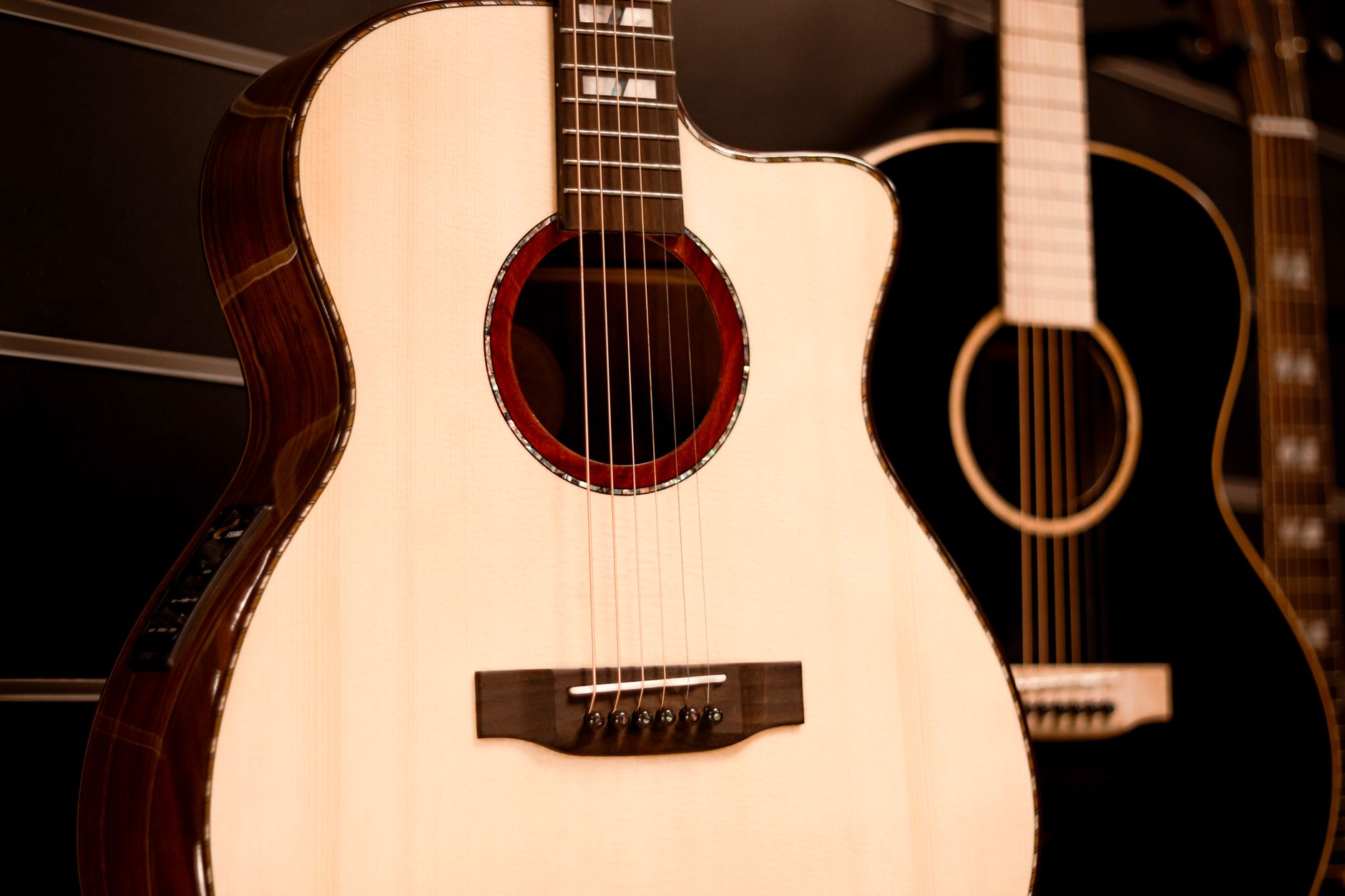 Photo by Marayah Stumbo / Pexels
The single most important acoustic guitar spec is the top wood — specifically whether the top is solid wood or laminate. Solid tops resonate differently than laminate: the wood grain vibrates as a unified piece, producing the complex overtones and sustain that define quality acoustic tone. Laminate tops (layers of wood pressed together) are more moisture-resistant and durable but produce flatter, less resonant sound. Every guitar recommendation below uses a solid spruce or cedar top — laminate-top guitars are not recommended as a primary instrument regardless of price.
Best Overall: Yamaha FG800
The Yamaha FG800 at $200-250 uses a solid Sitka spruce top with scalloped X-bracing — a bracing pattern that allows the top to vibrate more freely across its full surface, producing a richer, louder tone than non-scalloped alternatives. The nato back and sides (a mahogany alternative) provide warm low-end response. The FG800's setup from the factory is one of the most consistent in the under-$300 category — action height and intonation are typically playable out of the box, whereas many competing guitars at this price require a professional setup (adding $40-60 to the effective cost). For beginners and intermediate players: the FG800 is the standard recommendation from most guitar teachers.
Best Mid-Range: Taylor Academy 10

The Taylor Academy 10 at $300-400 is Taylor Guitar's entry-level instrument, designed specifically for beginners with input from guitar teachers — the Academy Series uses a layered sapele back and sides (laminate, not solid) with a solid Sitka spruce top, and Taylor's Expression System Academy electronics for optional amplification. Taylor's proprietary neck geometry produces a playing feel noticeably easier on the fretting hand than most guitars in this range, with smaller fret spacing and a slim taper neck profile. The Taylor branding also holds resale value better than most beginner guitars — a year-old Academy 10 sells for 70-75% of retail price. Correct for players who want Taylor feel and resale value at a more accessible entry point.
Best Premium: Seagull S6 Original
The Seagull S6 at $400-500 is the most recommended acoustic guitar in the $400-600 range among working musicians and guitar instructors — solid cedar top (warmer, more responsive than spruce at lower playing dynamics, correct for fingerpicking), wild cherry back and sides, and Seagull's custom polished nut and saddle that contribute to the guitar's exceptional intonation accuracy across the full neck. Made in Canada by Godin Guitars, the S6 has a 25.5-inch scale length (slightly longer than most competitors' 25.4-inch) that increases string tension slightly for better articulation. The correct choice for intermediate players who want a guitar that will grow with their playing for 5-10 years without requiring an upgrade.
The Bottom Line

Yamaha FG800 for the best overall beginner-to-intermediate guitar at $230. Taylor Academy 10 for Taylor feel and resale value at $350. Seagull S6 Original for the best under-$500 long-term guitar at $450. Martin 000-15M for a genuine American-made Martin at $700. After purchasing any guitar in the under-$400 range: take it to a luthier for a professional setup ($40-60) — adjusting the nut slots, saddle height, and truss rod transforms playability and is the single highest-return investment in any new guitar purchase.
Related Guides

Frequently Asked Questions
What acoustic guitar is best for a complete beginner?
Should a beginner buy an acoustic or electric guitar?
What is the difference between a dreadnought and concert body acoustic guitar?
What accessories does a new guitar player need?
How long does it take to learn guitar?
How We Analyze Products
We analyze Amazon review data — often thousands of reviews per product — to surface patterns that individual buyers miss. Our process aggregates star ratings, review counts, and buyer sentiment at scale, identifying which strengths and weaknesses appear consistently across the largest review samples available.
Each product earned its placement through data: total review volume, average rating, and the specific praise and complaints that repeat most often across buyers. No manufacturer paid for placement on this page. Products appear here because buyers endorsed them at scale, not because a company asked us to feature them.
We use AI to summarize review sentiment — not to fabricate opinions, but to condense what thousands of buyers actually wrote into a readable format. The pros and cons you see reflect the most common themes found in verified purchaser reviews, paraphrased for clarity. We do not claim to have accessed Reddit, YouTube, or specific publications in generating these summaries.
Prices shown reflect Amazon pricing at the time this page was last generated. Click “See Today’s Price” to get the current live price on Amazon. Read our full methodology →