Best Guitar Capos for Practice 2026

Shubb C1 Nickel Guitar Capo at $22.95 is the best for practice -- the roller-and-clamp mechanism lets you dial in exact tension per guitar and string gauge, and it holds tune better than any spring-loaded capo at this price.
See Today’s Price →At a Glance
Guitar Capos for Practice Buying Guide
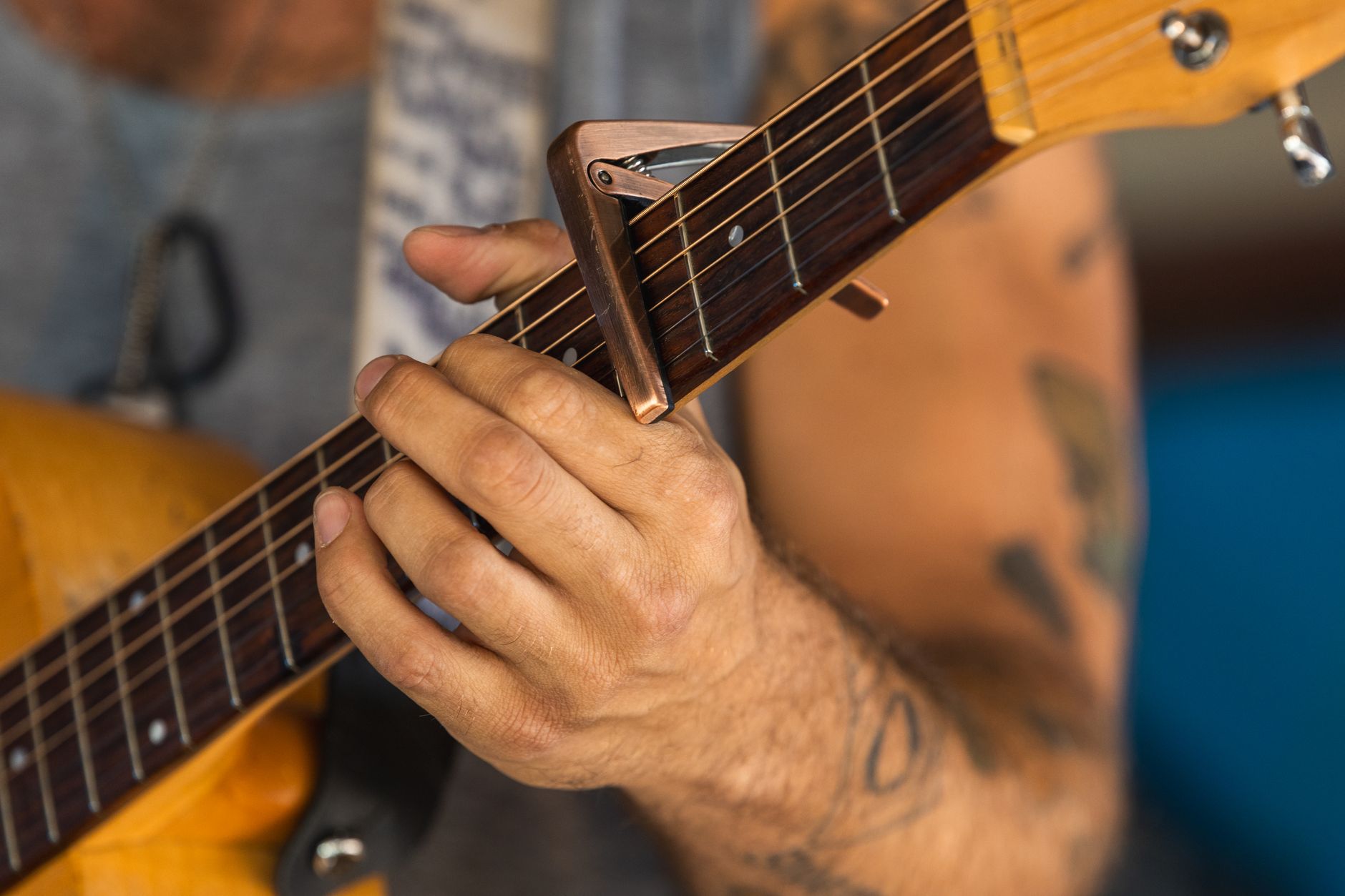 Photo by Stepan Vrany / Pexels
How we picked these. We compared practice capos across one-hand placement ease, stable spring tension at multiple fret positions, minimal buzz risk, and compact storage for a practice bag, cross-referencing picks from guitar instructors and verified player feedback. Products were selected for reliable quick-change performance during practice sessions.
A capo raises the guitar's pitch by clamping across all strings at a chosen fret, effectively creating a new nut position. For practice, the ideal capo goes on and off in one motion, does not detune the strings, and stays out of the way of chord fingering near the capo fret.
Spring-Loaded vs Screw-Tension Capos
Spring-loaded capos like the Kyser Quick-Change clip on and off instantly with one hand -- ideal for songs that require frequent capo changes. Screw-tension capos like the Shubb C1 require a small turn to tighten, but allow you to dial in the exact pressure needed for your specific guitar and string gauge, resulting in better intonation and less detuning. For regular practice on one or two guitars, screw-tension is worth the extra step.
Why Capos Cause Detuning
A capo that applies too much pressure pushes the strings sharp by fretting them too hard. Too little pressure causes buzzing or muffled strings. The ideal tension is the minimum required to produce clean, buzz-free notes across all strings. Adjustable-tension capos (Shubb, D'Addario NS Tri-Action) solve this by matching tension to your specific guitar -- acoustic guitars with high action need more pressure than electric guitars with low action.
Partial Capos for Advanced Practice
Partial capos cover only some strings, creating open-string drone effects and alternative tuning sounds without actually retuning. The Shubb Partial Capo and the Third Hand Capo are popular for fingerstyle and Celtic styles. If you practice alternate tuning techniques or open-string arrangements, a partial capo opens up new sonic territory without touching your tuning pegs.
Capo Placement: How Close to the Fret Wire?
Place the capo as close to the fret wire as possible without sitting on it -- typically within 2 to 3mm. Placing it in the middle of the fret space increases string deflection, causing sharping. The Kyser Quick-Change design makes it harder to place precisely; the Shubb and G7th designs make exact placement easier due to their narrower profiles.

Capo Compatibility: 6-String vs 12-String vs Classical
Standard capos (Shubb C1, Kyser KG6B) fit standard 6-string steel-string acoustic and electric guitars. Classical guitars have wider, flatter fretboards that require a specific classical capo. 12-string guitars require a wider capo designed for their extended nut width. Always check fretboard width compatibility before purchasing.
Watch Before You Buy
“The Shubb C1's screw-roller mechanism lets you dial in precise tension for perfect intonation — critical during practice sessions where you're repeatedly changing fret positions. After a one-time…”
See Today’s Price →What we like
- Screw adjustment allows precise tension control for perfect intonation
- Roller mechanism means one-handed operation after initial setup
- Neoprene pad is gentle on frets and neck finish
- Available for virtually every guitar type imaginable
- Set-it-and-forget-it tension stays consistent for years
Watch out for
- Initial tension setup requires two hands and some experimentation
- Slightly more bulk than a spring capo
Read Full Analysis
The Shubb C1 earns rank 1 on this practice capo page for the reason practicing guitarists choose it specifically over spring-action alternatives: adjustable tension. Fixed-spring capos apply the same force to every guitar and string gauge, which frequently results in slight sharpening — particularly noticeable during practice sessions where intonation is a focus. The Shubb's screw-roller mechanism lets you dial in exactly the tension needed for your specific guitar and string gauge: enough to hold cleanly without pulling strings sharp. After initial setup, repositioning becomes smooth one-handed operation. The neoprene pad protects fret finish from wear, which matters for nitro-lacquered or lightly-finished guitars that scratch under repeated hard-capo contact. At $22.95 on a practice-specific page, intonation precision is the deciding factor, and the Shubb is the capo built for exactly that requirement.
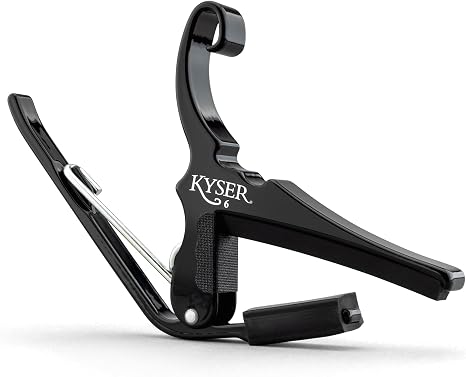
“The Kyser Quick-Change's spring-action aluminum body enables true one-handed capo placement mid-song — the fastest repositioning mechanism available at $24.95. It clips securely to the headstock…”
See Today’s Price →What we like
- One-handed operation for quick key changes mid-song
- Extremely durable aluminum construction
- Available in a wide range of colors and finishes
- Clips securely to headstock when not in use
- Consistent grip across 25+ years of proven design
Watch out for
- Spring tension cannot be adjusted, may pull lighter strings sharp
- Not ideal for very narrow electric necks without the electric-specific model
Read Full Analysis
Kyser Quick-Change at $24.95 earns its badge on a practice-focused page precisely because practice involves constant capo repositioning. When you're working through chord charts in multiple keys, experimenting with transpositions, or moving in and out of caped positions mid-song, the spring-action mechanism pays its dividend: squeeze, position, release — one hand, no knobs, no adjustment. No other capo mechanism is faster in the moment. The headstock clip storage matters more during practice sessions than it might seem. Rather than setting the capo on a music stand or leaving it loose on a guitar body, it parks cleanly on the headstock and sits there within easy reach between uses. Players who move in and out of caped positions frequently within a session know how much this small habit improves flow. The fixed spring tension is the design limitation to understand. For standard and medium-gauge strings, the Kyser's spring provides adequate even pressure. For very light strings (10s and below), the spring can push intonation slightly sharp — during performance this matters; during practice, a slight sharp is usually audible enough that you can adjust. If you practice predominantly with light strings and hear consistent sharpness, the D'Addario NS Tri-Action on this page allows tension adjustment without sacrificing much speed. For a practice page where the primary use case is speed and ease of repositioning, the Kyser's 25+ years of proven design and wide color availability make it the most dependable choice.

“The D'Addario NS Tri-Action at $25.99 bridges the gap between spring speed and screw precision with its micrometer tension adjuster — you get fast one-handed operation with tuning-accurate pressure.…”
See Today’s Price →What we like
- Micrometer tension adjustment combines speed of spring with precision of screw
- Ergonomic trigger handle is comfortable for players with smaller hands
- Works on both acoustic and electric guitar necks
- Competitive price for the features offered
- Sleek, modern design with secure headstock clip
Watch out for
- Zinc alloy frame feels slightly less premium than aluminum competitors
- Tension adjuster can loosen over time with heavy use
Read Full Analysis
D'Addario NS Tri-Action at $25.99 bridges the two main capo philosophies: spring-action speed and screw-adjustment precision. The integrated micrometer tension adjuster lets you fine-tune clamping pressure without switching mechanisms — you get one-handed placement with the speed of a spring capo and tuning accuracy approaching a Shubb screw model. For practice sessions where you want fast repositioning but cannot tolerate a sharp-tuning capo on lighter strings, this combination solves the problem that either pure approach leaves behind. For a practice-focused page, the acoustic-and-electric versatility is meaningful. Many players practice on both — an acoustic at home, an electric in a studio or rehearsal space. The NS Tri-Action works across both neck profiles without needing a model-specific purchase, unlike capos that come in acoustic-specific and electric-specific versions. The ergonomic trigger handle is notably comfortable for players with smaller hands. The trigger requires less grip strength than the Kyser's full squeeze, which matters during extended practice sessions. D'Addario's headstock clip keeps the capo accessible during playing without setting it down. The honest trade-offs: the zinc alloy construction feels slightly less premium than the Kyser's aluminum body — functional but not as confidence-inspiring in the hand. The tension adjuster can drift loose with very heavy daily use, so checking it periodically is good practice. At $24.95 vs. $24.95 for the Kyser, the $1 difference is negligible; the real decision is whether adjustable tension justifies the slightly softer build.

“At $39.95 the Paige delivers screw-adjustable tension in one of the lightest, least obstructive profiles available — making it a strong pick for practice sessions where neck access matters.…”
See Today’s Price →What we like
- Lightweight and minimal — one of the least obstructive capos available
- Screw tension allows precise intonation-friendly pressure
- Affordable entry point for players wanting adjustable tension
- American-made quality control
Watch out for
- Two-hand operation required for repositioning
- Does not clip to headstock for storage
- Less widely available than competitors
Read Full Analysis
The Paige 6-String Guitar Capo at $39.95 occupies a specific niche on this page: screw-adjustable tension without the complexity or cost of the G7th Performance 3 ($69.99). For practice players who care about intonation and are willing to sacrifice one-handed speed for precision, the Paige is the choice between the budget spring capos (Shubb at $22.95, Kyser at $24.95, D'Addario at $25.99) and the premium G7th. The screw-tension mechanism is the defining feature. Spring capos apply fixed pressure regardless of fret position, string gauge, or neck profile — often overtightening, which pulls strings sharp and degrades intonation. The Paige allows micro-adjustment of clamping pressure to the minimum required for clean fretting without pitch disruption. For practice sessions where intonation accuracy matters more than rapid key changes, that precision is the practical value. Lightweight profile is a secondary advantage for players who find spring capos obstructive around the first few frets during chord transitions. American-made quality control translates to consistent tension retention across the life of the capo — the screw mechanism doesn't drift the way some cheaper adjustable designs do. The real limitation is operational friction. Two hands are required to reposition — you cannot flip it up the neck with a thumb while keeping the other hand on the fretboard. There is no headstock clip for temporary storage between key changes, unlike the Kyser or Shubb. For practice environments where key changes are infrequent and intonation is the focus, neither matters. For live or rehearsal use where rapid repositioning is routine, the Kyser ($24.95) is faster and the G7th ($69.99) is faster still while adding intonation benefit.

“At $69.99 the G7th Performance 3 is the most sophisticated capo on this list: Adaptive Radius Technology automatically conforms the silicone pad to any fretboard curvature, eliminating tuning buzz…”
See Today’s Price →What we like
- Adaptive Radius Technology conforms to any fretboard curvature automatically
- One-handed squeeze-and-click locking mechanism
- Extremely low profile — least obstructive capo available
- Silicone pad is exceptionally gentle on frets
- Works perfectly on both acoustic and electric without swapping models
Watch out for
- Premium price point significantly above competitors
- Takes a brief adjustment period to learn the release mechanism
Read Full Analysis
The G7th Performance 3 at $69.99 is the most expensive capo on this page by a significant margin — $30 more than the Paige, $45 more than D'Addario and Kyser, $47 more than Shubb. The premium is built on two genuinely differentiated features that no other capo on this list offers: Adaptive Radius Technology and the squeeze-to-lock mechanism. Adaptive Radius Technology (ART) automatically conforms the silicone pad to the curvature of the fretboard without requiring the user to select a radius variant or apply uneven pressure. Most capos are designed for a specific neck radius — too flat a pad on a curved neck creates uneven clamping, which causes buzz on the higher or lower strings without consistent string-to-string pressure. The G7th ART pad self-shapes to whatever radius it encounters, making this the one capo on the page that works identically on acoustic, electric flat-radius, and electric vintage-radius necks without adjustment. The squeeze-and-click locking mechanism is genuinely one-handed: grip the capo, squeeze, position, and release — it locks at the applied pressure. Repositioning between keys requires one hand and about two seconds, which is significantly faster than the Paige's screw system and comparable to the Kyser's spring while delivering intonation-accurate pressure rather than fixed spring tension. The ultra-low profile keeps the fretting hand unobstructed closer to the capo than any spring design allows. Tradeoffs are price and a brief learning curve on the release mechanism — the release requires a specific grip that takes a few sessions to internalize. For daily practice players who want maximum intonation accuracy, the fastest repositioning, and neck-profile versatility without separate models, the G7th is the correct choice if the price is acceptable.
Frequently Asked Questions
What is a guitar capo and how does it work?
What type of capo is best for practice — trigger, screw, or partial capo?
How do I choose the correct capo tension for my guitar?
Can I use the same capo for acoustic and electric guitar?
What capo position should beginners practice with most?
How We Analyze Products
We analyze Amazon review data — often thousands of reviews per product — to surface patterns that individual buyers miss. Our process aggregates star ratings, review counts, and buyer sentiment at scale, identifying which strengths and weaknesses appear consistently across the largest review samples available. The 27,667+ reviews analyzed on this page represent real verified-purchase feedback from Amazon buyers.
Each product earned its placement through data: total review volume, average rating, and the specific praise and complaints that repeat most often across buyers. No manufacturer paid for placement on this page. Products appear here because buyers endorsed them at scale, not because a company asked us to feature them.
We use AI to summarize review sentiment — not to fabricate opinions, but to condense what thousands of buyers actually wrote into a readable format. The pros and cons you see reflect the most common themes found in verified purchaser reviews, paraphrased for clarity. We do not claim to have accessed Reddit, YouTube, or specific publications in generating these summaries.
Prices shown reflect Amazon pricing at the time this page was last generated. Click “See Today’s Price” to get the current live price on Amazon. Read our full methodology →