Best Piano Books for Beginners (2026): Learn Piano With the Right Method
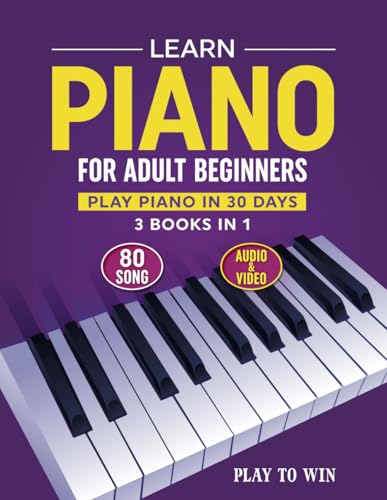
Alfred's Basic Adult All-in-One Piano Course is the best beginner piano method — proven over decades, used in studios worldwide, and structured for adult learning pace. For self-teaching with video access, the 3-in-1 'Learn Piano for Adult Beginners' at $19 provides online audio and video demonstrations alongside the book.
Piano Books for Beginners (2026) Buying Guide
 Photo by Brett Sayles / Pexels
The Adult Piano Learning Challenge: Why Most Methods Fail
Most piano methods were designed for children. They move slowly, use simplified notation that eventually has to be unlearned, and assume small hands with limited reach. Adult beginners have different needs:
- Faster pace: Adults absorb concepts faster than children and get bored with overly simple progressions
- Music theory understanding: Adults want to understand WHY, not just memorize patterns. Theory explanations that skip over "why this chord works" frustrate adult learners
- Standard notation from the start: Children's methods often start with letter names in the noteheads or color-coding that delays real sight-reading development
- Real music quickly: Adults want to play recognizable music, not "Mary Had a Little Lamb" for three months
The methods here are specifically designed for adult and late teen beginners. They move at an adult pace, explain theory, and progress to real music within the first few weeks.

Alfred's Basic Adult All-in-One Piano Course has been the standard adult piano method for decades, and for good reason: it works consistently across a wide range of learning styles and teaching approaches.
What makes it effective:
-
Integrates note reading, music theory, and technique in a single sequence (the "All-in-One" designation — it replaces three separate books: lesson, theory, and technique)

-
Moves at adult pace — pieces feel like real music quickly
-
Standard notation from page one — no training wheels to unlearn
-
Widely used in studio teaching, which means millions of YouTube tutorials, teacher explanations, and supplemental resources exist specifically for it
-
Self-teaching: the physical technique sections (hand position, fingering) benefit significantly from in-person guidance or video. If you're completely self-teaching without any lessons, the 3-in-1 multimedia option may serve you better.
There are three "Books" in the Alfred's Adult series (Book 1, 2, 3 plus supplementary). This recommendation is Book 1 — the starting point.
Multimedia Learning: Books + Audio + Video
The "Learn Piano for Adult Beginners: 3 Books in 1" uses a modern format: the book provides written instruction and exercises, while QR codes or access links provide audio demonstrations of each piece and video instruction for technique sections.
For self-teaching adults, the audio is essential — you need to hear what the music should sound like before you attempt to play it. A text description of rhythm alone is insufficient for most adults without classical training. The video technique demonstrations also replace much of what an in-person teacher would demonstrate for hand position and key attack.
The 3-in-1 format (beginner, intermediate, music theory) promises comprehensive coverage, though the depth per section is necessarily less than a dedicated method book. Think of it as a complete introduction that answers "what comes next?" at each stage.
Piano Note Reading Exercises: Supplemental Work
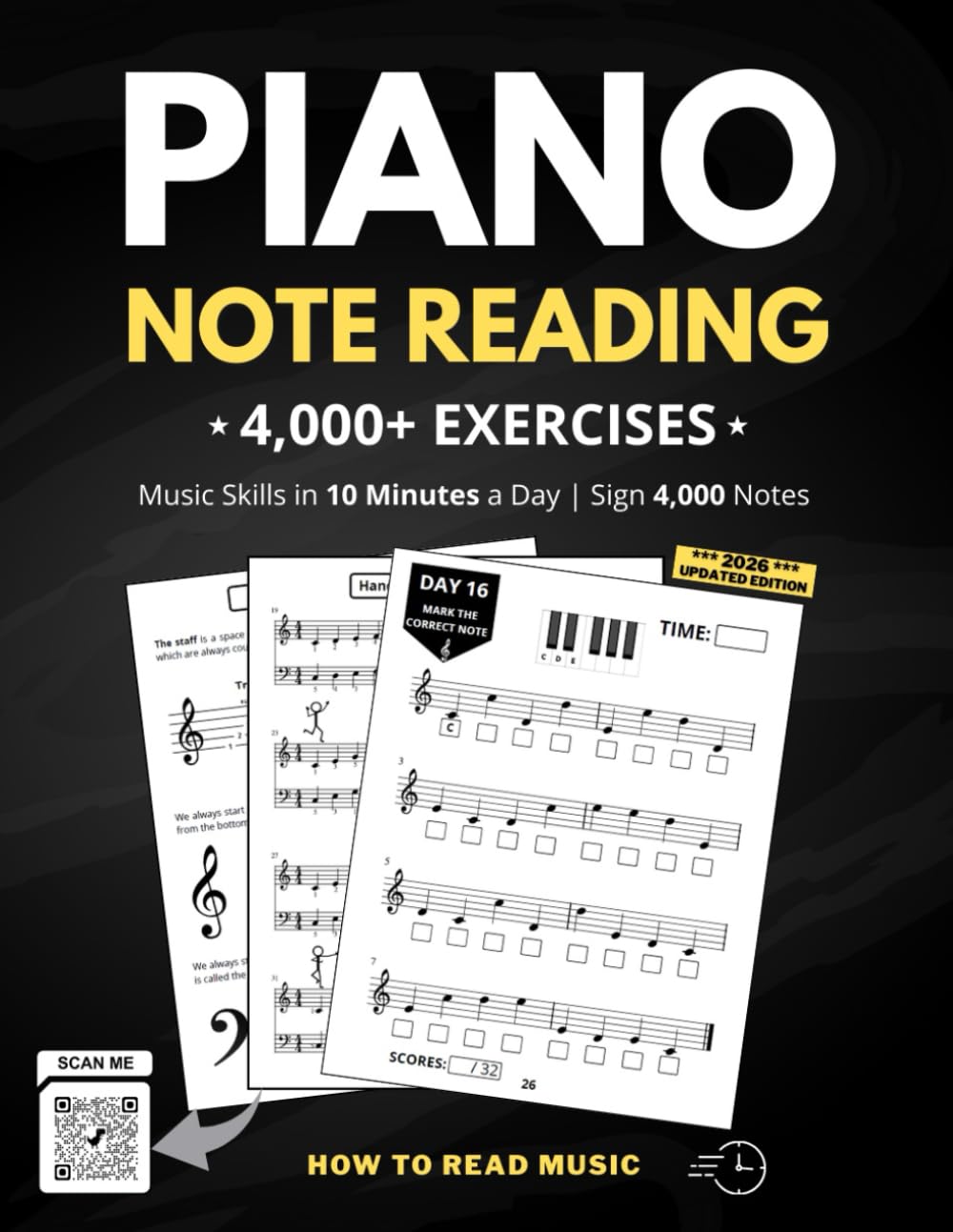
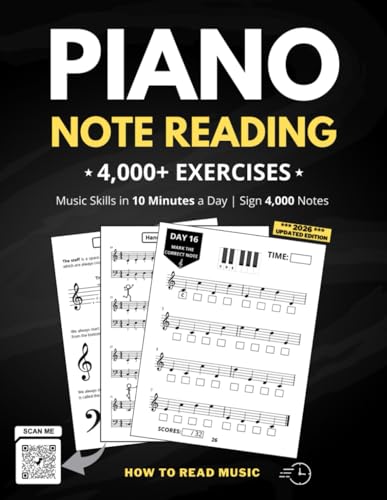
The Piano Note Reading Exercises book is a targeted supplement — not a method book but a focused drill book for note recognition. Many adult beginners can play by ear or memory but struggle to sight-read fluently. Dedicated note reading exercises build the recognition speed that makes sight-reading natural rather than laborious.
This is most useful as a supplement to Alfred's or another primary method, not as a standalone starting point. Use it when you notice that you're reading music note-by-note (do, re, mi... C, D, E... identifying each note individually) rather than reading patterns and intervals at sight.
Note Reading: The Skill That Determines Your Ceiling
Piano learning splits into two tracks: playing by ear (recognizing and reproducing music by sound) and sight-reading (reading and playing music from notation). Both are valuable; most piano learners naturally lean toward one.
Playing by ear alone: you can learn popular songs quickly and sound impressive early, but eventually hit a ceiling — you can only play what you've heard and memorized, and learning new pieces takes as long as it takes to memorize them by ear.
Sight-reading: slower initial progress, but eventually you can sit down with any sheet music and play it. The investment in note reading pays off multiplicatively over years.
Alfred's method builds both — the exercises build technique and note reading, while the pieces are designed to be musical from early on.
What to Expect: Realistic Progress Timeline
Weeks 1–4: Note names, basic hand position, simple five-note patterns in both hands separately. Play simple pieces with hands separately. Months 1–3: Hands together in simple pieces, bass clef reading develops, basic rhythms (quarter, half, whole notes), first chords in left hand. Months 3–6: Simple pieces with chords, beginning of scales, eighth notes, dynamics. Recognizable songs possible. Month 6–12: Solid beginner repertoire, sight-reading simple pieces slowly, beginning of technique exercises (scales, arpeggios). This timeline assumes 30 minutes of daily practice. Less practice time proportionally lengthens the timeline. No piano method replaces actual practice time.Do I need a piano to learn from these books? At minimum, a full 88-key digital keyboard with weighted keys — the weight simulates the feel of acoustic piano keys and develops the correct finger strength and touch sensitivity. Unweighted keyboards develop bad habits that are difficult to correct later. A 61-key keyboard can work for the early books but limits your range. Can I learn piano from a book alone without a teacher? Yes — especially with the multimedia options (3-in-1 with audio/video). Progress is typically slower than with a teacher, but many adult hobbyists successfully self-teach to a satisfying level. A teacher accelerates technical development (especially hand position and tone production) significantly, even if just for occasional lessons. How much should I practice daily? 30 minutes of focused daily practice produces faster progress than an occasional 2-hour session. The piano requires repetition to build muscle memory — daily exposure is more effective than weekly marathons. Even 15–20 minutes daily produces real progress over weeks. What's the difference between Alfred's Book 1, 2, and 3? Book 1 is the starting point: note reading, basic technique, first pieces. Book 2 continues with more complex rhythms, new notes in higher/lower registers, and music theory depth. Book 3 brings more advanced technique. Start with Book 1 regardless of prior music experience (unless you already read music fluently from another instrument). Should I learn both treble and bass clef from the start? Yes — Alfred's Adult introduces both from the beginning. Both hands need to read their own staff notation. Learning one clef first (melody) and adding bass later is a shortcut that creates a reading imbalance that's frustrating to fix later.
At a Glance

Showing 3 of 3 products
Alfred's Basic Adult All-In-One Piano Course
“Alfred's All-in-One is the industry-standard adult piano method — used by teachers and self-learners alike.”
See Today’s Price →What we like
Watch out for
Read Full Analysis
Alfred's Basic Adult All-in-One Piano Course Book 1 is the foundational text for adult piano learning. The All-in-One format integrates what other publishers sell as three separate books — lesson, theory, and technique — into a single progressive sequence. Standard notation from page one (no crutches to unlearn), adult-paced progressions that reach real music quickly, and decades of refinement based on studio use worldwide. Used in private studios, music schools, and conservatories globally. If you're taking lessons, this is almost certainly what your teacher will assign. If you're self-teaching, this is the starting point against which all other methods should be compared.
Learn Piano for Adult Beginners: 3 Books in 1: Play Piano in 30 Days! ( Audio + Video )
“A comprehensive self-study piano package for adults who learn best with a structured timeline.”
See Today’s Price →What we like
Watch out for
Read Full Analysis
The Learn Piano for Adult Beginners: 3 Books in 1 is the best option for adults who are completely self-teaching without a teacher. The audio demonstrations let you hear what each piece should sound like before you attempt it — essential for rhythm and phrasing that text descriptions can't convey. Video technique guides show hand position and key attack that can't be demonstrated in print. The three-book structure (beginner, intermediate, theory) keeps you on a clear path through the learning progression. At $19, it's the more economical starting point and better suited for self-directed learning.
Piano Note Reading Exercises
“A targeted note-reading workbook that fills the specific gap that general piano books often neglect.”
See Today’s Price →What we like
Watch out for
Read Full Analysis
The Piano Note Reading Exercises book is the targeted solution for the most common adult piano plateau: the transition from note-by-note reading (identifying each note individually) to pattern and interval reading (seeing groups of notes as recognizable shapes). Dedicated exercises build the recognition speed that makes sight-reading natural. Use this as a supplement to Alfred's or the 3-in-1 method — it's not a standalone method but a focused accelerator for the specific skill most adults find hardest. At $14, it's an inexpensive addition that addresses the single bottleneck between adequate and fluent reading.
Frequently Asked Questions
Do I need a real piano or will a keyboard work?
Can I learn piano from a book alone without a teacher?
How much should I practice daily?
What's the difference between Alfred's Book 1, 2, and 3?
Alfred's vs. multimedia 3-in-1 — which should I choose?
How We Analyze Products
We analyze Amazon review data — often thousands of reviews per product — to surface patterns that individual buyers miss. Our process aggregates star ratings, review counts, and buyer sentiment at scale, identifying which strengths and weaknesses appear consistently across the largest review samples available.
Each product earned its placement through data: total review volume, average rating, and the specific praise and complaints that repeat most often across buyers. No manufacturer paid for placement on this page. Products appear here because buyers endorsed them at scale, not because a company asked us to feature them.
We use AI to summarize review sentiment — not to fabricate opinions, but to condense what thousands of buyers actually wrote into a readable format. The pros and cons you see reflect the most common themes found in verified purchaser reviews, paraphrased for clarity. We do not claim to have accessed Reddit, YouTube, or specific publications in generating these summaries.
Prices shown reflect Amazon pricing at the time this page was last generated. Click “See Today’s Price” to get the current live price on Amazon. Read our full methodology →