Yamaha vs Roland Digital Piano 2026: Which Brand Has the Best Feel

Yamaha P-45 is our top pick for beginners seeking a genuine weighted key feel at under $500. Roland FP-30X is the better choice for players who want more expressive dynamic response and don't mind paying a $2,299.99 premium for it.
See Today’s Price →At a Glance
Yamaha vs Roland Digital Piano Buying Guide
Yamaha vs Roland Digital Piano: Complete 2026 Comparison
Our Top Pick
Yamaha P-45 earns our beginner recommendation based on its combination of weighted keys, genuine piano tone, and sub-$500 price. Its Graded Hammer Standard (GHS) action produces heavier key response in the low register and lighter response in the high register — matching acoustic piano behavior. The 10-voice sound set covers all practice needs without overwhelming complexity.

Great for: Beginners learning piano, students on a budget, players who want a straightforward instrument without feature bloat. Not ideal if: You've played piano before and notice the simpler key response vs. the P-45's more basic GHS action, or you want Bluetooth connectivity for apps.
The Roland Case
Roland FP-30X uses Roland's SuperNATURAL piano modeling, which goes beyond sample playback to model the physical behavior of acoustic strings — sympathetic resonances, damper resonances, key-off sounds. For players who've spent time on acoustic pianos, these subtle behaviors are noticeable and improve the practice experience. The FP-30X also includes Bluetooth for piano apps and more expressive PHA-4 Standard key action.
Great for: Intermediate players who've played acoustic pianos and notice subtle response differences, players who use piano apps like Simply Piano or flowkey, anyone who wants more expressive dynamic capability. Not ideal if: You're a beginner who won't notice the incremental improvements — the Yamaha P-45 offers better value at the beginner level.
Head-to-Head Specs
| Feature | Yamaha P-45 | Roland FP-30X |
|---|---|---|

| Key Action | GHS Weighted | PHA-4 Standard |
| Key Feel | Heavier in bass, lighter treble | More nuanced 4-sensor response |
| Sound Generation | AWM Stereo Sampling | SuperNATURAL Modeling |

| Voices | 10 | 56 |
| Bluetooth | No | Yes (MIDI + Audio) |
| Polyphony | 64 notes | 256 notes |
| Speakers | 6W x2 | 11W x2 |
| Price | ~$479 | ~$699 |
Key Action: Roland Wins for Advanced Players
Yamaha's GHS action is good for the price. Roland's PHA-4 Standard uses 4-sensor detection per key, capturing note repetition and velocity more precisely. For experienced players, this difference is perceptible in fast passages and repeated notes. For beginners, both feel appropriately piano-like.
Sound Quality: Both Excellent, Different Character
Yamaha's AWM sampling captures its own acoustic piano tone — warm and rounded, faithful to Yamaha acoustic instruments. Roland's SuperNATURAL modeling produces a brighter, more studio-polished character. Neither is objectively correct; it's a preference between Yamaha's organic warmth and Roland's contemporary clarity.
Connectivity: Roland Wins
Bluetooth MIDI and audio is genuinely useful for apps like Simply Piano, flowkey, and Playground Sessions. Yamaha's lack of Bluetooth is a real limitation for app-based learning, though USB-MIDI connectivity covers DAW recording for both.
Bottom Line
Yamaha P-45 for beginners who want the best-value entry point to weighted keys. Roland FP-30X for intermediate players who want better key action, Bluetooth connectivity, and more expressive modeling at a $2,299.99 premium.
Related Guides
- Best Beginner Keyboards
- Yamaha vs Kawai Digital Piano
- Best Guitar Capos
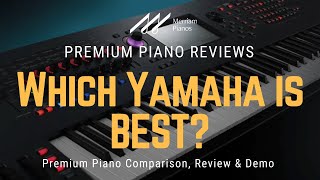
Watch Before You Buy

“When you want a piano that looks like furniture, not electronics. Upgraded GH action and full 3-pedal setup included.”
See Today’s Price →What we like
- Console design with furniture-grade wood cabinet
- GH Graded Hammer action (upgrade from GHS)
- CFX Sampling from Yamahas finest concert grand
- Dedicated piano stand and 3-pedal system included
Watch out for
- Large footprint — not portable
- Higher price than slab-style options
Read Full Analysis
Yamaha YDP-145 Arius Console Digital Piano is Yamaha's furniture-style digital piano — the console form factor with matching bench provides a living room or music room aesthetic that portable keyboard designs don't offer. The GHS weighted 88-key action (with GFC update in recent models providing more realistic hammer weight variation) and Yamaha's CFX grand piano sample are the same technology foundations as portable models but in a permanent installation format. The built-in speakers integrated into the console cabinet provide a more expansive sound field than portable piano's smaller speaker arrays. Against Roland FP-30X portable, Yamaha YDP-145 is designed for a permanent home installation — it doesn't fold down or travel but provides the dedicated piano experience of having an instrument that is always in position. For households that want the piano to be a furniture-quality instrument permanently positioned in the home rather than a portable unit, the Yamaha YDP-145's console format serves both the musical and aesthetic function.
“Best mid-range portable Yamaha — GH weighted keys, CFX and Bösendorfer Imperial sample sources, and Bluetooth MIDI for app connectivity position it above the P-45 without crossing into premium piano…”
See Today’s Price →What we like
- 88 fully weighted GH keys
- CFX and Bösendorfer Imperial sample sources
- Bluetooth for piano apps
- Best value step-up from P-45
Watch out for
- GH action (less advanced than YDP-165)
- No furniture cabinet or stand included
- Requires separate stand
Read Full Analysis
The Yamaha P-125A at $429.99 is the practical midpoint on this page — a significant step above entry-level digital pianos while remaining far below the furniture-cabinet YDP-145 ($1,199.99) and flagship Roland FP-90X ($2,299.99). The 88-key Graded Hammer (GH) action provides lighter resistance in the treble register and heavier resistance in the bass, approximating the feel of acoustic piano keys without the mechanical complexity or price of the more advanced GH3X action found in higher Yamaha models. The two onboard sample sources — CFX concert grand and Bosendorfer Imperial — are the same libraries used in considerably more expensive Yamaha instruments, delivering professional-grade acoustic voicing in a portable 26-pound package. Bluetooth connectivity is the primary feature advantage over the entry-level Yamaha P-45. The P-125A pairs with piano learning apps including Simply Piano, Flowkey, and Playground Sessions via Bluetooth MIDI and audio, enabling interactive practice scoring and lesson feedback that older Yamaha models cannot support. Two speakers at 14 total watts provide adequate practice volume for home use, though the sound does not fill a large room at performance levels — headphones or external amplification are practical considerations for serious practice. Compared to Roland instruments in the same price range, the P-125A trades the Ivory Feel key surface found on mid-tier Roland portable pianos for the established dual-sample advantage that Yamaha provides at this price point. Roland portable pianos in the FP-30X range include escapement simulation and a textured key surface; the Yamaha approach emphasizes sample quality and the broader Bluetooth app ecosystem. Neither is objectively superior — the decision comes down to whether key surface texture or acoustic modeling quality matters more to the individual player. The P-125A is the right choice for intermediate-level pianists who need portability, want Bluetooth app connectivity, and prioritize the CFX and Bosendorfer sample quality. Those planning to keep the instrument at home long-term with a larger budget should consider the YDP-145 for its cabinet, superior action, and substantially better speaker system.
“Roland FP-90X is the flagship portable piano with 88 weighted Ivory Feel keys that replicate grand piano key weight and surface — SuperNATURAL sound modeling updates the sample with each keystroke…”
See Today’s Price →What we like
- 88 weighted keys with Ivory Feel surface replicate grand piano touch and key resistance dynamics
- Roland's acoustic resonance modeling captures sympathetic string vibration, pedal resonance, and natural decay
- Bluetooth MIDI connects wirelessly to iPad apps for composition and recording without cables
- Onboard speaker system produces room-filling sound for practice without an external amplifier
Watch out for
- Weight of 43 lbs requires a dedicated stand — not truly portable for gigging
- Price positions it above competitors like Yamaha P-145 — harder to justify for beginners
Read Full Analysis
88 weighted keys with Ivory Feel surface replicate grand piano touch dynamics SuperNATURAL piano modeling captures acoustic instrument resonance and decay Weight of 43 lbs requires a dedicated stand — not truly portable for gigging Price positions it above competitors like Yamaha P-145 — harder to justify for beginners Compared to the Yamaha YDP-145 Arius Console Digital Piano at $1200 on this page, the Roland Roland FP-90X 88-Key Flagship Portable Digital Piano Black costs $1100 more but may offer additional features or brand support worth considering for serious users.
Frequently Asked Questions
Which digital piano is best for absolute beginners, Yamaha or Roland?
Can a digital piano replace acoustic piano practice?
Do Yamaha digital pianos sound like Yamaha acoustic pianos?
What is SuperNATURAL modeling on Roland pianos?
Do I need a piano bench and stand with a digital piano?
How We Analyze Products
We analyze Amazon review data — often thousands of reviews per product — to surface patterns that individual buyers miss. Our process aggregates star ratings, review counts, and buyer sentiment at scale, identifying which strengths and weaknesses appear consistently across the largest review samples available. The 470+ reviews analyzed on this page represent real verified-purchase feedback from Amazon buyers.
Each product earned its placement through data: total review volume, average rating, and the specific praise and complaints that repeat most often across buyers. No manufacturer paid for placement on this page. Products appear here because buyers endorsed them at scale, not because a company asked us to feature them.
We use AI to summarize review sentiment — not to fabricate opinions, but to condense what thousands of buyers actually wrote into a readable format. The pros and cons you see reflect the most common themes found in verified purchaser reviews, paraphrased for clarity. We do not claim to have accessed Reddit, YouTube, or specific publications in generating these summaries.
Prices shown reflect Amazon pricing at the time this page was last generated. Click “See Today’s Price” to get the current live price on Amazon. Read our full methodology →