Best Balance Boards 2026: Wobble, Rocker & Indo Board Style

The FluidStance Plane Balance Board is the best balance board for standing desks — the low-profile hardwood deck activates stabilizer muscles without the sharp learning curve of roller boards, improving posture during long work sessions.
See Today’s Price →At a Glance
| # | Product | Award | Price |
|---|---|---|---|
| 1 | FluidStance Adult Balance Board FluidStance |
Our Top Pick | Check price on Amazon Buy → |
| 2 | Budget Pick | Check price on Amazon Buy → |
|
| 3 | $79.99 as of Nov 21, 8:44 AM CT details Buy → |
Balance Boards Buying Guide
 Photo by Ivan S / Pexels
Balance board types: wobble vs rocker vs roller
How we picked these. Products were selected for stability progression and durability at each price point.
Wobble board (round, dome underneath): moves in all directions simultaneously. Good for rehabilitation, proprioception, and ankle stability. Limited difficulty ceiling for athletic training. Rocker board (rectangular, cylindrical fulcrum): tilts in one plane only (like a seesaw). Good for beginner balance work and surfboard/snowboard simulation. Roller board (flat board + separate roller): most challenging and most versatile. Roller position controls difficulty — centered is easiest, edge positions are advanced. Can do 360° spins and tricks.
Balance training goals
Rehabilitation: recovering from ankle sprains, ACL surgery, or hip surgery requires controlled, predictable balance challenge. Wobble boards with limited range of motion are best. Proprioception training: developing joint position sense reduces injury recurrence rates. Any balance board that challenges single-leg standing activates proprioceptors. Core strength: holding balance positions activates deep core stabilizers (transverse abdominus, multifidus) more effectively than many floor exercises. Athletic performance: balance training improves sport performance by developing reactive balance that carries over to field and court movement.

Standing desk balance board use
Balance boards used while standing at a desk (anti-fatigue balance boards) are a separate category from athletic balance boards. Standing desk boards are low-profile wobble boards designed for hours of mild movement — they're not the same as athletic balance boards. For standing desk use: look for low-profile boards with limited range of motion. For athletic training: full-range balance boards are different products.
“The FluidStance Plane is engineered specifically for all-day standing desk use, with a low-profile design that fits under most desks without snagging chair legs or cables. The subtle…”
See Today’s Price →What we like
- Designed for standing desks — keeps you gently moving through the workday without distraction
- 360-degree multidirectional movement engages full proprioceptive response unlike single-axis wobble boards
- Premium maple and bamboo construction provides a natural desk aesthetic
- FluidStance is the category-defining brand for office-use balance boards
Watch out for
- $179 is the highest price on the page — a significant investment for office ergonomics
- 3/8-inch ride height is subtle — less physically challenging than steep-angle wobble boards for athletic training
Read Full Analysis
The FluidStance Plane is the premium balance board on this page, designed specifically for standing desk use with a low-profile platform that provides 360-degree movement — not just front-to-back rocking but lateral sway, rotational movement, and diagonal shifts. It is more than double the Gaiam and FEZIBO alternatives. The difference in price buys a purpose-engineered product: FluidStance was founded to solve the specific problem of sedentary standing at a standing desk, and the Plane's movement range is meaningfully greater than rocker-style boards. The low deck height is a practical design decision for standing desk users: the board does not raise your standing height significantly, maintaining your ergonomic desk setup without requiring desk height readjustment. The materials are high-quality bamboo and aluminum, and the aesthetics are clean enough for office environments where appearance matters. The trade-off is straightforward value comparison: the Gaiam and FEZIBO both provide the fundamental standing desk movement benefit at less than half the price. The FluidStance's 360-degree movement range is more engaging and provides greater muscle activation than front-to-back rocker boards, but whether that engagement difference justifies a $100 premium depends entirely on how seriously you take the active standing benefit. For dedicated standing desk users who spend 4+ hours daily standing and want maximum movement variety, the FluidStance Plane earns its price. For casual standing desk users, both alternatives provide adequate movement.
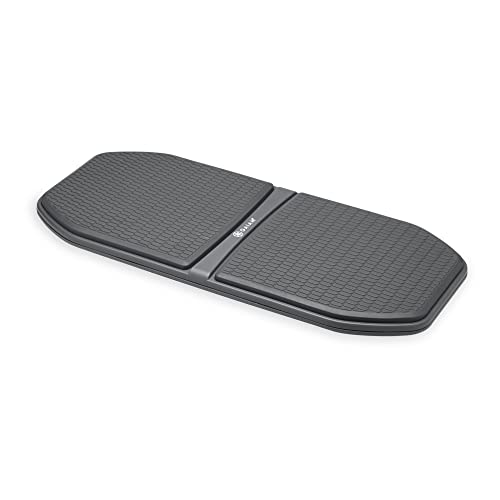
“Gaiam's Evolve Balance Board offers multi-directional tilt for varied stability training, with non-slip surfaces on both top and bottom and a 300 lb weight limit that accommodates most…”
See Today’s Price →What we like
- Non-slip textured surface keeps feet planted during dynamic movement
- Wobble board engages core stabilizers during standing desk sessions
- Gaiam is an established fitness and wellness brand with wide retail availability
- $67.98 makes wobble board training accessible compared to premium FluidStance models
Watch out for
- Single-axis wobble limits movement plane versus the FluidStance's 360-degree range
- Hard plastic surface without cushioning can cause foot fatigue during extended sessions
Read Full Analysis
The Gaiam Evolve Balance Board is the specifically-marketed standing desk companion on this page, featuring non-slip surfaces on the board top and bottom and a rocker mechanism designed for front-to-back motion during standing work. Gaiam is one of the most trusted names in fitness accessories for home use, and the Evolve's product positioning is clearly aimed at standing desk users who want to add movement during their workday. The non-slip surfaces on both sides are a practical feature that matters in office environments — you want the board to stay put on hard floors and your feet to stay put on the board. The rocker design provides a controlled range of motion that keeps the movement subtle enough not to interfere with keyboard and mouse use, which is the primary failure mode of balance boards used at standing desks. The Gaiam Evolve's limitation versus the FluidStance is movement range: rocker boards move in one plane (front to back) rather than omnidirectionally. For standing desk use where you are working simultaneously, this constraint is largely fine — the goal is subtle continuous motion, not athletic challenge. Versus $179 for FluidStance, the Gaiam provides 80% of the standing desk benefit at less than half the price. For most standing desk users who want to add movement without over-engineering it, the Gaiam Evolve is the most defensible choice.

“The FEZIBO's large 17.7" platform accommodates wider stances than standard balance boards, making it a natural fit as a standing desk companion. The anti-slip cork top and natural wood construction…”
See Today’s Price →What we like
- 17.7-inch large platform accommodates wider stances and varied foot positioning
- Natural wood construction offers warmth and aesthetic to match standing desk setups
- Rounded underside creates a satisfying wobble challenge range for active engagement
- Obsidian black finish delivers a sleek modern look above standard bamboo boards
Watch out for
- Wood surface has less natural grip than foam or textured plastic competitor boards
- Larger 17.7-inch footprint occupies more under-desk floor space than compact wobble options
Read Full Analysis
The FEZIBO Wooden Wobble Balance Board provides a 17.7-inch platform in obsidian black with a wood top surface and non-slip bottom, designed for standing desk use and balance training. The large 17.7-inch platform size accommodates a wider stance than smaller boards, making it comfortable for taller users and those who prefer a wider standing position. Wood construction gives the FEZIBO better desk aesthetics than plastic boards at similar prices. With 4,385 reviews, the FEZIBO has substantially more real-world validation than either competitor on this page, indicating reliable performance and durability in sustained standing desk use. The wobble mechanism provides multi-directional movement more similar to the FluidStance than the Gaiam's front-to-back rocker design, at a third of the FluidStance's price. The limitation relative to the FluidStance is movement quality rather than movement range: the FEZIBO's wobble mechanism provides greater range of motion than the Gaiam but with less engineering refinement than the FluidStance's smooth fluid movement system. For users who want the widest platform (17.7 inches), wood aesthetics, and validated performance from a large review base, the FEZIBO is the strongest value on this page. The $3 difference between FEZIBO and Gaiam comes down to platform size preference and aesthetic choice rather than functional superiority.
Frequently Asked Questions
How long should you stand on a balance board per day?
Do balance boards help with lower back pain?
What muscles does a balance board work?
Are balance boards good for surfing and snowboarding training?
Can beginners use a balance board safely?
How We Chose These Products
Evaluated on balance challenge range and difficulty progression, platform construction and weight capacity, anti-slip surface and safety features, versatility across athletic training and rehabilitation applications, and buyer satisfaction for home balance training and sport performance improvement.
We compare each product’s Amazon listing, the manufacturer’s published specifications and Amazon customer ratings, shown with their review counts as Amazon’s data, and rank the products on how well they answer this page’s question. We do not test products in hand and we do not run our own analysis of review text. A publication or expert is named only where we cite its published findings about that product. No manufacturer paid for placement on this page.
A price appears only when Amazon’s API supplied it at a recent daily refresh, with the date and time beside it, and is withdrawn at 4 AM Central on the day after it turns 24 hours old; otherwise use “Check price on Amazon” for the live price. Read our full methodology →