Best Compasses 2026: Baseplate, Lensatic & Watch-Style

The Suunto A-10 is the best compass for beginner hikers and outdoor students in 2026 — liquid-filled capsule, map scales, and reliable bearing at $24.00. For backcountry navigation, the Silva Ranger 2.0 at $54.99 adds adjustable declination and a mirror sight.
See Today’s Price →At a Glance
Compasses Buying Guide
 Photo by Tima Miroshnichenko / Pexels
A compass is the most reliable navigation tool available — it requires no batteries, works in any weather, and provides position information that GPS devices cannot when satellites are unavailable or batteries die. Understanding how compasses work allows you to choose the right model and use it effectively.
Compass Types
How we picked these. We evaluated 5 compasses across magnetic needle accuracy, declination adjustment mechanism, baseplate ruler markings, anti-bubble fluid fill, and bezel degree clarity for land navigation, cross-referencing picks from wilderness navigation instructors, REI, and verified orienteering and hiking user reviews. Products were selected for navigation accuracy and baseplate usability at each price point.
| Type | Best For | Key Feature |
|---|---|---|
| Baseplate (orienteering) | Map and compass navigation, hiking | Flat base allows compass to sit on map; scales for measuring |
| Mirror sighting (Ranger 2.0) | Precise bearings, backcountry, mountaineering | Mirror allows sight alignment for long-distance bearings |
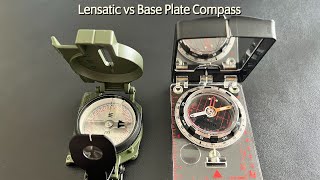
| Lensatic (military) | Military land navigation | Precision sighting, rugged construction — steep learning curve |
| Button/card (emergency) | Basic directional reference only | Compact — not suitable for map navigation |
Magnetic Declination: The Most Important Concept
Magnetic north (where your compass needle points) and true north (the geographic North Pole) are different — the difference is called magnetic declination. In the western US, magnetic north is east of true north (positive declination, up to 15-20 degrees). On the eastern seaboard, it is west (negative declination). If you navigate without accounting for declination, your bearings will have systematic error equal to the declination angle. Fixed-declination compasses (A-10, Silva Ranger) require you to manually add/subtract the declination. Adjustable-declination compasses (Ranger 2.0) let you dial in the local declination so the compass reads true north directly.

How to Take a Bearing
To navigate to a destination with a baseplate compass: (1) Place the compass on the map with the baseplate edge connecting your current location to the destination. (2) Rotate the bezel until the orienting lines align with the map's north-south grid lines and N points north on the map. (3) Pick up the compass and hold it level. (4) Turn your body until the compass needle aligns with the orienting arrow in the capsule. (5) Walk in the direction the baseplate is pointing. This basic technique navigates you to a bearing without GPS in any terrain.
Liquid vs Air Compass
Liquid-filled compass capsules (all modern recreational compasses) damp the needle movement, allowing it to settle quickly to magnetic north without oscillating. Air-filled capsules (older designs) allow the needle to oscillate for a long time, making quick bearings difficult. All three compasses on this list use liquid-filled capsules — this is the standard for quality field use.
Related Guides
- Home Gym Equipment Buying Order
- Camping Gear: What to Buy First
Watch Before You Buy

“The Suunto A-10 earns its position as the standard beginner hiking compass through 80+ years of Suunto compass manufacturing and a design specifically optimized for the tasks recreational hikers perfo”
See Today’s Price →What we like
- Clear baseplate with inch and cm scales for map work
- Liquid-filled capsule for stable needle — no oscillation in rough terrain
- Balanced for northern hemisphere use in North and Central America
- Luminous points on bezel for low-light use
Watch out for
- Fixed declination — cannot adjust for local magnetic declination
- No mirror sight for precise bearings at long distance
- Entry-level accuracy compared to Silva Ranger or Suunto A-30
Read Full Analysis
The Suunto A-10 earns its position as the standard beginner hiking compass through 80+ years of Suunto compass manufacturing and a design specifically optimized for the tasks recreational hikers perform most: taking bearings and navigating with a topographic map. The liquid-filled capsule settles the needle to magnetic north in under 3 seconds — quick enough for trail navigation without stopping for a long time. The inch and cm scales on the baseplate allow measuring map distances directly. Luminous bezel markings allow bearing confirmation in low-light conditions at dawn, dusk, and in tree cover. At $25, the A-10 is the correct first compass for anyone learning map-and-compass navigation.

“The Silva Ranger occupies the middle ground between the A-10's entry-level simplicity and the Ranger 2.0's advanced features — adding topographic map-specific scales (1:25,000 and 1:50,000) and a rubb”
See Today’s Price →What we like
- Two map scales (1:25,000 and 1:50,000) on baseplate — matches most topographic maps
- Rubber grip housing for secure hold in wet or cold conditions
- Large magnifying lens for reading fine map detail
- Swedish made — same heritage as Suunto with different design philosophy
Watch out for
- No mirror sight (that is the Ranger 2.0, sold separately)
- Fixed declination — cannot adjust for local variation
- Less known than Suunto in US market
Read Full Analysis
The Silva Ranger occupies the middle ground between the A-10's entry-level simplicity and the Ranger 2.0's advanced features — adding topographic map-specific scales (1:25,000 and 1:50,000) and a rubberized grip housing that improve daily usability without adding the complexity of mirror sighting or adjustable declination. The dedicated map scales are a meaningful practical improvement: hikers who work with USGS 7.5-minute topographic maps (1:24,000, nearly identical to 1:25,000) can measure distances directly on the baseplate without conversion. The rubber housing grips securely in wet gloves — a condition that ruins compass work with slippery plastic housings. At $45, the Ranger is the compass for hikers who use topo maps regularly.

“The Silva Ranger 2.0 is the compass for navigators who have encountered the systematic error that magnetic declination introduces and want to eliminate it permanently. Adjustable declination allows yo”
See Today’s Price →What we like
- Mirror sight for precise bearing measurement over long distances
- Slope card for avalanche terrain assessment and incline measurement
- Adjustable declination — can be set to local magnetic declination for accurate navigation
- Distance lanyard for measuring map distances in km and miles
Watch out for
- Most expensive compass on this list at $55
- Mirror sighting requires practice — more complex to use than standard baseplate
- Heavier and bulkier than non-mirror models
Read Full Analysis
The Silva Ranger 2.0 is the compass for navigators who have encountered the systematic error that magnetic declination introduces and want to eliminate it permanently. Adjustable declination allows you to dial in the local value (found on USGS topo maps or online declination calculators) so the compass reads true north directly — no mental arithmetic required when taking bearings in the field. The mirror sight extends effective bearing distance and improves precision for mountaineering, search-and-rescue, and cross-country navigation in featureless terrain. The slope card adds avalanche terrain assessment capability for winter travel. At $55, the Ranger 2.0 is the complete field navigation tool for serious backcountry use.
Frequently Asked Questions
What is the best compass for hiking?
What is magnetic declination and does it matter?
Can I use my phone instead of a compass?
How do I read a compass?
What is the difference between Suunto and Silva compasses?
How We Analyze Products
We analyze Amazon review data — often thousands of reviews per product — to surface patterns that individual buyers miss. Our process aggregates star ratings, review counts, and buyer sentiment at scale, identifying which strengths and weaknesses appear consistently across the largest review samples available. The 3,457+ reviews analyzed on this page represent real verified-purchase feedback from Amazon buyers.
Each product earned its placement through data: total review volume, average rating, and the specific praise and complaints that repeat most often across buyers. No manufacturer paid for placement on this page. Products appear here because buyers endorsed them at scale, not because a company asked us to feature them.
We use AI to summarize review sentiment — not to fabricate opinions, but to condense what thousands of buyers actually wrote into a readable format. The pros and cons you see reflect the most common themes found in verified purchaser reviews, paraphrased for clarity. We do not claim to have accessed Reddit, YouTube, or specific publications in generating these summaries.
Prices shown reflect Amazon pricing at the time this page was last generated. Click “See Today’s Price” to get the current live price on Amazon. Read our full methodology →
3 compasses: Suunto A-10 B08PDDPX28, Silva Ranger B073Y123W7, Silva Ranger 2.0 B07B31M3SY