Best Kayak for Beginners 2026: Get on the Water Fast

Intex Explorer K2 is the best beginner tandem kayak for the full kit at a low price. Intex Challenger K1 is the best solo beginner kayak for stability and simplicity.
See Today’s Price →At a Glance

Showing 3 of 3 products
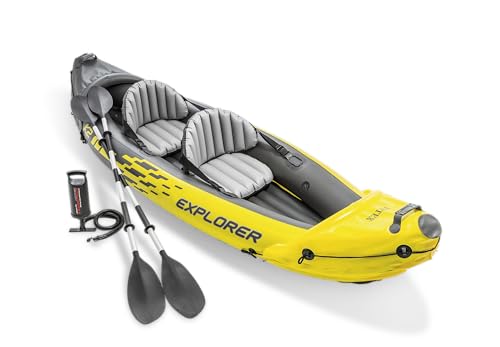
Intex 68307EP Explorer K2 Inflatable Kayak Set
“The Explorer K2 is the most widely sold inflatable kayak because it balances affordability with usable performance on flatwater lakes and calm rivers. The included pump and paddles make it a complete ”
See Today’s Price →What we like
Watch out for
Read Full Analysis
The Intex Explorer K2 at $126.12 is the most widely purchased inflatable kayak because it lowers the barrier to entry for two-person kayaking without requiring vehicle roof racks, a storage shed, or a $600 hardshell investment. The included pump inflates the kayak in 10-15 minutes and the included paddles mean the box contains everything needed to paddle the same day it arrives. On flatwater lakes and slow-moving rivers, the Explorer K2 performs adequately at beginner paces. The limitations are honest: the inflatable hull does not track as straight as hardshell alternatives, the included paddles are heavy compared to quality carbon options, and durability requires keeping it away from sharp rocks. For beginners testing whether kayaking is a hobby they want to pursue, the K2 at $126 is the rational entry — you can upgrade to a hardshell once you know you will use it regularly, without having committed $700+ to test the activity.

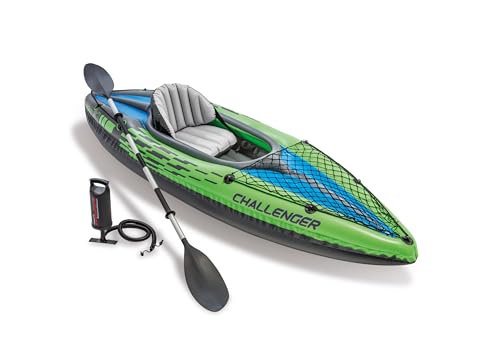
Intex Challenger K1 Kayak Kit
“The Challenger K1 is an affordable solo inflatable kayak for calm lake and slow-river paddling. The complete kit with paddle and pump minimizes the accessories needed to get on the water.”
See Today’s Price →
INTEX Challenger Inflatable Kayak Series
“An affordable entry-level inflatable kayak for casual lake paddling. Best as an introduction to kayaking before investing in a hardshell or premium inflatable.”
See Today’s Price →Kayak for Beginners Buying Guide
 Photo by Aleksei Mzhachev / Pexels
Our Top Pick
Intex 68307EP Explorer K2 Inflatable Kayak Set at $126.12 [Best Tandem]
Budget Pick: Intex Challenger K1 Kayak Kit at $95.84 — a solid choice if you're watching your budget.
Who This Is For
This guide is for first-time kayakers who want to get on the water without the cost, storage, and logistics of a hard-shell kayak. Inflatable kayaks are the practical entry point — they store in a duffel bag, travel in any car, and launch from any shore. This guide is also useful for families and casual paddlers who want to share a kayak between two people on lakes and calm rivers, and for anyone who wants to try kayaking before committing to the cost of a hard-shell boat.
What to Look For
- Inflatable construction quality: Entry-level inflatables use welded PVC chambers. The key quality indicator is the number of separate air chambers — more chambers mean the kayak stays afloat even if one chamber is punctured. Look for at least two main air chambers plus a separate inflatable floor. Multi-layer PVC is more puncture-resistant than single-layer. Drop-stitch construction, used in more premium inflatables, creates a rigid floor that feels much closer to a hard shell — it is worth the step up in price if you plan to paddle seriously.
- Weight capacity and stability: Weight capacity ratings include you, your gear, and any water that enters the boat. Leave a 20 to 30 percent buffer below the listed capacity — a kayak packed to its rated limit sits very low in the water and is unstable. Wider kayaks (30 inches or more) are significantly more stable for beginners. Narrower designs track better (go straighter) but require more balance and paddling skill.
- Included paddle quality: The paddle included in most budget kayak kits is frequently the weakest component. Cheap paddles are heavy and tiring over a full day of paddling. If you plan to paddle more than occasionally, upgrading to a lightweight aluminum or fiberglass paddle is worth more than the kayak upgrade at this price range. Pay attention to paddle length — it should be sized for your height and kayak width.
- Setup and breakdown time: Most inflatables take 10 to 20 minutes to inflate and 10 minutes to deflate and pack. If setup time is important — such as for spontaneous outings — look for models with a high-volume hand pump or foot pump that inflates faster. Some paddlers keep their inflatable partially assembled in a garage for faster deployment.
Common Mistakes
Launching on moving water before building flatwater skills is the most common beginner safety mistake. Start on a calm lake or slow-moving river for your first 5 to 10 outings. Currents, wind, and wave action all require correction techniques that take time to develop. An inflatable kayak on moving water without paddling experience can lead to capsizing and getting separated from the boat.
Overpacking the kayak reduces stability significantly. A kayak that is loaded to its weight limit sits lower in the water and tips more easily. Keep total weight — including paddler weight — to no more than 75 to 80 percent of the rated capacity when you are learning.
Skipping a personal flotation device because the water looks calm is a dangerous habit. PFDs are required by law in many states for all vessel occupants. Always wear a properly fitted PFD regardless of perceived conditions.
Price Context

Entry-level inflatable kayaks run $80 to $130 and include a paddle, hand pump, and carry bag. These are functional for calm flatwater but use lower-grade PVC and basic paddles. In the $130 to $250 range, you get improved construction, better paddles, and in some cases, rudder systems for improved tracking. Above $400, drop-stitch construction becomes standard and performance approaches that of hard-shell recreational kayaks. For beginners testing whether they enjoy kayaking, the $80 to $130 tier is a sensible starting point before investing in a serious boat.
For anyone who paddles more than a few times per season, a mid-range inflatable or an entry-level hard shell purchased used is a better long-term value than repeatedly buying budget inflatables.
Related Guides

Frequently Asked Questions
Are inflatable kayaks safe for beginners?
Do inflatable kayaks tip easily?
What should beginners pack for kayaking?
How long does an inflatable kayak take to inflate?
Can I use an inflatable kayak on a river?
How We Analyze Products
We analyze Amazon review data — often thousands of reviews per product — to surface patterns that individual buyers miss. Our process aggregates star ratings, review counts, and buyer sentiment at scale, identifying which strengths and weaknesses appear consistently across the largest review samples available. The 65,584+ reviews analyzed on this page represent real verified-purchase feedback from Amazon buyers.
Each product earned its placement through data: total review volume, average rating, and the specific praise and complaints that repeat most often across buyers. No manufacturer paid for placement on this page. Products appear here because buyers endorsed them at scale, not because a company asked us to feature them.
We use AI to summarize review sentiment — not to fabricate opinions, but to condense what thousands of buyers actually wrote into a readable format. The pros and cons you see reflect the most common themes found in verified purchaser reviews, paraphrased for clarity. We do not claim to have accessed Reddit, YouTube, or specific publications in generating these summaries.
Prices shown reflect Amazon pricing at the time this page was last generated. Click “See Today’s Price” to get the current live price on Amazon. Read our full methodology →