Best Pull-Up Assist Bands 2026: Heavy, Light & Loop
Serious Steel makes the best pull-up assist bands — durable commercial latex, consistent resistance across the full range of motion, and sold individually so you buy exactly the resistance level you need. WOD Nation is the best value set (3 bands at $26.95) for beginners who want multiple resistance options to progress through without buying separate bands.
Pull-Up Assist Bands Buying Guide
 Photo by www.kaboompics.com / Pexels
## How to Choose Pull-Up Assist Bands
Pull-up assist bands (also called resistance bands or pull-up support bands) are one of the most effective tools for building toward unassisted pull-ups and for adding pull-up volume in workouts. Here's what separates a good band from one that breaks after three months.
Latex Quality: The Single Most Important Factor

All pull-up assist bands are made from latex rubber — but not all latex is equal. Commercial-grade latex (used by Serious Steel and WOD Nation) is thicker, more consistent in wall thickness, and more resistant to tearing from the friction of repeated stretching. Consumer-grade latex (found in many budget bands) develops micro-tears faster and can snap unexpectedly. The tell: commercial latex bands have a uniform matte finish with no surface bubbles or texture variation. Check reviews for reports of snapping — it's a red flag for latex quality.
Band Thickness (Resistance Level): How to Pick the Right One
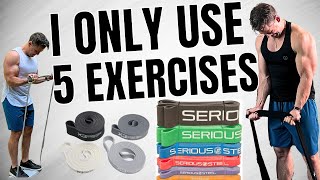
Pull-up assist bands are sold by resistance range, indicated by color and thickness. Common ranges:

- Light (1/4 inch, ~5-35 lbs): Minimal assistance, used by intermediate athletes for high-rep sets or warm-ups
- Medium (1/2 inch, ~10-55 lbs): The most common starting point, supporting roughly 50% of bodyweight for a 150 lb person
- Heavy (7/8 inch, ~30-80 lbs): Used by beginners and for heavy assistance in deficit work
- Extra Heavy (1-1/8 inch, ~50-125 lbs): For true beginners who haven't yet built lat and bicep engagement, or for very large athletes
The right band gives you enough assistance to complete 3-5 clean reps with full range of motion. If you can barely complete 1 rep or easily bang out 15, adjust the band weight.
Serious Steel Assisted Pull-Up Bands: Best Single-Band Purchase
Serious Steel uses commercial-grade natural latex in consistent wall thickness — this is the same spec used in CrossFit box gyms that run bands through hundreds of sessions. The bands are available in 7 resistance levels, sold individually. The key advantage over set purchases: you buy exactly what you need for your current strength level and add a lighter band when you're ready to reduce assistance. The bands are long enough for both pull-up assistance and standard resistance band exercises (bicep curls, face pulls, lat pulldowns).

WOD Nation 3-Band Set: Best Value for Beginners
The WOD Nation set includes three different resistance levels at $26.95 — a significant value versus buying three bands individually from other brands. For beginners, the multi-level set is practical: you'll likely need to drop to a lighter band within 8-12 weeks as you build strength, and having the progression already on hand means you don't need to reorder. The latex quality is comparable to Serious Steel for everyday home use, though serious athletes who use bands multiple times per week may find the Serious Steel latex more durable long-term.
WODFitters Pull-Up Assist Bands: Best for Travel and Versatility
WODFitters bands are slightly thinner in form factor, making them more portable and easier to carry in a gym bag. They work equally well for pull-up assistance, mobility work, and general resistance exercises. The resistance range is appropriate for intermediate athletes who need just enough help to complete their sets — these are particularly popular for kipping pull-up practice and for assistance work during high-volume programs like gymnastics training.
VEICK Resistance Bands with Door Anchor: Best for Home Gym Without a Pull-Up Bar
The VEICK set includes a door anchor attachment, which lets you perform lat pulldowns and pull-up simulation exercises without a pull-up bar. If you're training at home without ceiling-mounted equipment, the door anchor enables most of the same pulling mechanics as a bar-based pull-up. The set includes multiple bands and handles, making it the most versatile option for home training where space and equipment are limited.
How to Use Pull-Up Assist Bands Correctly
1. Loop the band over a pull-up bar and let the band hang down 2. Step both feet (or one knee) into the bottom loop of the band 3. Grab the bar with a grip slightly wider than shoulder-width 4. The band stretches as you lower, providing more assistance at the bottom (where pull-ups are hardest) 5. Pull up until your chin is above the bar
The elastic nature of bands provides more assistance at the bottom of the movement and less at the top — which mirrors the actual strength curve of a pull-up. This makes band-assisted pull-ups more effective for building the specific strength pattern needed for unassisted pull-ups compared to machine-assisted pull-ups (which provide even assistance throughout).
What to Look For When Buying Pull-Up Assist Bands
Resistance range: Match to your current strength. Beginners typically need 50-80 lb assistance; intermediate athletes need 20-40 lb assistance. Band length: Standard pull-up assist bands are 41 inches long. This length allows comfortable looping over a bar with enough slack to step into without the band being too loose or too taut. Individual vs. set purchase: If you know your strength level and have room for only one band, buy a single band at the right resistance. If you're a beginner expecting to progress, a 3-band set saves money.The difference between the WOD Nation set ($26.95 for 3 bands) and Serious Steel ($31.90 for 1 band) is a matter of depth versus breadth. The set is better value for variety; the single Serious Steel band is better quality for long-term use at one resistance level. For home use 2-3 times per week, both will last years. For commercial gym use or daily training, invest in Serious Steel's commercial-grade latex.

At a Glance
| # | Product | Award | Price | Our Score | |
|---|---|---|---|---|---|
| 1 | Serious Steel Assisted Pull-Up Bands |
Best Overall | $31 | 9.2 | Buy → |
| 2 |  WOD Nation Pull Up Assistance Band Set … WOD Nation Pull Up Assistance Band Set … |
Best Value Set | $29 | 8.9 | Buy → |
| 3 | WODFitters Pull Up Assist Bands |
Best for Travel | $19 | 8.5 | Buy → |
| 4 |  VEICK Resistance Bands with door anchor VEICK Resistance Bands with door anchor |
Best for Home Gym | $22 | 8.2 | Buy → |
Showing 4 of 4 products
Serious Steel Assisted Pull-Up Bands
“Serious Steel assisted pull-up bands are the go-to for building toward unassisted pull-ups — the multiple loop sizes provide progressive assistance reduction as strength improves.”
See Today’s Price →
WOD Nation Pull Up Assistance Band Set 3 Bands Black Red Purple 41in
“WOD Nation's 7-band set covers every resistance level from light mobility to heavy pulling — the best complete home gym resistance band investment for less than the cost of 1 Rogue band.”
See Today’s Price →What we like
- Full set of 7 bands (all resistances)
- Great value per band
- Good natural latex quality
- Popular in CrossFit community
- All sizes for progression
Watch out for
- Individual bands less premium than Rogue
- More bands than most need
WODFitters Pull Up Assist Bands
“The WODFitters Pull Up Assist Bands are the right tool for anyone working toward unassisted pull-ups or adding banded accommodating resistance to barbell work. The long flat band format is more versat”
See Today’s Price →What we like
- Most versatile band format — wraps around pull-up bars, barbells, and body segments
- Natural latex provides consistent resistance and durability
- Essential for assisted pull-up progression
- Also effective for powerlifting banded work
Watch out for
- No handles — requires wrapping or looping technique
- Not suited for cable-machine-style exercises without handle attachments
- Single band sold (not a set in most configurations)

VEICK Resistance Bands with door anchor
“VEICK resistance bands with a door anchor expand exercise variety beyond floor-based movements — the anchor point enables lat pulldowns, cable rows, and chest presses from a home gym without cable mac”
See Today’s Price →Frequently Asked Questions
How much do pull-up assist bands actually help?
What resistance level should I start with?
Can pull-up assist bands be used for other exercises?
How long do resistance bands last?
Should I use one foot or two feet in the band?
How We Analyze Products
We analyze Amazon review data — often thousands of reviews per product — to surface patterns that individual buyers miss. Our process aggregates star ratings, review counts, and buyer sentiment at scale, identifying which strengths and weaknesses appear consistently across the largest review samples available. The 17,797+ reviews analyzed on this page represent real verified-purchase feedback from Amazon buyers.
Each product earned its placement through data: total review volume, average rating, and the specific praise and complaints that repeat most often across buyers. No manufacturer paid for placement on this page. Products appear here because buyers endorsed them at scale, not because a company asked us to feature them.
We use AI to summarize review sentiment — not to fabricate opinions, but to condense what thousands of buyers actually wrote into a readable format. The pros and cons you see reflect the most common themes found in verified purchaser reviews, paraphrased for clarity. We do not claim to have accessed Reddit, YouTube, or specific publications in generating these summaries.
Prices shown reflect Amazon pricing at the time this page was last generated. Click “See Today’s Price” to get the current live price on Amazon. Read our full methodology →