Best Telescope Under 200 (2026)

Our top telescope under $200 is the Gskyer 70mm AZ Mount at $96.98. Large enough aperture to show planetary detail, light enough for a child or beginner, and priced under $100 to minimize buyer risk on a new hobby. The Celestron PowerSeeker 127EQ ($183.53) is the best step-up under $200 with serious 127mm aperture and an equatorial mount for tracking objects.
See Today’s Price →At a Glance

Showing 3 of 3 products
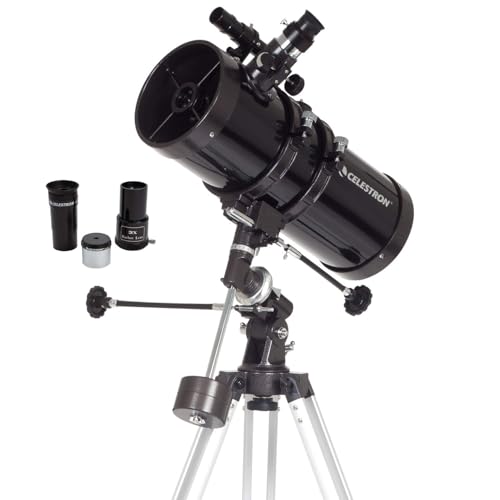
Celestron PowerSeeker 127EQ Telescope
“The best value reflector telescope for the money. The 127mm aperture punches well above its price, revealing Saturn's rings and Jupiter's moons clearly on dark nights.”
See Today’s Price →What we like
- 127mm Newtonian reflector gathers far more light than 60mm or 90mm scopes
- German equatorial mount enables motor drive upgrades later
- Includes 20mm, 4mm eyepieces and 3x Barlow for varied magnification
- Lightweight and easy to carry outside
Watch out for
- Eyepiece quality limits the optics — upgrade eyepieces for best results
- EQ mount has learning curve for complete beginners
Read Full Analysis
The Celestron PowerSeeker 127EQ combines a 127mm aperture reflector telescope with an equatorial mount, delivering enough light-gathering power to observe Saturn's rings, Jupiter's moons, and deep-sky objects like the Orion Nebula clearly from a suburban backyard. At $183.53, it's the most powerful telescope under $200 with a meaningful aperture upgrade over 60-70mm refractors. The equatorial mount allows smooth celestial tracking as objects move across the sky. Best for astronomy beginners who are serious about learning and want planetary detail without breaking the budget.

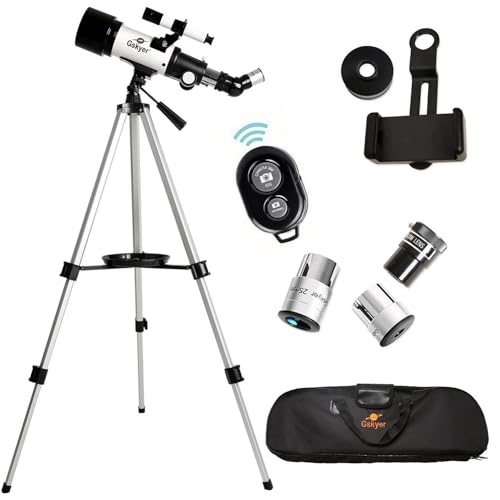
Gskyer 70mm Aperture 400mm AZ Mount Refracting Telescope for Kids
“The right first telescope for families and kids who want to explore the night sky on clear evenings — easy to set up and fun to use at a friendly price.”
See Today’s Price →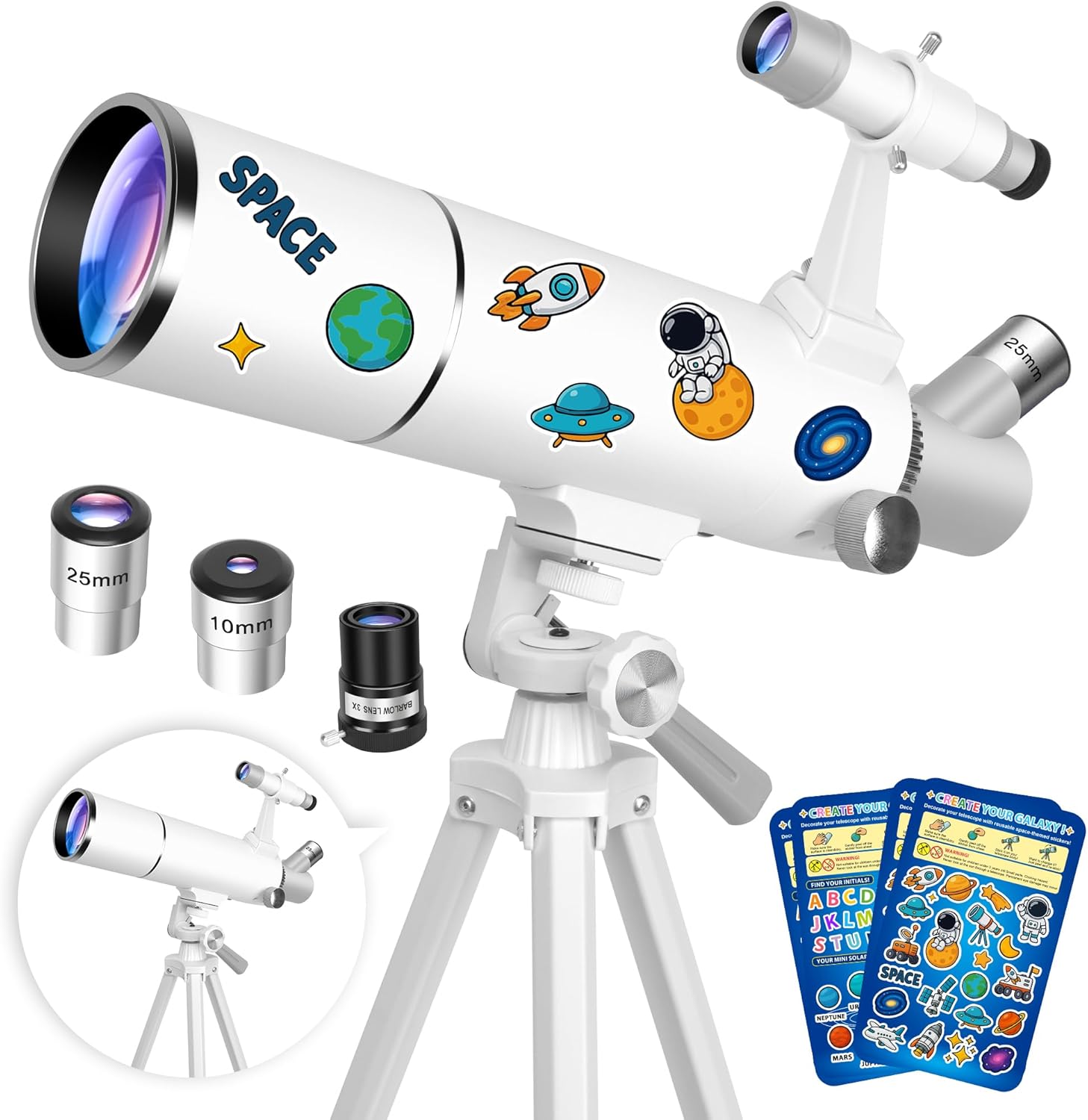
Hawkko 80mm/500mm Refractor Telescope for Adults
“Best for backyard stargazers who want a ready-to-use refractor for moon and bright planet viewing without the complexity of GoTo or equatorial mounts.”
See Today’s Price →What we like
Watch out for
Read Full Analysis
Hawkko 80mm aperture refractor provides strong light-gathering for a sub-$70 price. 500mm focal length delivers a wide field of view for locating celestial objects before increasing magnification. 80mm aperture resolves lunar craters, Saturn's rings, and Jupiter's moons clearly under dark skies — sufficient for entry-level planetary observation.
Telescope Under 200 (2026) Buying Guide
 Photo by Jan van der Wolf / Pexels
For telescope beginners, the three most important specs are aperture, mount type, and what comes in the box. Ignore advertised magnification numbers — they are marketing, not performance. Aperture is the specification that actually determines what you can see.
Aperture: The Specification That Determines Everything
Aperture is the diameter of the primary lens or mirror — the single most important telescope specification because it determines how much light the telescope gathers. More light = brighter, more detailed images of fainter objects. Under $200: 70–80mm refractor apertures show the Moon in detail, planetary features (Saturn's rings, Jupiter's cloud bands), and bright star clusters. 114–127mm reflector apertures gather significantly more light — they begin to reveal fainter nebulae and show more planetary detail. The maximum useful magnification is approximately 2× the aperture in millimeters: a 70mm scope's useful maximum is about 140×; a 127mm scope reaches about 254×. High magnification beyond this limit produces a bright blurry blob rather than sharper detail — advertised magnifications of "600×" on budget scopes are meaningless numbers. Choose the largest aperture within your budget.
Refractor vs Reflector: Choosing the Right Design
Refractor telescopes (Gskyer 70mm, Hawkko 80mm) use a glass lens at the front of the tube to focus light. They're sealed (no internal mirror to knock out of alignment), require minimal maintenance, and produce sharp planetary images. Their limitation at this price: chromatic aberration (slight color fringing around bright objects like the Moon and Jupiter) caused by budget lens designs. Reflector telescopes (Celestron PowerSeeker 127EQ) use a mirror to collect and focus light — larger aperture at lower cost per millimeter than refractors, making 127mm reflectors available under $200 while an equivalent refractor would cost $400+. Reflectors require occasional collimation (aligning the mirror) — a 10-minute process that beginners learn quickly. For the sheer light-gathering advantage at this price, the 127mm reflector shows significantly more than any 70–80mm refractor.
Mount Type: Alt-Azimuth vs Equatorial
Mount type determines how you move the telescope to track objects. Alt-azimuth (AZ) mounts move up-down and left-right — intuitive for beginners, quick to set up, and the best starting point for visual observation. Equatorial (EQ) mounts align with Earth's rotational axis, allowing you to track an object with a single-axis motion as it moves across the sky. EQ mounts are better for astrophotography and extended observation sessions, but they require a polar alignment setup step that beginners find confusing initially. The Celestron PowerSeeker 127EQ uses an equatorial mount — the EQ in the model name. For visual observation only, either mount type works. For anyone interested in astrophotography, the equatorial mount is the necessary starting point despite the steeper learning curve.
Eyepieces, Magnification, and Observing Location

A complete telescope kit should include at least two eyepieces (low power for wide field views, high power for planetary detail) and ideally a 2× Barlow lens to double the magnification of any eyepiece. Low-power eyepieces (25mm, 20mm) provide the widest field of view — best for finding objects and viewing large structures like the Orion Nebula or Andromeda Galaxy. High-power eyepieces (10mm, 6mm) magnify planetary features. Check that the kit includes multiple eyepieces before purchasing — some budget scopes include only a single eyepiece. Observing location matters as much as telescope aperture: even a modest 80mm refractor reveals dramatically more under dark suburban or rural skies than under bright city light pollution. Find your nearest dark sky site using a light pollution map and drive 30 minutes — the difference is immediately apparent.
Related Guides
Frequently Asked Questions
What can I see with a $100 telescope?
What is the best magnification to use on a beginner telescope?
Refractor vs. reflector telescope -- which is better for beginners?
What is an equatorial mount and do I need one?
What is the best time to use a telescope?
How We Analyze Products
We analyze Amazon review data — often thousands of reviews per product — to surface patterns that individual buyers miss. Our process aggregates star ratings, review counts, and buyer sentiment at scale, identifying which strengths and weaknesses appear consistently across the largest review samples available. The 10,293+ reviews analyzed on this page represent real verified-purchase feedback from Amazon buyers.
Each product earned its placement through data: total review volume, average rating, and the specific praise and complaints that repeat most often across buyers. No manufacturer paid for placement on this page. Products appear here because buyers endorsed them at scale, not because a company asked us to feature them.
We use AI to summarize review sentiment — not to fabricate opinions, but to condense what thousands of buyers actually wrote into a readable format. The pros and cons you see reflect the most common themes found in verified purchaser reviews, paraphrased for clarity. We do not claim to have accessed Reddit, YouTube, or specific publications in generating these summaries.
Prices shown reflect Amazon pricing at the time this page was last generated. Click “See Today’s Price” to get the current live price on Amazon. Read our full methodology →