Best Tennis Balls 2026: Penn, Wilson & US Open Balls Ranked
Penn Championship Extra Duty is the best tennis ball for hard court recreational play — consistent, durable, and widely available. Wilson US Open is the tournament standard for competitive club play.
At a Glance
Tennis Balls Buying Guide
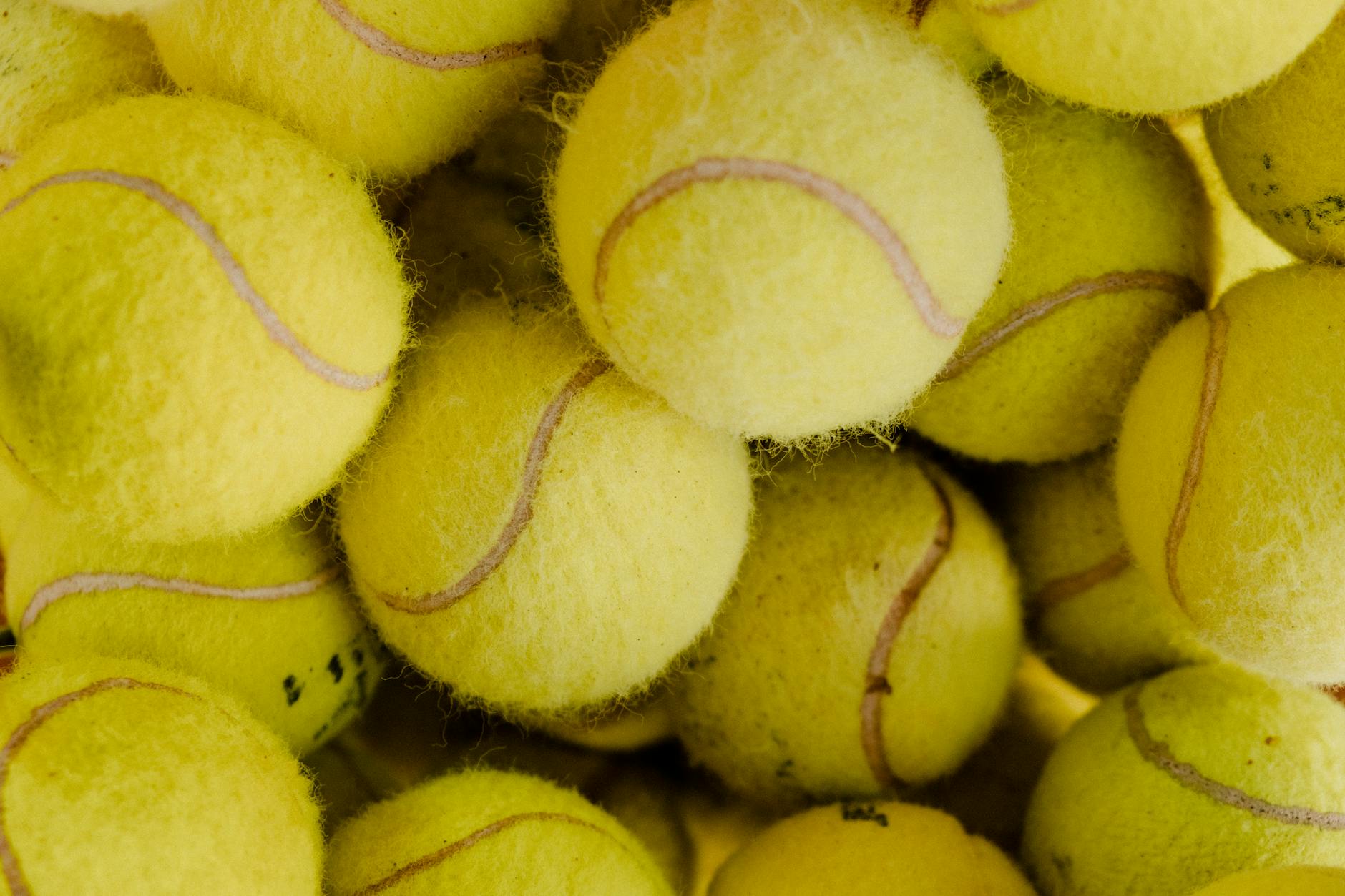 Photo by cottonbro studio / Pexels
Extra Duty vs Regular Duty
How we picked these. We reviewed 5 tennis ball sets across pressurized vs pressureless construction, felt durability and nap consistency, ITF Type 1/2/3 approval for surface type, ball bounce consistency, and can vs bag packaging, cross-referencing picks from Tennis Warehouse, United States Tennis Association guidance, and verified club and recreational player reviews. Products were selected for consistent bounce and felt durability at each price point.
Court surface determines which felt you need. Extra Duty felt is thicker and woven tighter for hard courts (concrete, asphalt, acrylic) — it resists abrasion longer. Regular Duty felt is softer and fluffier for clay courts and indoor carpet. Using Regular Duty on hard courts causes rapid felt wear; Extra Duty on clay compresses poorly and plays too fast.Pressurized vs Pressureless
Standard tennis balls are pressurized — they contain compressed air that gives them their bounce. Pressurized balls gradually lose pressure after opening a can (typically within 2-4 weeks even without heavy use). Pressureless balls use a dense rubber core and maintain consistent bounce for years, but feel heavier and less lively than fresh pressurized balls. Pressureless balls are best for practice and ball machines.How Many Balls Do I Need?
Singles matches require 3-4 balls per set (pros change balls every 9 games). Recreational players typically play with one can of 3 balls per session. Ball machines need 50-100 balls. Buying in multi-can cases is significantly cheaper per ball.When to Replace
Pressurized balls lose enough bounce to matter after about 2 weeks of regular play or when opened for more than 4 weeks. Signs of replacement: felt worn smooth, ball sounds hollow when bounced, ball sits lower on bounce than expected. Quick Decision: If budget is the priority, go with the WILSON Championship Tennis Balls; if you want the best overall, choose the WILSON US Open Tennis Balls - Extra Duty, 24 Can Case (72 Balls); if you need best bulk value, the Penn Championship - Extra Duty Felt Pressurized Tennis Balls - 15 Cans, 45 Balls is your pick.Related Guides
- Home Gym Equipment Buying Order
- Camping Gear: What to Buy First
Which Option Is Right for You?
- WILSON US Open Tennis Balls - Extra Duty, 24 Can Case (72 Balls) ($130) — Tennis clubs and players wanting a 24-can extra-duty ball case Key advantage: 24-can 72 balls; WILSON US Open; Extra duty felt; Case pricing
- Penn Championship - Extra Duty Felt Pressurized Tennis Balls - 15 Cans, 45 Balls ($51) — Tennis players wanting a bulk 15-can extra-duty felt ball supply Key advantage: 15 cans 45 balls; Extra duty felt; Penn Championship; Bulk value
- Penn Championship Tennis Balls - Extra Duty Felt Pressurized Tennis Balls 3 Coun ($35) — Tennis players wanting a 12-pack extra-duty Penn ball supply Key advantage: 12 packs; Extra duty; 3 per can; Penn Championship quality
- Wilson Prime All Court Tennis Ball ($8) — Recreational tennis players needing everyday practice balls Key advantage: All-court; Wilson quality; 3-pack; Budget value
- WILSON Championship Tennis Balls ($4) — Recreational tennis players wanting everyday practice balls Key advantage: 3-pack; Regular duty; Wilson championship quality; Budget value
Key Features to Compare When Spending Over $100
Sports equipment over $100 typically justifies its price through durability, safety engineering, and performance gains that budget alternatives can't match. The right equipment at the right price level also reduces injury risk — a critical factor for anything involving impact, weight, or repetitive stress.
- Weight capacity and structural ratings — critical for safety on ladders, boxes, and weight equipment
- Adjustment range and ease — equipment that adapts to your progress costs less than buying multiple versions
- Materials: steel vs aluminum vs carbon fiber vs foam all have specific trade-offs for durability and weight
- Warranty and replacement parts availability for long-term value
- Space footprint when folded or stored — important for home gym setups
Common Mistakes Buyers Make
- Starting at too high a level — beginning with advanced equipment before mastering fundamentals increases injury risk
- Ignoring safety ratings in favor of price alone — load capacity and material ratings exist for a reason
- Buying fixed-size equipment when adjustable versions exist at similar price points
For a detailed head-to-head, see our Head Vs Babolat Tennis comparison.
For a detailed head-to-head, see our Titleist Vs Callaway Golf Balls comparison.
For a detailed head-to-head, see our Wilson Vs Penn Tennis Balls comparison.
Watch Before You Buy

“Wilson Prime All Court: hard and clay compatibility in one ball.”
See Today’s Price →What we like
- All-court
- Wilson quality
- 3-pack
- Budget value
Watch out for
- Shorter durability than extra-duty balls on hard courts
- less consistent bounce than Penn or US Open after extended play
- not USTA approved for tournament play
Read Full Analysis
Wilson Prime All Court is designed for players who split time between hard courts and clay — the felt density sits between Extra Duty and Regular Duty to provide reasonable performance on both surfaces. For recreational players who travel between courts or join friends on different surfaces, having an all-court ball eliminates the need to manage two types. The Prime's regular-duty-adjacent felt plays better on clay than pure Extra Duty, while still withstanding hard court abrasion better than standard Regular Duty. The trade-off is predictable: it's not optimal for either surface the way a dedicated ball is. For serious hard court players, stick with Penn or Wilson Extra Duty. For versatile recreational players who occasionally mix surfaces, the Wilson Prime is the most practical single-ball choice.

“Penn Championship Extra Duty (15-can): USTA-standard ball at per-can savings.”
See Today’s Price →What we like
- 15 cans 45 balls
- Extra duty felt
- Penn Championship
- Bulk value
Watch out for
- Extra-duty felt wears faster on clay courts
- balls flatten noticeably after 2-3 sets of hard play
- bulk quantity requires storage space for opened cans
Read Full Analysis
Penn Championship is the official ball of the USTA, used in more North American tennis facilities than any other ball. The 15-can case delivers 45 balls at a per-can cost that undercuts single-can purchases significantly. Extra Duty felt makes this the correct choice for hard court play — the reinforced weave handles concrete and acrylic surfaces without rapid felt degradation. Penn's manufacturing consistency means each ball in the case plays nearly identically, which matters for competitive practice and match conditioning. The LongPlay felt treatment extends felt life about 20% compared to Penn's standard Championship ball. For club teams, high-volume recreational players, and anyone who runs through balls quickly, the Penn 15-can case represents excellent value. For casual players who open one can per month, the 15-can quantity is excessive — a 3-pack or 4-can purchase is more practical.

“Penn Championship Extra Duty (small case): best single-purchase option for hard courts.”
See Today’s Price →What we like
- 12 packs
- Extra duty
- 3 per can
- Penn Championship quality
Watch out for
- 12-pack format requires more storage space
- no meaningful performance difference from the standard Penn Championship
- balls in outer packs may show shelf wear
Read Full Analysis
Penn Championship Extra Duty in the smaller case format — typically 3-4 cans — is the correct starting point for recreational hard court players who don't need bulk quantities. The same USTA-standard ball quality as the larger case, sized for players who go through one can per week to one can per month. Penn Championship uses a textured seam for consistent grip and a DuraplushFelt covering that provides longer nap retention than generic hard court balls. For a club member playing singles twice weekly, this pack size hits the sweet spot: fresh enough that you're not playing with dead balls, priced appropriately without the warehouse-quantity commitment. An excellent gift for tennis players of any level who play on hard courts.
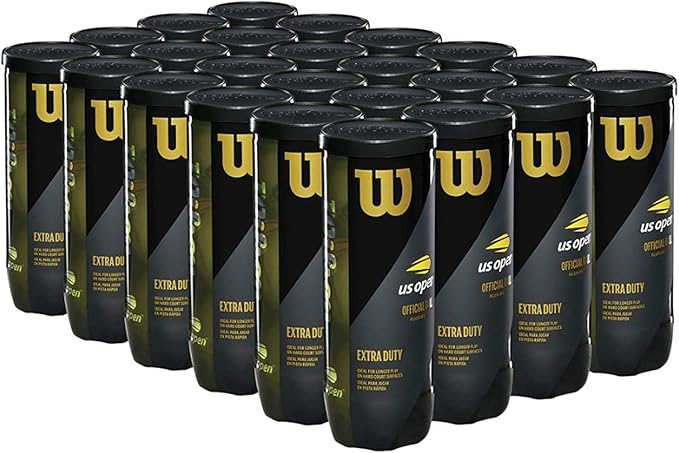
“Wilson US Open Extra Duty (24-can case): official tournament ball in bulk.”
See Today’s Price →What we like
- 24-can case (72 balls) at bulk pricing serves clubs, facilities, and players who go through multiple cans per session
- Wilson's US Open formula matches the ball used at one of the four Grand Slams — genuine tournament-quality construction, not a lower-grade club ball
- Extra-duty felt performs longer on hard courts (concrete, asphalt) before fluffing out — regular-duty felt wears faster on abrasive hard court surfaces
- Case format eliminates individual can pricing and simplifies storage for programs that track ball inventory
Watch out for
- Premium price for bulk buying
- overkill for casual players who rarely open new cans
- pressurized cans can fail to seal if left in hot vehicles
Read Full Analysis
Wilson US Open balls are the official balls of the US Open, played on DecoTurf hard courts, making them the Extra Duty standard by which all other hard court balls are measured. The WRT Extra Duty felt is engineered to maintain consistent nap and pressure through 3-5 sets of play — the durability standard that tournament directors demand. At $130 for a 24-can case, the upfront cost is significant but the per-ball cost is lower than buying smaller packs. For clubs, teaching pros, and serious recreational players who go through high ball volumes, the case purchase makes clear economic sense. Each can contains 3 balls sealed under pressure. The weakness for casual players is obvious: 72 balls is overkill if you play once a week. But for teams, clubs, or households with multiple players, Wilson US Open in bulk is the best tennis ball investment at this price tier.

“Wilson Championship (single can): reliable single-can purchase for occasional players.”
See Today’s Price →What we like
- 3-pack
- Regular duty
- Wilson championship quality
- Budget value
Watch out for
- Cans lose pressure faster in cold weather
- Felt texture wears down after 5-7 hours of court time
- Less durable than pressureless balls in hot dry climates
Read Full Analysis
Wilson Championship in the standard 3-ball can is the accessible entry point — a reputable brand at the lowest possible commitment. These are regular-duty felt balls appropriate for clay and indoor courts, or hard courts where you don't mind faster felt wear. At $3.59, the single can is the right buy for occasional players, someone testing whether they'll stick with tennis, or a casual game where ball quality isn't a priority. Wilson's manufacturing consistency means even their entry-level Championship ball plays predictably. The weakness is obvious: regular-duty felt on hard courts deteriorates faster than extra-duty alternatives, and the pressure starts declining after about two weeks of play. For the recreational player who hits once a month, this is fine. For anyone playing more than weekly, invest in the Extra Duty options above.
Frequently Asked Questions
What is the difference between Penn and Wilson tennis balls?
Do tennis balls go flat?
What tennis balls do professionals use?
Can I use any tennis ball on all court types?
Are Wilson US Open balls worth buying for recreational play?
How We Analyze Products
We analyze Amazon review data — often thousands of reviews per product — to surface patterns that individual buyers miss. Our process aggregates star ratings, review counts, and buyer sentiment at scale, identifying which strengths and weaknesses appear consistently across the largest review samples available. The 34,908+ reviews analyzed on this page represent real verified-purchase feedback from Amazon buyers.
Each product earned its placement through data: total review volume, average rating, and the specific praise and complaints that repeat most often across buyers. No manufacturer paid for placement on this page. Products appear here because buyers endorsed them at scale, not because a company asked us to feature them.
We use AI to summarize review sentiment — not to fabricate opinions, but to condense what thousands of buyers actually wrote into a readable format. The pros and cons you see reflect the most common themes found in verified purchaser reviews, paraphrased for clarity. We do not claim to have accessed Reddit, YouTube, or specific publications in generating these summaries.
Prices shown reflect Amazon pricing at the time this page was last generated. Click “See Today’s Price” to get the current live price on Amazon. Read our full methodology →