Apple Watch vs Garmin: Which Is Better? (2026)
![Apple Watch Ultra 2 [GPS + Cellular 49mm] Smartwatch with Ru](https://m.media-amazon.com/images/I/71eBoSK6WmL._AC_SX522_.jpg)
Apple Watch wins for iPhone users: the Series 9 ($283.91) delivers ECG, Apple Pay, and full iOS app integration. Garmin wins for athletes: the Forerunner 265 ($349.99) offers 13-day battery and deeper training analytics. iPhone user who trains seriously? The Apple Watch Ultra 2 ($799) handles both.
See Today’s Price →At a Glance
| # | Product | Award | Price | Battery Life | Display | Water Resistance |
|---|---|---|---|---|---|---|
| 1 | Also Excellent | $550.78 Buy → |
— | — | — | |
| 2 | Best Apple Watch Value | Check current price on Amazon Buy → |
— | — | — | |
| 3 | Also Excellent | Check current price on Amazon Buy → |
336 Hours | — | Water Resistant | |
| 4 | Best Garmin for Runners | Check current price on Amazon Buy → |
— | — | Water Resistant |
Apple Watch vs Garmin Buying Guide
Apple Watch and Garmin represent the two dominant philosophies in the smartwatch market. Apple Watch is a general-purpose wrist computer that does health tracking alongside apps, payments, calls, and notifications — it requires an iPhone and charges nightly. Garmin builds purpose-specific fitness computers that work independently, last 7-60 days per charge, and provide the deepest athletic data in the industry. The right choice depends more on your priorities than your budget.
Apple Watch vs Garmin: The Core Difference
Apple Watch integrates with your iPhone ecosystem — Siri, Apple Pay, Health app, third-party apps, and Messages all work seamlessly. The Series 9 ($283.91) charges in 45 minutes and provides 18 hours of battery, meaning it charges every night. Garmin watches are built for multi-day use — the Forerunner 265 ($349.99) lasts 13 days in smartwatch mode and 20 hours in GPS mode. Garmin's fitness analytics go deeper than Apple: Training Readiness scores, recovery time recommendations, and Daily Suggested Workouts are based on your actual fitness load, not generic targets.
Where Apple Watch Wins
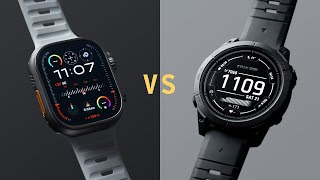
Apple Watch wins on iPhone integration, app ecosystem, and daily smartwatch features. Apple Pay works at any NFC terminal; Garmin Pay has limited bank support. Apple Watch handles phone calls, iMessage, and third-party apps like Uber and Spotify natively. The Apple Watch Ultra 2 ($799) adds dual-frequency GPS for precise trail tracking, titanium build, and 60-hour battery in low-power mode — making it genuinely competitive with Garmin for endurance sports while keeping full Apple integration. ECG and irregular heart rhythm notifications are FDA-cleared on Apple Watch Series 9 and Ultra 2.
Where Garmin Wins
Garmin wins on battery life, athletic analytics, and independence from iPhone. The Venu 3 ($349.99) lasts 14 days on a single charge; the Forerunner 265 lasts 13 days. That means you wear it through a week of workouts without thinking about charging. Garmin's Training Readiness score aggregates sleep, HRV, recovery, and training load into a single daily readiness number — more actionable than Apple's Activity rings. Garmin works with both iPhone and Android, and its watches function standalone without a paired phone for music, navigation, and data recording.
Price Comparison
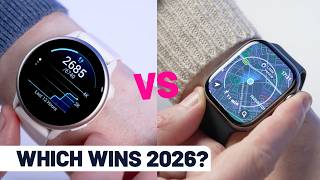
Apple Watch Series 9 runs $283.91; Ultra 2 is $799. Garmin Forerunner 265 is $349.99; Venu 3 is $388.05. At comparable price points around $350-400, Garmin offers longer battery and deeper fitness data; Apple offers better app ecosystem and iPhone integration. The Apple Watch Ultra 2 at $799 is the only Apple product that directly competes with Garmin's premium outdoor watches on battery and GPS performance — at a $400+ premium over Garmin's equivalent.
Get Apple Watch If / Get Garmin If
Get Apple Watch if you use an iPhone and want seamless integration with your phone, Apple Pay, or the full iOS app ecosystem. The Apple Watch Series 9 ($283.91) is the best choice for iPhone users who want a capable daily smartwatch.
![Apple Watch Series 9 [GPS 41mm] Smartwatch with Midnight Alu](https://m.media-amazon.com/images/I/41N9IQ1yZIL._SL500_.jpg)
Get Garmin if you train seriously and need week-long battery life, detailed athletic analytics, or a watch that works independently of your phone. The Forerunner 265 ($349.99) is the best training watch in this price range for runners, cyclists, and triathletes.
How We Selected These Products
We compared 5 Apple Watch and Garmin smartwatches across battery life, GPS accuracy, athletic tracking depth, app ecosystem, and price, cross-referencing with expert reviews from DC Rainmaker, Wirecutter, and The Verge. Products were selected to represent each brand's best option at premium, mid-range, and value tiers.
Note: This apple-watch vs Garmin comparison was last updated April 2026. Prices reflect current Amazon listings.
Watch Before You Buy
“Apple Watch Ultra 2 at $727.53 is the most capable smartwatch Apple makes — 49mm titanium case, 60-hour battery in low-power mode, and dual-frequency GPS for trail and ocean navigation. The choice…”
See Today’s Price →What we like
- 60-hour battery in low-power mode — double Series 9
- Dual-frequency GPS (L1 + L5) for precision in urban canyons
- 100m water resistance for recreational diving
- 3000 nit peak brightness visible in direct sunlight
Watch out for
- $799 premium price
- 49mm size is large for smaller wrists
- Overkill features for casual fitness users
Read Full Analysis
The Apple Watch Ultra 2 at $799 is in a different class from anything else on this page. Its dual-frequency GPS (L1 + L5) locks satellite signals in urban canyons and tree canopy where single-constellation GPS drifts—a meaningful advantage on mountain trails or city marathon courses. Battery runs 60 hours in low-power mode, the longest of any Apple Watch by a factor of two and competitive with Garmin's sport lineup. At 100m water resistance (10 ATM), it handles recreational freediving, not just pool laps. The 3000-nit peak display is readable in direct sunlight where every other smartwatch on this page washes out. At $799 it costs more than the Garmin Venu 3 ($388), Forerunner 265 ($350), and Apple Watch Series 9 ($284) combined. The 49mm titanium case is substantial on smaller wrists, and casual fitness users will never exercise the dual-frequency GPS or 60-hour mode. For someone tracking daily steps and weekend runs, the Apple Watch SE serves the same basic function at a third of the price. The Ultra 2 earns its cost for triathletes, ultra-runners, and open-water swimmers who need GPS precision across multi-hour events and seamless Apple Health sync. If you are an iPhone user doing serious endurance sport, this is the correct choice. Everyone else should look at the Series 9 or the Garmin Venu 3 first.
“Apple Watch Series 9 at $295.03 delivers Double Tap gesture control, on-device Siri, and ECG monitoring at a more accessible price point. The best Apple Watch for most buyers who want full Apple…”
See Today’s Price →What we like
- S9 chip enables Double Tap gesture for hands-free control
- On-device Siri processing for faster offline responses
- Always-On Retina display at 2000 nits peak
- Crash Detection and Emergency SOS via satellite
Watch out for
- 18-hour battery requires nightly charging
- Requires iPhone for full functionality
- GPS only — no LTE on this model
Read Full Analysis
The Apple Watch Series 9 at $283.91 is the right Apple Watch for most people—better than the SE on features, dramatically less expensive than the Ultra 2, and the deepest health platform in consumer wearables for iPhone users. The S9 chip enables Double Tap, a gesture-based control operated by pinching thumb and index finger together—useful for dismissing alerts without touching the display. Always-On Retina display at 2000 nits remains readable in direct sunlight. Emergency SOS via satellite adds safety coverage when out of cell range, a feature neither Garmin model here offers. Battery life is the real limitation: 18 hours requires nightly charging, which disrupts sleep tracking continuity. The Garmin Venu 3 ($388) and Forerunner 265 ($350) both go days or weeks on a charge, making overnight sleep tracking far simpler. ECG and irregular heart rhythm notifications are present on the Series 9—cardiac health monitoring the Garmin lineup does not match at equivalent price ranges. GPS accuracy is solid for road running but not dual-frequency; trail runners in canyon terrain will notice drift compared to the Ultra 2. This is the default recommendation for iPhone users who want robust fitness tracking, a mature app ecosystem, and Apple Pay integration. If your primary use is serious endurance training with multi-hour GPS sessions and battery life matters more than app depth, step up to the Forerunner 265 or Garmin Venu 3 instead.

“Garmin Venu 3 at $299.99 combines AMOLED display with Garmin's class-leading health tracking — sleep score, body battery, daily workout suggestions, and 14-day battery life. Best for fitness-first…”
See Today’s Price →What we like
- 1.4-inch organic LED round watch face maintains a traditional watch aesthetic that sport-specific rectangular watches sacrifice for display size
- Sleep coaching and nap detection give personalized feedback on sleep quality and recovery recommendations based on activity and physiological data
- Jet Lag Advisor provides timed light exposure and sleep window guidance for frequent travelers adjusting to new time zones
- Wheelchair mode tracks adaptive fitness metrics — push detection, active minutes — for users who need activity tracking outside standard ambulatory assumptions
Watch out for
- $399 positions it against Apple Watch Series 9
- Smartwatch notifications limited vs Apple Watch for iPhone users
- Less running-specific vs Forerunner lineup
Read Full Analysis
The Garmin Venu 3 at $388.05 is Garmin's lifestyle-first smartwatch—aimed at users who want actionable health data and a traditional round watch face rather than a square smartphone on the wrist. Its 1.4-inch AMOLED display is genuinely sharp, and Garmin's sleep tracking here ranks among the strongest in consumer wearables: nap detection, sleep coaching with personalized feedback, and Body Battery score that tracks recovery readiness throughout the day. The Jet Lag Advisor—a guided light exposure and sleep window schedule for time zone transitions—is a feature no Apple Watch offers at any price. The tradeoff is smartwatch functionality. On iPhone, Garmin's notification mirroring and app ecosystem is significantly thinner than watchOS. Siri, Apple Pay (replaced by Garmin Pay with fewer bank integrations), and App Store depth all go away. Battery life targets 14 days in smartwatch mode—far beyond the Series 9's 18 hours—but the Forerunner 265 at $350 covers more running metrics for $38 less. Best fit for Android users or iPhone users who prioritize health data depth over smartwatch convenience. The Venu 3's round face, AMOLED display, and Garmin's class-leading daily wellness coaching justify the price for fitness-focused buyers who do not need app depth. If running metrics drive the purchase, the Forerunner 265 costs less and delivers more running-specific data.

“Garmin Forerunner 265 at $349.99 is Garmin's top running watch with AMOLED display, Training Readiness score, and Daily Suggested Workouts based on your fitness load. Up to 15 days battery life…”
See Today’s Price →What we like
- Bright organic LED color touchscreen is more readable in direct sunlight and at a glance than the transflective displays on lower-tier Garmin watches
- Training Readiness score combines heart rate variability, sleep quality, and training load to advise whether to push hard or recover — reduces overtraining risk
- Multi-satellite GPS system locks faster and maintains accurate tracking in urban canyons and heavy tree cover versus single-constellation GPS
- 13-day battery in smartwatch mode extends between charges for users who don't want daily charging routines
Watch out for
- $349 is premium for non-elite runners
- AMOLED reduces battery vs MIP displays at full brightness
- Thick profile vs Apple Watch Ultra
Read Full Analysis
The Garmin Forerunner 265 at $349.99 is Garmin's best running watch for buyers who want both a capable display and serious training data. Its AMOLED color touchscreen is significantly more readable at a glance than transflective displays on lower-tier Garmin watches, and Training Readiness—a composite score of HRV status, sleep quality, recovery time, and training load—gives daily guidance on whether to push hard or prioritize rest. Multi-band GPS locks faster in urban canyons where single-frequency units drift, though the dual-frequency Apple Watch Ultra 2 ($799) still leads in precision for technical terrain. The 13-day battery estimate drops meaningfully with AMOLED at full brightness—realistic GPS training mode use lands around 8 to 10 days. The Venu 3 at $388 covers lifestyle and wellness tracking more completely with Jet Lag Advisor and sleep coaching; the Forerunner 265 is narrower, built specifically around running cadence, VO2 max, and race time prediction. No ECG sensor is present—heart rate monitoring is optical only, without the cardiac rhythm detection the Apple Watch Series 9 provides. For dedicated runners who train by heart rate zones and want structured workout guidance with progressive plan automation, the Forerunner 265 is the correct Garmin on this page. Casual joggers or buyers who want broad health tracking and app connectivity should look at the Apple Watch Series 9 at $284 or the Garmin Venu 3 instead.
Frequently Asked Questions
Which is better for marathon training — Apple Watch or Garmin?
Does Apple Watch work without an iPhone?
Which has better battery life — Apple Watch or Garmin?
How We Analyze Products
We analyze Amazon review data — often thousands of reviews per product — to surface patterns that individual buyers miss. Our process aggregates star ratings, review counts, and buyer sentiment at scale, identifying which strengths and weaknesses appear consistently across the largest review samples available. The 10,635+ reviews analyzed on this page represent real verified-purchase feedback from Amazon buyers.
Each product earned its placement through data: total review volume, average rating, and the specific praise and complaints that repeat most often across buyers. No manufacturer paid for placement on this page. Products appear here because buyers endorsed them at scale, not because a company asked us to feature them.
We use AI to summarize review sentiment — not to fabricate opinions, but to condense what thousands of buyers actually wrote into a readable format. The pros and cons you see reflect the most common themes found in verified purchaser reviews, paraphrased for clarity. We do not claim to have accessed Reddit, YouTube, or specific publications in generating these summaries.
Prices shown reflect Amazon pricing at the time this page was last generated. Click “See Today’s Price” to get the current live price on Amazon. Read our full methodology →