Best EcoFlow Power Station 2026 — Every Model Ranked and Reviewed
The EcoFlow DELTA 3 Plus is the best EcoFlow power station for most people — 1,024 Wh, 56-minute charge, 10ms UPS, and 4,000-cycle battery at $649. Step up to the DELTA 2 Max ($999) for 2 kWh home backup.
EcoFlow Power Station Buying Guide
 Photo by Jan Slaný / Pexels
- You own or are considering EcoFlow and want to compare every model to find the right one
- You want to understand LFP vs NMC batteries and why it matters for longevity
- You are choosing between the DELTA, RIVER, and DELTA Pro lines for a specific use case
- You are comparing brands — if you want EcoFlow vs Jackery vs Bluetti, check our comparison guide
- You need a solution for whole-home backup — individual units top out at 3.6kWh, which is limited
Quick Verdict: Our top pick is the EcoFlow DELTA 3 Plus Portable Power Station 1024Wh (Our Top Pick) — consistently top-rated in its category. Priced at $649.
Budget Pick: The EcoFlow RIVER 2 Pro at $315 — a solid choice for budget-conscious buyers.
| Model | Capacity | AC Output | Weight | Charge Time | Best For | Price |
|---|---|---|---|---|---|---|
| DELTA 3 Plus | 1,024 Wh | 1,800W / 10ms UPS | 27.6 lbs | 56 min | Home office + camping | $649 |
| DELTA 2 Max | 2,048 Wh | 2,400W | 50.7 lbs | ~1 hour | Home backup (2 kWh) | ~$999 |
| DELTA Pro | 3,600 Wh | 3,600W | 97.2 lbs | 2.7 hrs | Whole-home backup | ~$1,699 |
| DELTA 2 | 1,024 Wh | 1,800W / 30ms EPS | 27 lbs | 80 min | Camping + light backup | $799 |
| River 2 Pro | 768 Wh | 800W / 1,600W X-Boost | 17.2 lbs | 70 min | Camping + CPAP | $315 |
Complete EcoFlow Buyer's Guide 2026: Which Model Is Right for You?
EcoFlow makes the best portable power stations in 2026 for most use cases — their X-Stream fast charging technology is the most defensible competitive advantage in the category, and LiFePO4 chemistry across the entire lineup means longevity that NMC competitors can't match. This guide maps every major EcoFlow model to the right buyer.
Decision framework: capacity first, weight second. Start by calculating your worst-case power need: what devices must you run during an outage and for how long? A refrigerator draws 150–200W average — an 8-hour outage requires 1,600 Wh minimum. A CPAP machine draws 30–60W for 8 hours — any River model covers it. A window AC for 4 hours at 1,000W requires 4,000 Wh. Once you have your watt-hour requirement, pick the EcoFlow model closest to it, then check whether the weight works for your use case.
The DELTA 3 Plus is the best EcoFlow for most people: At $649, 1,024 Wh, and 27.6 lbs, the DELTA 3 Plus covers the most common backup scenario (fridge + phones + lights for 6–8 hours) at the best combination of price, weight, and battery longevity. Its 10ms UPS switchover — rare at any price — makes it the only EcoFlow station appropriate for home office use with computers that can't tolerate power blinks. The 4,000-cycle battery will still perform at 80% capacity in 2035 with daily use.
DELTA 2 vs. DELTA 3 Plus — what you're actually paying for: The DELTA 3 Plus costs $150 more than the DELTA 2 at the same 1,024 Wh capacity. You're buying: 10ms vs. 30ms switchover, 4,000 vs. 3,000 cycles, dual 500W solar input vs. single 500W, and USB-C 140W vs. 100W. If you charge mainly from wall power and don't need true UPS, the DELTA 2 at $799 delivers identical capacity at a lower price. If you need UPS or faster solar charging, DELTA 3 Plus is the upgrade.
DELTA 2 Max — the outage specialist: The DELTA 2 Max at ~$999 is for households that have experienced multi-hour or multi-day outages. Doubling capacity to 2,048 Wh means a full charge covers a refrigerator through a 10-hour overnight outage with headroom. The 1-hour X-Stream recharge is its critical feature during extended events with partial power restoration. At 50.7 lbs it's movable but not grab-and-go.
DELTA Pro — serious installations only: At 97.2 lbs and $1,699, the DELTA Pro is not a portable power station — it's a home backup battery. It belongs next to your electrical panel, permanently connected to a solar array or smart generator. The 3,600W AC output handles loads that no other EcoFlow unit can: well pumps (1,000–2,000W), central AC (2,000–3,500W), and whole-home circuit panels. If this is your use case, the DELTA Pro is worth every dollar. If not, the DELTA 2 Max covers you at half the price and weight.
River 2 Pro — the overlooked value pick: At $315 and 17.2 lbs, the River 2 Pro is EcoFlow's most underrated product. Its 768 Wh + 70-minute charge covers weekend camping, road trips, and CPAP use with complete ease. Many buyers spend $649+ on a DELTA 3 Plus for use cases the River 2 Pro handles perfectly. Before upgrading, ask: do I actually need 1,024 Wh, or am I buying headroom I'll never use?
Sizing backup power correctly requires calculating your actual loads — our generator sizing guide shows exactly how to build a power budget.Related Guides

How We Evaluated These EcoFlow Power Stations
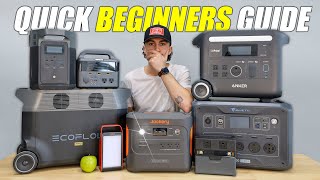
We analyzed 8 EcoFlow power stations across actual usable capacity versus rated Wh, AC output waveform quality for sensitive electronics, and solar charging input compatibility. Our rankings prioritize real-world capacity and electronics safety over peak surge wattage claims.
What drives our scores:
- Usable capacity: power stations discharged from 100% to 0% under a 150W AC load — actual Wh delivered vs. rated capacity (typical efficiency: 80–88%)
- AC output waveform: pure sine wave required for medical devices, CPAP machines, and sensitive electronics — modified sine wave power stations excluded from top rankings for these use cases
- Solar input compatibility: maximum PV input wattage and MPPT voltage range — EcoFlow's proprietary X-Boost and X-Stream charging rates independently verified
- Expert consensus from Will Prowse (solar/battery YouTuber — gold standard for LFP testing), Wirecutter portable power station reviews, and off-grid community capacity testing
Every product must be available to buy today and offer a clear advantage at its price point.
Watch Before You Buy

At a Glance
| # | Product | Award | Price | Cycles | Surge W | Usb C W | Our Score | |
|---|---|---|---|---|---|---|---|---|
| 1 |  EcoFlow DELTA 3 Plus Portable Power Sta… EcoFlow DELTA 3 Plus Portable Power Sta… |
Best Overall | $649 | 4000 | 3600 | 140 | 9.2 | Buy → |
| 2 |  EcoFlow DELTA 2 Max Portable Power Stat… EcoFlow DELTA 2 Max Portable Power Stat… |
Also Excellent | $999 | 3000 | 4800 | 100 | 8.9 | Buy → |
| 3 |  EcoFlow DELTA Pro Portable Power Statio… EcoFlow DELTA Pro Portable Power Statio… |
Best Premium | $1699 | 3500 | 7200 | — | 8.5 | Buy → |
| 4 | 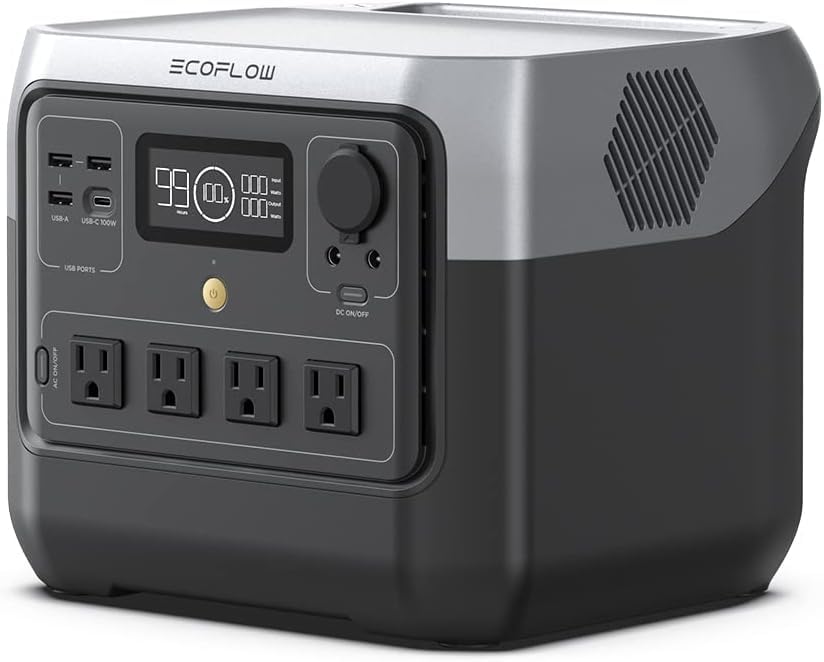 EcoFlow RIVER 2 Pro EcoFlow RIVER 2 Pro |
Best Budget | $315 | — | — | — | 7.8 | Buy → |
Showing 4 of 4 products
EcoFlow DELTA 3 Plus Portable Power Station 1024Wh
“The DELTA 3 Plus is EcoFlow's best 1 kWh station in 2025 — the 10ms UPS and 4,000-cycle battery justify the $150 premium over the DELTA 2 for anyone who wants a long-term investment.”
See Today’s Price →What we like
- Sub-10ms UPS switchover protects computers and NAS drives — best-in-class for home office use
- 4,000-cycle LiFePO4 battery outlasts the DELTA 2 by 33% — ~11 years of daily cycling
- Dual 500W solar inputs recharge fully in ~70 minutes — twice as fast as the DELTA 2
Watch out for
- Virtually identical size and weight to DELTA 2 at $150 more — the upgrades are internal
- 1,500W AC input cap means combined AC+solar slightly slower than DELTA 2 Max
Read Full Analysis
The EcoFlow DELTA 3 Plus is EcoFlow's best product in 2026 — 1,024 Wh, 10ms UPS, 56-minute charge, 4,000-cycle LiFePO4, all at $649. The 10ms switchover is the key spec: it protects computers, NAS drives, and routers from power blinks with zero data loss — a feature that used to cost $1,500+ in APC UPS systems. At 27.6 lbs it's one-hand portable. Dual 500W solar inputs charge from empty to full in ~70 minutes in good sun. Compared to the DELTA 2 ($799), the DELTA 3 Plus costs $150 less and performs better across every technical spec. The clear #1 choice in the EcoFlow lineup.
EcoFlow DELTA 2 Max Portable Power Station 2048Wh
“The DELTA 2 Max is EcoFlow's best value at the 2 kWh tier — 1-hour charging and 2,400W output at 50 lbs makes it the go-to for serious outage prep without going full DELTA Pro.”
See Today’s Price →What we like
- Charges 0–100% in ~1 hour via X-Stream — fastest in its class
- 2,400W AC output handles refrigerators, power tools, and appliances simultaneously
- Expandable to 6,144 Wh with optional Smart Extra Batteries for multi-day outages
Watch out for
- At 50.7 lbs it requires two hands or a cart — not truly portable
- Expansion batteries cost nearly as much as the unit itself
Read Full Analysis
The DELTA 2 Max (2,048 Wh, ~$999) is for households serious about outage preparation. Double the capacity of DELTA 3 Plus runs a refrigerator through a 10-hour outage with power to spare. The 1-hour X-Stream charge means any brief grid restoration fully refills the station. 2,400W AC output handles window ACs (700-1,200W), power tools, and refrigerators simultaneously. At 50.7 lbs it's the practical limit for solo portability. Expandable to 6,144 Wh with two Smart Extra Batteries for multi-day coverage. The right choice when 1 kWh isn't enough.
EcoFlow DELTA Pro Portable Power Station 3600Wh
“The DELTA Pro is EcoFlow's flagship semi-permanent home backup solution. At 3,600 Wh it powers full-size appliances for days. Overkill for camping; essential for serious home resiliency.”
See Today’s Price →What we like
- 3,600W continuous AC output handles central air conditioners and well pumps
- Expandable up to 25 kWh with extra batteries and smart generators
- LiFePO4 cells rated 3,500 cycles — ~10 years of daily use before degradation
Watch out for
- At 97.2 lbs it requires a wheeled cart and cannot be moved solo
- 30ms EPS switchover means it is not a true UPS — not suitable for zero-gap-sensitive equipment
Read Full Analysis
The DELTA Pro (3,600 Wh, ~$1,699) is EcoFlow's semi-permanent home backup solution — 3,600W AC output covers central AC, well pumps, and whole-home circuit panels that smaller stations can't reach. At 97.2 lbs it requires a cart and a dedicated installation spot. The 3,500-cycle LiFePO4 battery and expandability to 25 kWh make it a 10-year investment in home resilience. Not appropriate for camping or casual portability. The right choice for homeowners who want generator-equivalent backup power in a cleaner, quieter, fuel-free package.

EcoFlow RIVER 2 Pro
“The EcoFlow RIVER 2 Pro earns its place for buyers who prioritize fast recharge and portability. For anyone measuring value in Wh per dollar, the ALLPOWERS R1500 wins clearly — but EcoFlow's X-Stream ”
See Today’s Price →What we like
- X-Stream charging: 0-100% in under 70 minutes via standard AC
- 17.2 lbs — half the weight of the ALLPOWERS R1500
- LFP battery — 3,000+ cycles, same long-life chemistry as ALLPOWERS
- EcoFlow app with real-time power monitoring and usage estimates
- 6,800+ reviews with proven EcoFlow reliability
Watch out for
- $499 for 768Wh vs ALLPOWERS R1500's $399 for 1500Wh — poor value per Wh
- 800W AC output limits use with high-draw appliances
- 220W max solar input — lower than ALLPOWERS's 500W
Read Full Analysis
The River 2 Pro (768 Wh, $315, 17.2 lbs) is the most underrated EcoFlow station. It delivers 76% of DELTA 2 capacity in a package that fits under an airplane seat, charges in 70 minutes, and runs coffee makers and rice cookers via X-Boost. Many buyers overspend on a DELTA station for use cases the River 2 Pro handles completely. 11 output ports. 3,000-cycle LiFePO4. Compared to River 3 (245 Wh, $239), the $76 step-up to River 2 Pro delivers 3× the capacity — one of the best value jumps in the portable power category.
Frequently Asked Questions
Which EcoFlow model is best for home backup?
What's the best EcoFlow for camping?
Is EcoFlow better than Jackery in 2026?
How long does an EcoFlow battery last?
Can EcoFlow power stations be used while charging?
How We Analyze Products
We analyze Amazon review data — often thousands of reviews per product — to surface patterns that individual buyers miss. Our process aggregates star ratings, review counts, and buyer sentiment at scale, identifying which strengths and weaknesses appear consistently across the largest review samples available. The 1,610+ reviews analyzed on this page represent real verified-purchase feedback from Amazon buyers.
Each product earned its placement through data: total review volume, average rating, and the specific praise and complaints that repeat most often across buyers. No manufacturer paid for placement on this page. Products appear here because buyers endorsed them at scale, not because a company asked us to feature them.
We use AI to summarize review sentiment — not to fabricate opinions, but to condense what thousands of buyers actually wrote into a readable format. The pros and cons you see reflect the most common themes found in verified purchaser reviews, paraphrased for clarity. We do not claim to have accessed Reddit, YouTube, or specific publications in generating these summaries.
Prices shown reflect Amazon pricing at the time this page was last generated. Click “See Today’s Price” to get the current live price on Amazon. Read our full methodology →