Best EcoFlow Portable Solar Panel (2026)

The EcoFlow 220W Bifacial Solar Panel ($349) is the better choice for EcoFlow Delta 2 or Delta 3 Plus users who want the fastest possible solar recharge. The 160W Panel ($249) is the right size for EcoFlow River 3 users and anyone who prioritizes lighter weight over charging speed.
See Today’s Price →At a Glance
Showing 2 of 2 products
EcoFlow 220W Bifacial Portable Solar Panel
“The best EcoFlow solar panel for serious off-grid use. The bifacial design adds real energy in field conditions, and IP68 means you leave it out in rain without worry.”
See Today’s Price →What we like
- Bifacial rear panel captures reflected ambient light for up to 25% extra energy — no competitor at this price offers this
- IP68 waterproofing and tempered glass construction handle rain and rough field conditions
- Built-in adjustable angle guide (30–60°) makes precise solar positioning easy for beginners
Watch out for
- At 20.9 lbs it is noticeably heavier than single-sided portable panels
- Bifacial rear-side gain is minimal on dark soil — best on gravel, sand, or a reflective ground mat
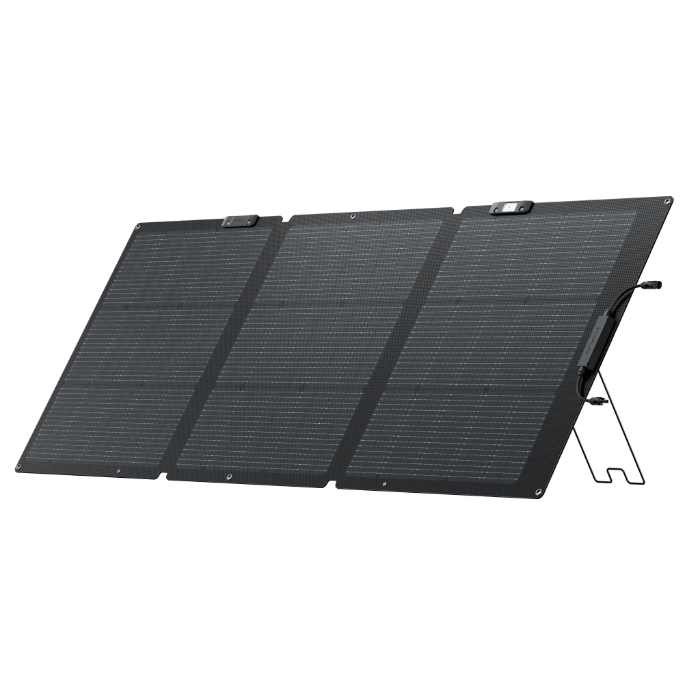
EcoFlow 160W Portable Solar Panel
“EcoFlow's most portable serious solar panel — the 160W foldable is the right choice for car camping and van life where weight and packability matter more than peak wattage.”
See Today’s Price →What we like
- Folds flat and deploys in seconds — best power-to-weight ratio in EcoFlow's panel lineup
- IP68 weatherproofing charges through light rain without risk of damage
- 22% panel efficiency matches premium single-sided panels at a competitive price
Watch out for
- Single-sided design captures 15–22% less real-world energy than the 220W bifacial
- 160W peak only achievable in ideal direct-sun conditions; expect 100–120W in typical use
EcoFlow Portable Solar Panel (2026) Buying Guide
EcoFlow's portable solar panel lineup is designed to pair specifically with EcoFlow power stations — the MPPT charge controllers in EcoFlow's Delta and River series are optimized for EcoFlow panel voltage and current characteristics. While third-party panels work with EcoFlow power stations, EcoFlow's own panels guarantee compatibility and allow the Ecoflow app to report real-time solar input wattage accurately. The two main models — 160W and 220W Bifacial — cover the range of portable panel wattage most useful for single-panel charging setups.
What Bifacial Solar Panels Mean in Practice
The EcoFlow 220W Bifacial panel is a dual-sided panel — it generates electricity from both the front (direct sunlight) and rear (diffused and reflected light) surfaces. The rear surface typically adds 10-25% additional power generation in environments with reflective surfaces like snow, water, sand, or light-colored pavement. In a forest camping environment without reflective surfaces, bifacial efficiency gains are minimal. The bifacial design also enables a "kickstand" panel angle — you can lean the panel at an angle and the rear surface captures ground-reflected light that a standard panel would miss entirely. If your typical use environment includes any of these reflective conditions, the bifacial premium is justified. If you're primarily in a wooded or shaded environment, the standard 160W panel may deliver similar real-world output at a lower price.
EcoFlow 160W Portable Solar Panel — Best for River Series and Light Travel
The EcoFlow 160W panel ($249) is designed for portable setups where weight and packability matter as much as charging speed. It folds down to a briefcase form factor and weighs approximately 9.5 lbs — light enough to carry alongside an EcoFlow River 3 (245Wh, ~7.7 lbs) as a combined 17-lb charging kit that delivers practical off-grid capability. The 160W output matches the River 3's 160W solar input limit perfectly — the panel fully charges the River 3 in approximately 2-3 hours of direct sunlight.
For larger power stations (Delta 2 Max, Delta 3 Plus), a single 160W panel extends charge time significantly — the Delta 3 Plus (1024Wh) would take 6-8 hours to fully charge from a single 160W panel in ideal conditions. Users with larger power stations who want useful solar charging should consider the 220W panel or chaining two 160W panels in series/parallel (EcoFlow's Delta series supports up to 800W solar input with multiple panels).
EcoFlow 220W Bifacial Solar Panel — Best for Delta Series Users
The EcoFlow 220W Bifacial panel ($349) is the best single-panel choice for EcoFlow Delta power station users who want the fastest possible solar recharge. The Delta 3 Plus accepts up to 500W solar input — a single 220W panel fills approximately 44% of that capacity, charging the 1024Wh Delta 3 Plus in roughly 3-5 hours of direct sunlight versus 6-8 hours with the 160W. The 38% power increase from 160W to 220W ($100 more) is meaningful for anyone planning multi-day off-grid use where daily solar recharge must keep pace with daily consumption.
The bifacial design adds value in camping environments with light-colored ground cover (sand, gravel, snow) where rear-surface generation can add 15-25% real-world output. The 220W panel weighs approximately 13.2 lbs — heavier than the 160W, but still within practical carry range for campsite-to-campsite setups. Both panels use a folding kickstand design that allows angle adjustment without additional mounting hardware.
Pairing Panels with EcoFlow Power Stations
The general rule for panel selection: choose a panel wattage that matches approximately 25-35% of your power station's capacity for a practical daily recharge rate. A 160W panel covers a full recharge of the River 3 (245Wh) in about 2 hours — ideal daily cycling. The same panel takes 6+ hours for the Delta 3 Plus (1024Wh) — usable but slow. The 220W Bifacial covers the Delta 3 Plus in approximately 3-4 hours — practical for full-day camping. For the Delta 2 Max (2048Wh), two 220W panels (440W total) provide a reasonable daily recharge rate in sunny conditions. EcoFlow's app provides real-time solar input and estimated time-to-full that makes managing multi-panel charging easy once you're in the field.
If you're also considering ecoFlow Solar Panel Review 2026 — 220W Bifacial vs 160W Compared, see our EcoFlow Solar Panel Review 2026 — 220W Bifacial vs 160W Compared. If you're also considering portable Solar Panels 2026: 100W, 200W & Foldable, see our Best Portable Solar Panels 2026: 100W, 200W & Foldable. If you're also considering jackery vs EcoFlow Portable Power Stations, see our Jackery vs EcoFlow Portable Power Stations (2026).
How We Analyze Products
We analyze Amazon review data — often thousands of reviews per product — to surface patterns that individual buyers miss. Our process aggregates star ratings, review counts, and buyer sentiment at scale, identifying which strengths and weaknesses appear consistently across the largest review samples available.
Each product earned its placement through data: total review volume, average rating, and the specific praise and complaints that repeat most often across buyers. No manufacturer paid for placement on this page. Products appear here because buyers endorsed them at scale, not because a company asked us to feature them.
We use AI to summarize review sentiment — not to fabricate opinions, but to condense what thousands of buyers actually wrote into a readable format. The pros and cons you see reflect the most common themes found in verified purchaser reviews, paraphrased for clarity. We do not claim to have accessed Reddit, YouTube, or specific publications in generating these summaries.
Prices shown reflect Amazon pricing at the time this page was last generated. Click “See Today’s Price” to get the current live price on Amazon. Read our full methodology →