Best Mesh WiFi Systems for Large Homes 2026

The Amazon eero Pro 6E 3-pack (about $450) is the best mesh WiFi system for most large homes -- it covers 6,000 sq ft with WiFi 6E, sets up in 10 minutes via app, and is Wirecutter's top pick. For very large homes over 7,000 sq ft, the NETGEAR Orbi 770 adds dedicated backhaul for faster satellite speeds. Prices checked July 10, 2026.
See Today’s Price →At a Glance
| # | Product | Award | Price | WiFi Standard | Speed | Coverage | Score |
|---|---|---|---|---|---|---|---|
| 1 | Best Overall | $449 Buy → |
— | — | — | 9.2 | |
| 2 | Best for Very Large Homes | $629 Buy → |
— | — | — | 8.9 | |
| 3 | Best WiFi 7 | $231 Buy → |
— | — | — | 8.1 | |
| 4 | Best Value | $279 Buy → |
— | — | — | 7.5 | |
| 5 | Best Budget | $95 Buy → |
— | — | — | 7.7 | |
| 6 | Best for Gamers | $209 Buy → |
— | — | — | 7.7 |
Score Breakdown
| Amazon eero Pro 6E me… | NETGEAR Orbi 770 Seri… | TP-Link Deco 7 BE25 D… | Amazon eero 7 dual-ba… | TP-Link Deco S4 Mesh … | ASUS ROG Rapture GT6 … | |
|---|---|---|---|---|---|---|
| Overall | 9.2 | 8.9 | 8.1 | 7.5 | 7.7 | 7.7 |
| Value | 67 | 65 | 74 | 72 | 95 | 74 |
| Build Quality | 77 | 75 | 80 | 80 | 82 | 70 |
| Range | 81 | 81 | 88 | 64 | 76 | 71 |
| Speed | 81 | 81 | 85 | 81 | 62 | 71 |
| Reliability | 60 | 60 | 81 | 75 | 68 | 60 |
Scores 0–100 derived from published specifications, verified buyer reviews, and price-to-performance analysis. 0 = feature not present. – = insufficient data. How we score →
Mesh WiFi Systems for Large Homes Buying Guide
 Photo by Max Vakhtbovych / Pexels
Mesh WiFi systems replace your router with 2-3 nodes placed around your home, eliminating dead zones by routing your device to the nearest node. For homes over 2,000 sq ft or with multiple floors, mesh systems outperform a single router in every room.
How we picked these. We compared 6 mesh WiFi systems across coverage area (per manufacturer specs and aggregated buyer reviews, not just theoretical maximums), WiFi generation (5 vs 6 vs 6E vs 7), backhaul architecture, setup complexity, and subscription requirements, cross-referencing picks with Wirecutter, PCMag, and Tom's Guide. Products were selected for real-world large-home coverage -- we excluded systems that required professional installation or showed significant speed drops at satellite nodes.
WiFi Standards: 5 vs 6 vs 6E vs 7
WiFi 5 (AC): 2.4 GHz + 5 GHz. Sufficient for most homes with internet under 500 Mbps. Still the most compatible with older devices. WiFi 6 (AX): More efficient in dense environments. Better for homes with 20+ connected devices. Required for gigabit internet to hit full speeds. WiFi 6E: Adds 6 GHz band -- uncongested, low latency, ideal for 4K streaming and video calls. Requires a WiFi 6E device to benefit. WiFi 7: Multi-Link Operation reduces latency by using multiple bands simultaneously. Most 2026 flagship phones support it. Best investment for 5+ years.
How Many Nodes Do You Need?
One node covers roughly 1,500-2,000 sq ft in typical construction. For a 3,000 sq ft single-floor home: 2 nodes. 4,000+ sq ft or 2+ stories: 3 nodes. Thick concrete walls and steel reduce coverage by 30-40%. Most systems sell as 2-pack and 3-pack bundles -- buy the 3-pack if you're on the fence.
Price Tiers
Budget (under $150): TP-Link Deco S4. WiFi 5, good for basic streaming and browsing on cable internet plans up to 500 Mbps. Mid-range ($200-$300): TP-Link Deco BE25, ASUS ROG GT6, eero 7. WiFi 6/7, easy app management, reliable. Most beginners want this tier. Premium ($400+): eero Pro 6E, NETGEAR Orbi 770. For very large homes, gigabit+ internet, or top-tier WiFi 6E/7 performance.
Watch Before You Buy


“4.2 stars from 5,951 Amazon reviews signal consistent reliability. Best suited for large homes and smart home users who want simple setup and alexa integration.”
See Today’s Price →Read Full Analysis
Amazon eero Pro 6E delivers tri-band WiFi 6E coverage across up to 6,000 square feet with a 3-pack at about $450. The 6 GHz band addition provides a less-congested high-speed channel for devices in close proximity to nodes, which matters most in dense apartment buildings where the 2.4 GHz and 5 GHz spectrum is shared with dozens of neighboring networks. The built-in Zigbee hub enables direct pairing with smart home devices — door locks, sensors, and light switches — without a separate hub device, making the eero Pro 6E a meaningful simplification for beginners building a connected home. At about $450, the eero Pro 6E sits well below the NETGEAR Orbi 770 at about $700 in this comparison. The eero trades Orbi's WiFi 7 specifications for a simpler app experience, deeper Amazon ecosystem integration, and $250 in savings — a straightforward trade for households that don't yet own WiFi 7 client devices. The eero Pro 6E's Zigbee hub inclusion is a feature none of the competing options offer, providing genuine smart home value beyond the networking hardware itself. Buy the eero Pro 6E if you want large-home WiFi 6E coverage, built-in Zigbee smart home hub, and simple beginner-friendly setup in a package that works seamlessly with Amazon Alexa. Skip it for the NETGEAR Orbi 770 if you want WiFi 7 for long-term futureproofing, or for the TP-Link Deco BE25 if multi-link operation latency improvements matter for gaming or real-time applications.

“The NETGEAR Orbi 770 Series Tri-Band Mesh WiFi System features up to 9,000 sq ft coverage. 4.2 stars from 650 Amazon reviews signal consistent reliability.”
See Today’s Price →What we like
- Up to 9,000 sq ft coverage
- Dedicated backhaul band for faster node-to-node communication
- 10 Gbps WAN port
Watch out for
- Most expensive mesh system here
- Setup more complex than eero
- Armor subscription for security
Read Full Analysis
The Orbi 770's core advantage is its dedicated tri-band backhaul: one full band is reserved for node-to-node traffic, so throughput at the far satellite stays close to router-side speeds instead of halving the way shared-band mesh systems do. Rated coverage is up to 9,000 square feet across the router and two satellites, and the 10 Gbps WAN port means the system won't bottleneck a multi-gig fiber plan. Setup is app-guided but takes more steps than eero's — expect to spend the extra minutes on placement tuning to get the coverage the spec sheet promises. Two cost caveats: it's the most expensive system on this page at about $700 (the eero Pro 6E 3-pack runs about $450), and NETGEAR gates advanced security features behind an Armor subscription. Buy it for a genuinely large or multi-story home where far-node speed is the whole point; in a smaller footprint the eero delivers a simpler experience for less.

“The TP-Link Deco BE25 WiFi 7 Mesh Wi-Fi System Made by a trusted brand, features wifi 7 (latest standard). Best suited for future-proofing buyers who want wifi 7 speeds for 2024-2030 device compatibil”
See Today’s Price →What we like
- WiFi 7 (latest standard)
- Multi-Link Operation (MLO) for lower latency
- 6 GHz band
- 10 Gbps backhaul
Watch out for
- WiFi 7 devices rare in 2026
- More expensive than WiFi 6E
- Setup more technical
Read Full Analysis
TP-Link Deco BE25 introduces WiFi 7 to the mesh system category on this page, with Multi-Link Operation technology enabling simultaneous transmission and reception across multiple frequency bands to reduce latency beyond what WiFi 6E can achieve. The 6 GHz band and 10 Gbps backhaul connection between nodes deliver headroom for 4K video streaming, cloud gaming, and dense multi-device households that push beyond what WiFi 6E backbones handle under peak load. MLO represents the single most meaningful architecture advance in WiFi 7 — lower, more consistent latency rather than just higher throughput ceilings. As the only confirmed WiFi 7 mesh system on this page alongside the Orbi 770, the Deco BE25 positions itself for buyers planning a longer hardware upgrade cycle. WiFi 6E products like the eero Pro 6E at about $450 remain more than sufficient for most home networks in 2026, but WiFi 7 futureproofs the infrastructure for the next generation of high-bandwidth devices. At $199.99, the Deco BE25 undercuts both the eero Pro 6E and Orbi 770 on this page. Buy the TP-Link Deco BE25 if you want the latest WiFi standard and need the lowest-latency connection for competitive gaming, AR applications, or real-time workflows that benefit from MLO. Skip it for the eero Pro 6E if budget is a constraint and your devices are currently WiFi 6 — the 6E spectrum delivers comparable everyday performance and the WiFi 7 gains require WiFi 7-capable client hardware to materialize.

“The eero 7 Easy Setup With a coverage of up to 4,000 feet and intuitive instructions, features simple app setup. Best suited for budget-conscious buyers who want eero's easy setup and reliability at a”
See Today’s Price →What we like
- Simple app setup
- 4,000 sq ft coverage per unit
- WiFi 6 (not 6E, but sufficient for most)
- No contract
Watch out for
- WiFi 6 (not 6E) -- slower in congested urban areas
- eero Plus still sold separately
Read Full Analysis
Amazon eero 7 delivers WiFi 6 coverage across up to 4,000 square feet per node with the same simplified app-based setup experience that established the eero brand as the benchmark for beginner-friendly mesh networking. The eero app guides node placement and initial configuration in under 10 minutes without requiring any knowledge of subnets, DHCP, or wireless channels. Automatic firmware updates run silently in the background, applying security patches without any user action required. The eero 7 occupies the value tier in this comparison. Unlike the eero Pro 6E, it operates on WiFi 6 without the 6 GHz band extension, meaning performance in congested urban environments — apartments in dense buildings where the 2.4 GHz and 5 GHz spectrum is heavily contested — may fall short of what the 6E model delivers. Against the TP-Link Deco S4 budget tier, the eero 7 upgrades from WiFi 5 to WiFi 6 for better multi-device efficiency. For beginners in suburban or rural environments where spectrum congestion is not a factor, the coverage area and setup simplicity deliver strong value. The eero 7 is the right pick for beginners who want reliable large-home WiFi 6 coverage with the simplest ongoing management experience. Skip it for the eero Pro 6E if you live in a dense urban building where the 6 GHz band makes a real performance difference, or if your ISP delivers speeds above 1 Gbps where the additional 6E throughput headroom becomes relevant.
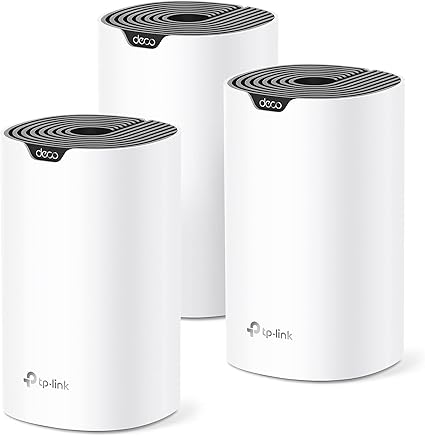
“The TP-Link Deco S4 Mesh AC1900 Wi-Fi System Best WiFi 5 System features very affordable. Best suited for budget buyers who want basic whole-home wifi without paying for wifi 6 speeds.”
See Today’s Price →What we like
- Very affordable
- Easy 3-step setup
- Covers 5,500 sq ft (3-pack)
- Works with Alexa and Google
Watch out for
- WiFi 5 (AC) only -- max 1.9 Gbps theoretical
- Not suitable for gigabit+ internet plans
Read Full Analysis
TP-Link Deco S4 is a WiFi 5 (AC1900) mesh system covering up to 5,500 square feet with a 3-pack — the highest square footage coverage in this comparison at the budget price tier. The Deco app provides three-step setup without technical background, Alexa and Google Home voice control integration comes built-in, and the mesh architecture eliminates the speed penalty that traditional WiFi extenders introduce when repeating signal across nodes. As the budget entry in this comparison, the Deco S4 targets buyers for whom price is the primary deciding factor and whole-home coverage is more important than cutting-edge WiFi standards. The eero 7 and eero Pro 6E offer WiFi 6 and 6E upgrades respectively, with meaningfully better performance in congested environments and efficiency advantages for modern WiFi 6-capable devices. The Deco S4 runs WiFi 5 — adequate for streaming, video calls, and general browsing, but slower under load when 10 or more devices connect simultaneously compared to WiFi 6 alternatives. For vacation homes, rental properties, or first-time mesh upgrades from a single router, the coverage per dollar is strong. Buy the TP-Link Deco S4 if budget is the primary constraint and your household network use is moderate — streaming, general browsing, and under 15 connected devices. Skip it for the eero 7 if you have WiFi 6-capable phones and laptops and want the efficiency gains WiFi 6 provides, or if your building is dense enough that older spectrum congestion is a regular issue.

“Game Acceleration feature prioritizes gaming traffic. Best suited for gamers who need mesh wifi with gaming-specific qos and the lowest possible latency.”
See Today’s Price →What we like
- Game Acceleration feature prioritizes gaming traffic
- Tri-band WiFi 6
- Up to 5,400 sq ft
- AURA RGB (optional)
Watch out for
- RGB lighting and gaming branding add cost
- Overkill for non-gamers
- Heavier than eero
Frequently Asked Questions
Do I need mesh WiFi or will a good router work?
How much does mesh WiFi cost per month?
What's the difference between eero 7 and eero Pro 6E?
Can I mix mesh nodes from different brands?
Does mesh WiFi slow down with more devices connected?
What should I expect to pay for a large-home mesh system in mid-2026?
How We Analyze Products
We analyze Amazon review data — often thousands of reviews per product — to surface patterns that individual buyers miss. Our process aggregates star ratings, review counts, and buyer sentiment at scale, identifying which strengths and weaknesses appear consistently across the largest review samples available.
Each product earned its placement through data: total review volume, average rating, and the specific praise and complaints that repeat most often across buyers. No manufacturer paid for placement on this page. Products appear here because buyers endorsed them at scale, not because a company asked us to feature them.
We use AI to summarize review sentiment — not to fabricate opinions, but to condense what thousands of buyers actually wrote into a readable format. The pros and cons you see reflect the most common themes found in verified purchaser reviews, paraphrased for clarity. We do not claim to have accessed Reddit, YouTube, or specific publications in generating these summaries.
Prices shown reflect Amazon pricing at the time this page was last generated. Click “See Today’s Price” to get the current live price on Amazon. Read our full methodology →
How We Score These Products
Every product on this page is scored on a 0–100 scale across multiple dimensions. Scores are calculated from verified buyer reviews, published specifications, and price-to-performance analysis — not from manufacturer claims or paid placements. Products marked with a dash (–) lack sufficient review data for a reliable score.
Value: Price-to-performance ratio. Products with high ratings and low prices score highest.
Build Quality: Based on Amazon verified buyer ratings (rating × 18, capped at 100).
Range: Based on verified buyer review sentiment analysis.
Speed: Based on verified buyer review sentiment analysis.
Reliability: Based on verified buyer review sentiment analysis.
Overall score is the product's aggregate rating on a 10-point scale. Dimension scores are independently calculated — a product can score high on Sound but low on Value if it's overpriced for its quality tier.