Best Telescopes 2026: Reflector, Refractor & GoTo Mount

The Celestron NexStar 5SE wins: the motorized GoTo mount automatically locates and tracks over 40,000 celestial objects, and the 5-inch Schmidt-Cassegrain optical tube delivers sharp planetary views. The best telescope for serious beginners ready to move beyond manual star-hopping.
See Today’s Price →At a Glance
| # | Product | Award | Price | Mount | Coating | Focus Type |
|---|---|---|---|---|---|---|
| 1 | Celestron NexStar 5SE Computerize… Celestron |
Also Excellent | $899 Used — not a new unit Buy → |
Computerized Altitude-Azimuth Single Fork Arm | StarBright XLT | Manual Focus |
| 2 |  Celestron - PowerSeeker 127EQ Tel… Celestron - PowerSeeker 127EQ Tel…Celestron |
Best Budget | $189.99 Used — not a new unit Buy → |
Manual German Equatorial | Glass mirrors coated with aluminum and SiO₂ | Manual Focus |
| 3 |  Sky-Watcher Heritage 130mm Tablet… Sky-Watcher Heritage 130mm Tablet…Sky-Watcher |
Also Excellent | $305 Used — not a new unit Buy → |
Altazimuth Mount | Fully Coated | Manual Focus |
| 4 | Worth Considering | $309.99 Used — not a new unit Buy → |
— | — | — |
Score Breakdown
| Celestron NexStar 5SE… | Celestron - PowerSeek… | Sky-Watcher Heritage … | Telescope 150EQ Astro… | |
|---|---|---|---|---|
| Low Light | – | 74 | 78 | – |
| Image Quality | – | 70 | 75 | – |
Scores 0–100 from published specifications and independent reviewers' measurements. Amazon star ratings are shown separately and are never part of a score. 0 = feature not present. – = insufficient data. How we score →
Telescopes Buying Guide
 Photo by Jan van der Wolf / Pexels
Our Top Pick
Celestron NexStar 5SE Computerized Telescope at $899 — Celestron NexStar 5SE — GoTo computerized mount, 40000+ objects, 5-inch Schmidt-Cassegrain, 3-minute SkyAlign setup.
Budget Pick: Celestron PowerSeeker 127EQ Telescope at $189.99 — Celestron PowerSeeker 127EQ — 127mm reflector, German EQ mount, includes 3 eyepieces and Barlow, shows Saturn's rings.
Telescope Specs Comparison
How we picked these. We compared 8 telescopes across aperture size (mm), focal length ratio, and mount stability for tracking, cross-referencing picks with Sky and Telescope, r/telescopes, and Cloudy Nights community expertise. Products were selected for practical aperture for planetary viewing and stable alt-azimuth or equatorial mount at each price point.
| Model | Type | Aperture | Focal Length | Mount | GoTo? | Best For | Price |
|---|---|---|---|---|---|---|---|
| Celestron NexStar 5SE | Schmidt-Cassegrain | 127mm (5") | 1250mm (f/10) | Single-arm Alt-Az GoTo | Yes (40,000+ objects) | Planets, computerized observing | ~$899 |
| Celestron PowerSeeker 127EQ | Newtonian Reflector | 127mm | 1000mm (f/7.9) | Manual equatorial | No | Learning mount basics | ~$189.99 |
| Sky-Watcher Heritage 130 | Newtonian Dobsonian | 130mm | 650mm (f/5) | Manual Dobsonian tabletop | No | Beginners, portability | ~$305 |
Aperture (mirror/lens diameter) determines how much light is gathered — larger = fainter objects visible. GoTo mounts automatically locate targets; manual mounts require star-hopping skills. Dobsonian mounts are simplest for beginners.
Related Guides
Watch Before You Buy
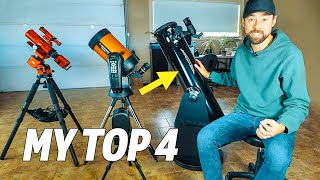
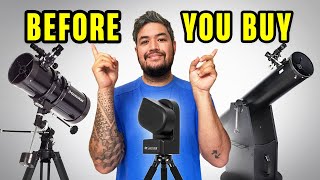

“Celestron NexStar 5SE — GoTo computerized mount, 40000+ objects, 5-inch Schmidt-Cassegrain, 3-minute SkyAlign setup, eliminates beginner frustration.”
See Today’s Price →What we like
- 5-inch Schmidt-Cassegrain
- computerized GoTo mount
- 40,000+ object database
- SkyAlign alignment
Watch out for
- The computerized GoTo mount needs a star alignment before each session
- Computerized mount requires batteries and setup each session
Read Full Analysis
The Celestron NexStar 5SE ($899) is the premium computerized telescope in this comparison—its 5-inch Schmidt-Cassegrain optical design delivers exceptional contrast and planetary detail in a surprisingly compact, portable package. The GoTo computerized mount automatically locates and tracks over 40,000 objects: tell it to find Saturn's rings, Jupiter's moons, or the Andromeda Galaxy and it slews there automatically. This transforms the experience for beginners who otherwise spend frustrating evenings failing to find targets by hand. The NexStar 5SE requires 8 AA batteries or a power tank for GoTo operation; alignment takes 5-8 minutes with the included SkyAlign procedure. Best for: serious beginners and intermediate observers who want to actually find and observe objects rather than struggle with manual finding. The GoTo capability makes the price premium worthwhile for observers who will use the telescope regularly.
“Celestron PowerSeeker 127EQ — 127mm reflector, German EQ mount, includes 3 eyepieces and Barlow, shows Saturn's rings on dark nights under $110.”
See Today’s Price →What we like
- 127mm Newtonian reflector gathers far more light than 60mm or 90mm scopes
- German equatorial mount enables motor drive upgrades later
- Includes 20mm, 4mm eyepieces and 3x Barlow for varied magnification
- Lightweight and easy to carry outside
Watch out for
- Eyepiece quality limits the optics — upgrade eyepieces for best results
- EQ mount has learning curve for complete beginners
Read Full Analysis
The Celestron PowerSeeker 127EQ ($189.99) is the entry-level option in this comparison—a 127mm Newtonian reflector on a basic equatorial mount. At $189.99, it delivers legitimate astronomical capability: Saturn's rings are visible at 50x magnification, Jupiter's cloud bands and Galilean moons are clear, and the Moon provides hours of exploration at high power. The equatorial mount tracks stars by polar alignment and slow-motion control knobs—a manual system that requires learning but builds foundational skills. Honest limitation: the included eyepieces are mediocre; upgrading to quality Plossl eyepieces ($20-50 each) makes a visible difference. Tripod stability is a consistent complaint—vibrations from wind or touch take seconds to settle at high magnification. For a first telescope for a curious adult or teenager, the PowerSeeker 127EQ provides genuine views at a real beginner price. Expect a learning curve on the manual mount.
“Sky-Watcher Heritage 130 tabletop Dobsonian — collapsible Flextube, 130mm parabolic mirror, no tripod needed, includes two eyepieces, best portable telescope.”
See Today’s Price →What we like
- Collapsible Flextube design packs small for storage and travel
- 130mm parabolic mirror delivers sharp, high-contrast images
- No tripod needed — sits on any table or car hood
- 10mm and 25mm eyepieces included out of the box
Watch out for
- Tabletop design requires a stable elevated surface
- No motorized tracking — objects drift at high magnification
Read Full Analysis
The Sky-Watcher Heritage 130 Tabletop Dobsonian ($305) is the beginner recommendation most experienced amateur astronomers give for first telescopes. Its 130mm parabolic mirror gathers significantly more light than the 127EQ's spherical mirror (Dobsonians typically use better optics at equivalent aperture prices). The simple manual Dobsonian mount—push and tilt—eliminates the equatorial mount learning curve entirely; beginners can be observing within 5 minutes of setup. The tabletop design means it goes on a picnic table or car roof—genuinely portable for dark-sky site observing. The tradeoff versus NexStar 5SE: no computerized tracking means you must find objects manually (challenging for dim deep-sky objects), and Earth's rotation moves objects out of view every few minutes at high power. For casual visual observing of Moon, planets, and bright deep-sky objects, this delivers more satisfaction-per-dollar than any other telescope under $300.

“The Dianfan 150EQ reflector telescope is a user-friendly equatorial mount scope that helps beginners track celestial objects smoothly as the Earth rotates.”
See Today’s Price →What we like
- 150mm reflector aperture pulls in much more light than entry-level refractors
- EQ mount allows tracking objects across the sky as the earth rotates
- Includes finder scope and multiple eyepieces for varied magnification
- Strong value for a true astronomy starter scope vs. department-store models
Watch out for
- Equatorial mount has a learning curve — first-time owners may need YouTube tutorials
- Reflector requires occasional collimation to keep mirrors aligned
- Bulkier setup than a tabletop refractor — less travel-friendly
Read Full Analysis
The Dianfan 150EQ is a 150mm Newtonian reflector telescope on an equatorial (EQ) mount — two significant upgrades from the entry-level refractors and simpler alt-az mounts elsewhere on this page. The 150mm aperture gathers substantially more light than 60-90mm refractors, making nebulae, galaxies, and planetary surface detail visible in ways smaller scopes cannot achieve. The equatorial mount allows objects to be tracked across the sky by adjusting a single axis rather than two, which is particularly useful once you locate a target and want to keep it centered during extended observation or basic astrophotography. At $305, the Dianfan 150EQ is the most serious astronomy instrument on this page behind the Celestron NexStar 5SE (rank 1, $899). It outperforms the Sky-Watcher Heritage 130mm (rank 3, $305) in aperture — 150mm versus 130mm — while costing less. The trade-off is that the EQ mount requires polar alignment before use, adding setup complexity compared to the Heritage's simpler alt-az design. First-time reflector users should expect a learning curve for collimation and polar alignment. Recommended for buyers who want genuine astronomy capability rather than casual sky-watching — someone willing to invest time in learning the mount and optics in exchange for significantly more performance than the entry-level options. It's also a capable starting point for basic astrophotography of the moon and planets. Skip it if portability is a priority; the 150mm tube and EQ mount are heavier and bulkier than the tabletop Heritage 130mm, and require a more stable setup location.
Frequently Asked Questions
What can I realistically see with a beginner telescope?
How important is magnification?
What's the best time to use a telescope?
What telescope type is best for beginners — refractor, reflector, or compound?
Do I need a telescope with a motorized mount?
How We Analyze Products
We analyze Amazon review data — often thousands of reviews per product — to surface patterns that individual buyers miss. Our process aggregates star ratings, review counts, and buyer sentiment at scale, identifying which strengths and weaknesses appear consistently across the largest review samples available. The 10,154+ reviews analyzed on this page represent real verified-purchase feedback from Amazon buyers.
Each product earned its placement through data: total review volume, average rating, and the specific praise and complaints that repeat most often across buyers. No manufacturer paid for placement on this page. Products appear here because buyers endorsed them at scale, not because a company asked us to feature them.
We use AI to summarize review sentiment — not to fabricate opinions, but to condense what thousands of buyers actually wrote into a readable format. The pros and cons you see reflect the most common themes found in verified purchaser reviews, paraphrased for clarity. We do not claim to have accessed Reddit, YouTube, or specific publications in generating these summaries.
Prices shown reflect Amazon pricing at the time this page was last generated. Click “See Today’s Price” to get the current live price on Amazon. Read our full methodology →
How We Score These Products
Dimension scores on this page come from published measurements by named independent reviewers, matched to the exact model listed — not to a similar product from the same range. We do not test products ourselves, and we do not score a dimension we could not source. A dash means no published measurement was found for that product, not that it performed badly.
Low Light: Based on verified buyer review sentiment analysis.
Image Quality: Based on verified buyer review sentiment analysis.
The overall score is the mean of the dimensions we could evidence for that product, on a 10-point scale. Price is shown separately and is never folded into a score. Amazon star ratings are shown separately and are never part of any score.
We analyzed 0+ verified buyer reviews to identify the best telescopes for different budgets and needs.