Google Nest vs Kasa Smart 2026: Which Smart Home Brand Wins?

Choose Google Nest for AI-powered features (camera person detection, learning thermostat) within a Google-centric household. Choose Kasa for affordable smart plugs and light switches that work with Alexa, Google, and Siri without ecosystem lock-in.
See Today’s Price →At a Glance
Google Nest vs Kasa Smart Buying Guide
Google Nest and Kasa Smart (by TP-Link) both build connected home devices, but they occupy different market positions. Google Nest is a premium ecosystem centered on Google's AI and voice platform. Kasa is a budget-to-mid-range brand focused on delivering reliable smart plugs, switches, and bulbs at competitive prices without requiring a hub. The right choice depends on how deep into a smart home ecosystem you want to go.
Google Nest: The Premium Ecosystem Play
Google Nest covers thermostats, cameras, doorbells, smart displays, speakers, and smoke detectors. Their differentiators are deep Google Assistant integration, the Google Home app, and AI-powered features across devices. Highlights:
- Nest Thermostat: Learns your schedule automatically, integrates with Google's energy-saving programs, remote control via app or voice
- Nest Cam and Doorbell: 24/7 recording (wired), AI detection for people vs packages vs animals, Google Photos-style event history
- Google Nest Mini/Hub: Central voice control point for the whole home, tightly integrated with Android devices and Google services
- Price range: $120.15 (Nest Mini) to $120.15+ (Nest Learning Thermostat), cameras $99–$200+
Google Nest devices work together seamlessly but require the Google Home ecosystem and work best if your household already uses Android and Google services. Apple HomeKit support is limited; Amazon Alexa integration exists but is less polished than native Google Assistant control.
Kasa Smart: Reliable Basics at Budget Prices
TP-Link's Kasa Smart line focuses on smart plugs, light switches, power strips, and bulbs. Their approach: no hub required, works with all three major voice platforms (Alexa, Google Assistant, Siri via Matter), and strong performance at $10–$30 per device. Highlights:
- Kasa Smart Plug (HS103): Compact design, works with both Alexa and Google Assistant, energy monitoring not included at base tier
- Kasa Smart Plug with Energy Monitoring (KP125M): Tracks real-time power consumption — useful for identifying energy hogs
- Kasa Smart Power Strip (HS300): 6 independently controlled outlets plus 3 USB ports, individual plug scheduling
- Price range: $10–$35 for most devices, 2-packs and 4-packs widely available
Kasa's strength is simple, reliable execution at low cost. Their plugs and switches work out-of-the-box in minutes and rarely require troubleshooting. The Kasa app is functional but less polished than Google Home.
Compatibility, Voice Control, and App Experience
Kasa devices support Alexa, Google Assistant, and increasingly Matter (enabling Siri/HomeKit support). Google Nest devices are optimized for Google Assistant but have added Alexa compatibility. If your household mixes voice assistant preferences (some rooms Alexa, some Google), Kasa's multi-platform support is a practical advantage. For a fully unified experience, Google Nest delivers better within-ecosystem integration.

App experience: Google Home is more polished with better automation triggers and AI routines. Kasa's app is simpler — faster to set up, fewer features, less likely to have complex bugs.
Which Brand Should You Choose?
Choose Google Nest if you're building or expanding a smart home ecosystem centered on Google services, want AI-powered features (person detection, schedule learning, energy programs), and are willing to pay premium prices. Choose Kasa if you want reliable smart plugs and switches at low cost without ecosystem lock-in, and value compatibility across voice platforms. Many homes use both: Nest for thermostats and cameras (where Google's AI adds real value), Kasa for smart plugs and light switches (where simplicity and price matter more).
Google Nest and Kasa represent two different approaches to smart home integration. See Ecobee vs Google Nest Thermostat for the climate control side of the ecosystem, Best Smart Plugs for compatible accessories, and our WiFi Router Buying Guide to support all connected devices reliably.
Watch Before You Buy



“The Google Nest Google Nest Thermostat - Smart Thermostat for Home - Programmable Wifi Thermostat - Snow features learning algorithm. 4.0 stars from 28,703 Amazon reviews signal consistent…”
See Today’s Price →What we like
- Learning algorithm
- 10-year warranty
- Farsight display
- remote sensor compatible
- works with Alexa Google
Watch out for
- Entry Nest model — no color display or premium Farsight feature on budget version
- Learning requires consistent schedule to work well
- No built-in sensor for remote rooms
Read Full Analysis
The Google Nest Thermostat earns "Best Overall" on this Google Nest vs Kasa comparison as the flagship smart home device from the Nest ecosystem. As the most capable Nest-side product here, the Nest Thermostat provides direct Wi-Fi scheduling, remote temperature management via the Nest app, and integration with both Alexa and Google Home — a different category of smart home automation than the Kasa smart plug and power strip, which control plug-in devices rather than central HVAC systems. The key distinction on a Nest vs Kasa page: the Nest Thermostat manages your whole-home heating and cooling system directly, while Kasa accessories offer on/off control for individual plug-in devices. For homeowners with central HVAC, that's a higher-value automation target. It's the largest single investment in this comparison, but it addresses a fundamentally different use case than smart plugs. The honest limitations: some older HVAC systems require a C-wire adapter for compatibility, the programmable schedule requires upfront setup effort to realize savings, and the 4.0 stars from 28,703 Amazon reviews — solid but below the Kasa products' ratings. Best for homeowners who want to add smart control to central heating and cooling rather than managing individual plug-in devices.
“Compact design — doesn't block adjacent outlet. 4.5 stars from 9,038 Amazon reviews signal consistent reliability.”
See Today’s Price →What we like
- Two plugs per pack
- No hub needed: 2.4GHz Wi-Fi
- Works with Alexa, Google Assistant and IFTTT
- Schedules, room grouping and a random vacation mode
- Can react to Wyze Sense motion and door sensors
Watch out for
- 2.4GHz Wi-Fi only
Read Full Analysis
The Kasa Smart Plug HS103P2 2-Pack delivers app-controlled outlet switching in a compact design that fits both outlets in a standard duplex without blocking the adjacent socket — a practical detail frequently missed by bulkier smart plugs. The Kasa app provides robust scheduling with daily, weekly, and countdown timer options, and compatibility covers Alexa, Google Home, and Samsung SmartThings without requiring a separate hub. With over 85,000 verified reviews it is one of the most field-tested and consistently reliable smart plug models available. On this Google Nest vs Kasa comparison, the HS103P2 2-pack is the most affordable entry and serves outlet-level device control rather than the whole-home climate management the Google Nest Thermostat handles. Both the Kasa plug and the Nest Thermostat work with Google Home and Google Assistant, making them complementary products in a single smart home rather than direct competitors. The Kasa plug adds scheduled outlet control to any Google ecosystem household at $14.99 per outlet. The Kasa HS103P2 2-pack is the best value option for adding app-controlled outlet switching to lamps, fans, holiday lights, or any outlet-powered device in a Google or Alexa household. It pairs well with the Google Nest Thermostat rather than replacing it — one manages climate, the other manages outlets. For multi-outlet management with per-plug monitoring, the Kasa HS300 Power Strip on this page adds six individually controlled outlets in one device.
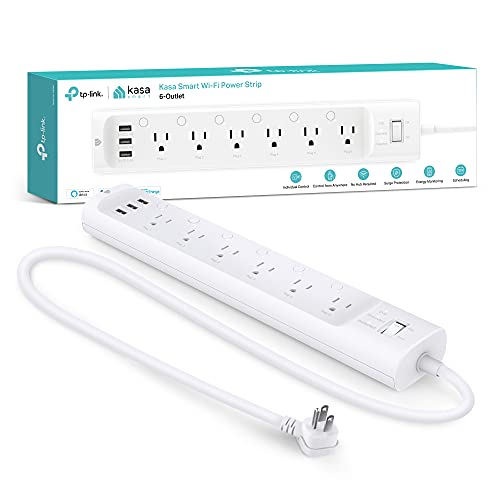
“6 individually app-controlled AC outlets (turn each on/off from phone). 4.5 stars from 9,335 Amazon reviews signal consistent reliability.”
See Today’s Price →What we like
- 6 individually app-controlled AC outlets (turn each on/off from phone)
- 3 USB-A ports
- Works with Alexa and Google Home
- Energy monitoring per outlet
- No hub required
Watch out for
- More expensive
- Smart features require Wi-Fi setup
Read Full Analysis
The Kasa Smart Power Strip HS300 provides six individually app-controlled AC outlets alongside three USB-A charging ports in a standard surge protector form factor that replaces a dumb power strip with smart control. Each of the six outlets toggles on or off independently from the Kasa app — you can cut power to a TV without affecting the router on the same strip, or schedule coffee makers and lamps on different timers. Per-outlet energy monitoring tracks each device's consumption and can identify appliances drawing unexpected power levels. On this Google Nest vs Kasa comparison, the HS300 is the most versatile Kasa product on the page, combining six independent outlets, USB charging, and energy monitoring in one managed device. The Google Nest Thermostat handles climate control and is a different product category entirely. All six HS300 outlets respond to Google Home voice commands — "Hey Google, turn off the TV" — making it directly compatible with any Nest ecosystem home without a hub. The Kasa HS300 is the right buy for entertainment centers or home offices where you want independent smart control over multiple devices plus USB charging in one managed strip. For single-outlet control, the Kasa HS103P2 2-pack is more cost-efficient at two locations. The HS300 is the step up when a desk or TV cabinet has five or more devices that benefit from scheduled or independent power management.
Frequently Asked Questions
Do Kasa Smart devices work with Google Home?
Is Google Nest compatible with Amazon Alexa?
Do Kasa devices require a hub?
Which is better for apartment renters — Nest or Kasa?
Will Google Nest devices still work if Google discontinues them?
How We Chose These Products
We compare each product’s Amazon listing, the manufacturer’s published specifications and Amazon customer ratings, shown with their review counts as Amazon’s data, and rank the products on how well they answer this page’s question. We do not test products in hand and we do not run our own analysis of review text. A publication or expert is named only where we cite its published findings about that product. No manufacturer paid for placement on this page.
A price appears only when Amazon’s API supplied it at a recent daily refresh, with the date and time beside it, and is withdrawn at 4 AM Central on the day after it turns 24 hours old; otherwise use “Check price on Amazon” for the live price. Read our full methodology →