How to Choose a Drone: Beginner's Guide (2026)
For most beginners: the DJI Mini 3 ($499 with controller) — under 250g so no FAA registration required, GPS stabilization, return-to-home, and 4K video. Upgrade to the Mini 4 Pro ($759) if low-light video quality is important.
At a Glance
How to Choose a Drone Buying Guide
 Photo by Aleson Padilha / Pexels
Choosing a first drone comes down to five decisions: size class, camera quality, flight time, FAA registration requirements, and whether you plan to fly indoors or outdoors. Getting this wrong means buying a drone you cannot legally fly, one that requires skills you have not yet developed, or one with a camera that does not meet your actual use case.
FAA Rules: What You Must Know Before Buying
In the US, any drone over 0.55 lbs (250g) must be registered with the FAA for $5 and the registration number marked on the drone. Flying requires following FAA Part 107 rules for recreational flyers: fly below 400 feet AGL, keep the drone in visual line of sight, never fly over people or moving vehicles, never fly near airports or controlled airspace without authorization via the FAA LAANC system, never fly at night without a waiver. Commercial use (selling photos or video) requires a Part 107 Remote Pilot Certificate — a written test. The DJI Mini 4 Pro at 249g and the DJI Mini 3 at 249g are intentionally designed to stay below the 250g registration threshold — a significant practical advantage for recreational flyers who want to avoid registration paperwork. Any drone over 250g needs registration before first flight.
Size Classes and What They're Good For
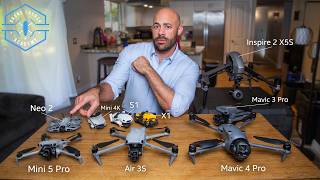
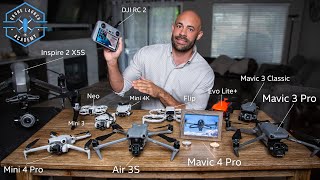
Micro/mini (under 250g): the right starting class for most beginners. Lighter, safer if it hits someone, qualifies for looser regulations, and modern examples like the DJI Mini 3 Pro ($759) produce stunning 4K video. The trade-off: more susceptible to wind (struggle above 15-20 mph) and shorter flight time (28-35 minutes typically). Mid-size (250g-900g): the DJI Air 3 ($299) and Autel EVO Lite+ ($299) — more stable in wind, better cameras, longer flight time (40-46 min), but heavier and more conspicuous. Large/prosumer (900g+): the DJI Mavic 3 Pro ($2,199) and higher — professional-grade stabilization, large sensors, used by commercial videographers. For first-time buyers: start in the under-250g class. You will crash. A crash in this class damages a $300-800 drone rather than a $2,200 one.

Camera Specs That Actually Matter
Drone cameras are spec-heavy but three things determine real-world footage quality: sensor size, gimbal quality, and video bitrate. Sensor size: 1/2" CMOS (DJI Mini 3) captures adequate light in good conditions. 1/1.3" CMOS (DJI Mini 4 Pro) handles lower light significantly better. 4/3" (Hasselblad on DJI Mavic 3) is professional territory. Gimbal stabilization: a 3-axis mechanical gimbal is mandatory for smooth video — 2-axis or EIS (electronic stabilization) produces acceptable but inferior footage on any drone that moves laterally. Video bitrate: 100 Mbps minimum for serious video work; below 50 Mbps produces compression artifacts during color grading. For real estate, travel, and personal content: the DJI Mini 3 Pro at $759 with a 1/1.3" sensor and 3-axis gimbal exceeds what most beginners need. For social media content only, the DJI Mini 3 at $499 is sufficient.
Flight Time and Range
Advertised flight times are measured in ideal (no wind, optimal speed, fresh battery) conditions. Real-world flight time is typically 80-85% of advertised: a 34-minute drone gives roughly 27-28 minutes usable flight time. Battery depletion accelerates in wind and cold. In sub-40°F temperatures, lithium-ion batteries lose 20-30% capacity — factor this into winter flying plans. Always land with at least 20% battery remaining to preserve cell health. Range is listed as the maximum radio distance — most beginners never approach this limit because visual line of sight (required by law) limits practical range to 400-800 meters.
Beginner Mistakes and What to Avoid
Buying before practicing: spend 2-4 hours on a drone simulator (DJI has a free one) before flying the real drone. This eliminates the most common crash scenarios — spatial disorientation and panic inputs during low battery. Flying in wind above your drone's rating: micro drones should not fly in sustained wind above 15 mph; they fight the wind using battery power, shorten flight time dramatically, and can lose position. Flying without checking airspace: the FAA B4UFLY app and AirMap show controlled airspace in real time. A first flight in controlled airspace without authorization can result in a $1,000+ fine. Buying the cheapest possible drone: sub-$299 no-name drones lack GPS stabilization — they drift constantly and require manual corrective inputs that beginners cannot provide reliably. The DJI Mini 3 at $299 (without RC) is the effective floor for a capable, stable first drone.
How We Evaluated This Guide
FAA registration and operational rules sourced from current FAA Part 107 and recreational flyer requirements. Camera specifications validated against DJI, Autel, and Skydio published technical documentation. For product picks, see our best drones for beginners, best drones under $100, and best drones overall.
Watch Before You Buy
“”
See Today’s Price →What we like
- Obstacle avoidance sensors reduce collision risk for pilots still building confidence in tight spaces
- Foldable compact design fits in a jacket pocket for spontaneous aerial capture without a dedicated bag
- 4K 60fps video capture delivers cinematic quality for social media and personal video projects
- Auto QuickShot modes create cinematic sequences including Dronie, Circle, and Helix with a single tap
Watch out for
- Premium pricing at $1779 requires a meaningful budget commitment
- Advanced configuration may require technical knowledge to fully optimize
Read Full Analysis
The DJI Flip Drone at $1,779 is the premium option on a page where both alternatives are $299—a price gap that reflects a fundamental difference in capability. Tri-directional obstacle avoidance sensors monitor the flight path for barriers, significantly reducing crash risk while a pilot is still building confidence in tight spaces like trees, buildings, and indoor environments. The 4K/60fps camera and Auto QuickShot modes—Dronie, Circle, Helix, and others—generate cinematic sequences automatically with a single tap, allowing beginners to produce polished aerial footage without manual flight choreography. The foldable chassis compresses to jacket-pocket size for spontaneous capture without a dedicated bag. At $1,779 it costs nearly six times the Ruko F11GIM2 ($299) and DJI Neo ($299). Both budget alternatives offer GPS return-to-home and basic 4K at their price points. The Ruko and Neo are the right learning tools for pilots who expect to crash during the skill-building phase; the DJI Flip's obstacle avoidance reduces that risk significantly but does not eliminate it. For a beginners guide page, the majority of new pilots are better served starting on a $299 machine before committing to a $1,779 investment. Best for beginners who want to skip the crash-heavy learning curve and start with professional obstacle avoidance, cinematic QuickShot automation, and 4K/60fps quality from the first flight—and have the budget to match. The DJI Neo at $299 is the correct starting point for everyone else; it shares DJI's reliability and GPS features at a far lower stakes entry price.

“The Ruko F11GIM2 Drone offers a solid beginner-to-intermediate feature set with GPS auto-return and a 4K camera. At $299 it strikes a good balance between capability and affordability for new pilots…”
See Today’s Price →What we like
- 4K camera with gimbal stabilization delivers smooth, professional-looking footage without the DJI price
- 56-minute combined flight time from two included batteries — longer session coverage than single-battery competitors
- GPS-assisted hover holds position in wind without manual correction for stable aerial photography
- Follow Me mode tracks and films a moving subject automatically without a second operator
Watch out for
- Advanced configuration may require technical knowledge to fully optimize
- Performance may lag behind premium models for intensive workloads
Read Full Analysis
The Ruko F11GIM2 is the gimbal-equipped version of Ruko's F11 series — the GIM2 designation specifically means a 2-axis mechanical gimbal stabilizes the 4K camera rather than relying on electronic stabilization alone. A mechanical gimbal is the key differentiator from budget drones at this price: it compensates for physical yaw and tilt during flight, resulting in smooth horizontal footage without the rolling shutter distortion that plagues non-gimbal drones in windy conditions. Brushless motors extend motor lifespan versus brushed competitors, GPS and optical flow sensors provide stable hovering indoors and outdoors, and two batteries provide approximately 56 minutes total flight time. At $299, the Ruko F11GIM2 is the more expensive drone on this page relative to the DJI Neo at matching price. The comparison with DJI is where the Ruko faces its hardest challenge: DJI's obstacle avoidance, camera processing, and flight control algorithms have years of engineering investment that Ruko has not matched. However, the Ruko F11GIM2 offers its 2-axis gimbal at $299 where DJI's budget gimbal drones (Mini 3) start at $459+ — making the Ruko the only sub-$300 option with a mechanical gimbal for buyers who can't reach DJI's price floor. The Ruko F11GIM2 is the best non-DJI gimbal drone for beginners who have a hard $300 budget and specifically need smooth, stabilized footage — real estate walk-arounds, travel videos, and outdoor event coverage benefit from the 2-axis gimbal in a way that EIS-only drones can't match. Skip it if you can stretch to $459+ for the DJI Mini 3: DJI's ecosystem, obstacle sensors, and 48MP camera quality are substantially better than what the Ruko delivers. Skip it also if you don't need a gimbal and want the maximum flight time at this price — other F11 variants without the gimbal fly longer per battery.

“The DJI Neo is one of DJI's most compact and beginner-friendly drones, with intelligent subject-tracking and one-button filming modes. Its lightweight design keeps it within easy regulatory limits…”
See Today’s Price →What we like
- Propeller guard design is safe enough for indoor flight — practice in a living room without risk of injury
- Under 249g weight avoids registration requirements in most operating scenarios
- Gesture control and auto-follow modes let solo creators film themselves without a second operator
- One-tap QuickShot modes produce cinematic aerial sequences without manual drone control expertise
Watch out for
- Advanced configuration may require technical knowledge to fully optimize
- Performance may lag behind premium models for intensive workloads
Read Full Analysis
The DJI Neo is DJI's most beginner-friendly drone, featuring built-in propeller guards that make indoor flight safe for practice in a living room without risk of injury or collateral damage — a feature that lets new pilots build confidence before taking the drone outdoors. At under 249 grams it falls below FAA registration requirements in most standard operating scenarios, removing a paperwork barrier for casual recreational flyers. Gesture control and auto-follow modes allow solo creators to film themselves without needing a second operator, and one-tap QuickShot cinematic modes produce aerial sequences without manual drone control expertise. At $299 on this drone guide, the DJI Neo matches the Ruko F11GIM2 on price while offering DJI's substantially more polished flight software, obstacle detection, and a larger ecosystem of accessories and support resources. The DJI Flip at $1,779 is a different-tier product entirely — a professional foldable aimed at advanced creators; the DJI Neo is specifically designed for beginners who want DJI reliability and automated filming modes at an accessible price point. DJI's QuickShot modes produce results the Ruko's manual flight cannot match for solo content creation. The DJI Neo is the right beginner drone for new pilots who want DJI's safety features, indoor capability through propeller guards, and automated filming modes without operating registration overhead. The Ruko F11GIM2 at $299 offers more conventional GPS-hold features for outdoor flying if manual control is preferred over automation. Step up to the DJI Flip only when professional-grade foldable design and 4K video for paid work justify the $1,479 price jump.
Frequently Asked Questions
Do I need to register my drone with the FAA?
How high can I legally fly a drone?
What is the best drone for a complete beginner?
How long does a drone battery last?
Can I fly a drone over my neighborhood?
What happens if I crash my drone?
How We Analyze Products
We analyze Amazon review data — often thousands of reviews per product — to surface patterns that individual buyers miss. Our process aggregates star ratings, review counts, and buyer sentiment at scale, identifying which strengths and weaknesses appear consistently across the largest review samples available. The 331+ reviews analyzed on this page represent real verified-purchase feedback from Amazon buyers.
Each product earned its placement through data: total review volume, average rating, and the specific praise and complaints that repeat most often across buyers. No manufacturer paid for placement on this page. Products appear here because buyers endorsed them at scale, not because a company asked us to feature them.
We use AI to summarize review sentiment — not to fabricate opinions, but to condense what thousands of buyers actually wrote into a readable format. The pros and cons you see reflect the most common themes found in verified purchaser reviews, paraphrased for clarity. We do not claim to have accessed Reddit, YouTube, or specific publications in generating these summaries.
Prices shown reflect Amazon pricing at the time this page was last generated. Click “See Today’s Price” to get the current live price on Amazon. Read our full methodology →