Best Compound Miter Saws of 2026

The DEWALT DWS715 12-Inch Single Bevel ($299) is the best compound miter saw for most users — it handles framing, trim, and flooring cuts with a 15A motor at the right price. Budget shoppers get the Metabo HPT C10FCGS at $139. Finish carpenters who need dual-bevel precision should step up to the Bosch GCM12SD at $649.
See Today’s Price →At a Glance
Compound Miter Saws of Buying Guide
 Photo by Christina & Peter / Pexels
A compound miter saw makes two types of cuts simultaneously: a miter (horizontal angle) and a bevel (tilt angle). That combination is what crown molding, picture frames, and angled trim demand. The question isn't whether to get compound — it's how much compound capability you actually need, and which features justify the price jump from $139 to $687.
Single Bevel vs Dual Bevel
How we picked these. We compared 6 tools and equipment across power output, build quality, ergonomics, and durability, cross-referencing expert reviews from Pro Tool Reviews, Tool Box Buzz, and This Old House and verified buyer feedback.
Single-bevel compound saws (DeWalt DWS713, DWS715; Makita LS1040) tilt the blade in one direction only. For most cuts this is fine — you flip the workpiece to cut the opposing angle. Dual-bevel saws (Bosch GCM12SD, Ridgid R4222) tilt both left and right, eliminating the flip and improving repeatability on complex crown molding runs. Dual bevel matters most when cutting long pieces that are awkward to flip or when making many identical compound cuts in succession. For occasional use, single bevel is sufficient and saves $100–$139.
Price Tiers: What You Get at Each Level
Under $200: The Metabo HPT C10FCGS ($139) is the honest entry point — a 15A 10" saw that handles most hobby and DIY work without the $300+ price tag. Its miter range (52° left/right) and 45° bevel cover standard cuts. $200–$350: This is where quality worksite saws live. DEWALT DWS713 ($199) gives you DEWALT's build quality in a single-bevel 10" package; DWS715 ($299) steps to 12" for wider crosscuts. The Ridgid R4222 ($199) adds dual-bevel at this price tier — exceptional value. Over $350: The Makita LS1040 ($369) and Bosch GCM12SD ($649) are for professional finish work. Bosch's Axial-Glide system and tighter detent tolerances justify its premium for carpenters doing high-end trim all day.
Our Picks and Why
For most homeowners and contractors: DEWALT DWS715 at $649. The 12" blade handles wider crown molding and longer stock than 10" models, and DEWALT's nationwide parts/service network means the saw stays running. Best budget pick: Metabo HPT C10FCGS at $139 — capable saw for weekend projects without a professional price. Best dual-bevel value: Ridgid R4222 at $199 — dual-bevel at single-bevel pricing, solid for crown molding work. Best precision: Bosch GCM12SD at $649 for finish carpenters who cut decorative trim all day and need sub-degree accuracy on every joint.
What to Avoid
Avoid no-name compound miter saws under $100 — detent accuracy and fence squareness are often off from the factory, meaning every cut needs shimming. Avoid buying a 12" saw primarily for capacity if you don't cut material wider than 6 inches — 10" blades are cheaper and perform equally for most trim work. Don't confuse a compound miter saw with a sliding compound miter saw: sliding models extend cut width significantly but cost more; if you only cut trim and baseboard, a non-sliding compound is usually sufficient and more compact.
Watch Before You Buy

“The Metabo HPT C10FCGS at $139 is the best-value professional-grade miter saw on this list — lightweight at 24 lbs, laser-guided for beginner accuracy, and backed by 9 positive miter stops for fast…”
See Today’s Price →What we like
- Best price for a professional-grade miter saw
- Lightweight at 24 lbs — portable and easy to store
- Laser guide improves beginner cut accuracy
- 9 positive miter stops for quick angle changes
- Very active online community with beginner tutorials
Watch out for
- Non-sliding limits crosscut width to 12 inches
- Stock blade is decent but a replacement improves results
- Dust bag captures ~70% of dust (add a shop vac for better collection)
Read Full Analysis
Metabo HPT (formerly Hitachi) has built a reputation for reliable, no-frills miter saws that hold their own against saws costing twice as much. The C10FCGS is a 10-inch compound miter saw powered by a 15 Amp motor spinning the blade at 5,000 RPM — enough speed for clean finish cuts in hardwood, softwood, and MDF. It cuts miters from 0 to 52 degrees left and right with 9 positive stops at the most common angles, and bevels from 0 to 45 degrees in one direction (single bevel). At $142, it is the most affordable saw on this page and a genuine value for DIYers, finish carpenters, and contractors who need a reliable dedicated miter saw without spending $250 or more on a sliding model. The C10FCGS shines on baseboard, crown molding, door casing, and picture frame cuts where a 10-inch blade covers most common stock widths. It will not crosscut wide boards — a 10-inch non-sliding saw is limited to roughly 6 inches at 90 degrees, so ripping wide material requires a table saw or circular saw. The dust bag captures a reasonable amount of debris but is not a substitute for shop-vac connection on fine finish work. Users who need dual bevel (tilts both left and right without flipping the workpiece) or sliding capacity for wider crosscuts should step up to the RIDGID R4222 or DeWalt DWS713 also on this page. For trim-focused work on a tight budget, the Metabo HPT is the smart starting point.
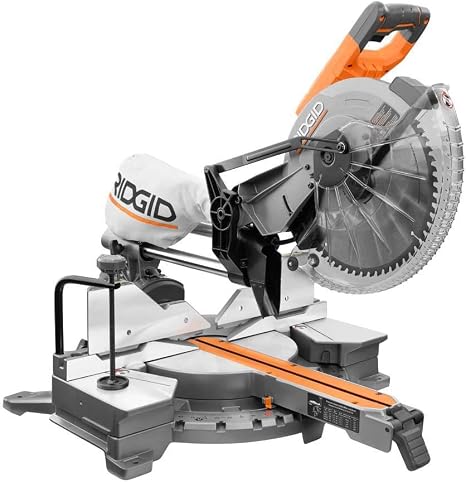
“The RIDGID R4222 12-inch Dual Bevel Sliding Miter Saw at $199 features a 15-amp motor built to handle hardwood without bogging, a 70-degree miter capacity that is among the widest in its class, and…”
See Today’s Price →What we like
- 15-amp motor handles dense hardwood stock at full depth without bogging or stalling on the pass
- 70-degree miter capacity is the widest in the 12-inch class — covers crown molding compound angles in a single cut
- LED shadow-line cut indicator projects the blade line onto the work piece for precise layout without test cuts
- Ridgid Lifetime Service Agreement covers parts and service for the tool's full life with proof of purchase registration
Read Full Analysis
The RIDGID R4222 is a 12-inch dual bevel sliding compound miter saw — a specification set that normally starts closer to $400 at competing brands. Dual bevel means the head tilts both left and right (up to 47 degrees each direction) without having to flip the workpiece, which saves significant time when cutting crown molding or chair rail returns. Sliding rails extend the crosscut capacity to approximately 16 inches at 90 degrees, handling wide baseboards, 2x12 framing stock, and sheet material edge cuts that a non-sliding 10-inch saw cannot reach. The 15 Amp motor maintains blade speed through dense hardwood and engineered lumber. At $248.99, it sits in an unusual value position: more saw than the DeWalt DWS713 (non-sliding, single bevel, same price) for the same investment. RIDGID backs all of their tools with a Lifetime Service Agreement when registered, meaning free parts and service at authorized centers for the life of the tool — a commitment no other brand at this price point matches. The trade-off is size and weight: a 12-inch sliding saw is significantly heavier and larger than the Metabo HPT C10FCGS, requiring a permanent bench or heavy-duty stand. The sliding rails also need occasional alignment to maintain accurate cuts over time. For a woodworker, trim carpenter, or serious DIYer who wants a single miter saw that can handle virtually any crosscut task, the R4222 represents the best combination of capacity, capability, and long-term value on this page.

“The DeWalt DWS713 at $189.99 is a reliable 15-amp, 10-inch single bevel compound miter saw with DeWalt's proven build quality at an accessible price point. The single bevel design means you'll need…”
See Today’s Price →What we like
- 10-inch blade
- single bevel
- 15-amp motor
- DeWalt brand affordable
Watch out for
- Single bevel only — must flip workpiece to cut opposing angles
- No sliding function limits maximum cut width to 10-inch blade capacity
- 15-amp corded design requires a nearby outlet on job sites
Read Full Analysis
The DeWalt DWS713 is a 15 Amp 10-inch single bevel compound miter saw built on the same platform as the more expensive DWS715 (dual bevel) and DWS716 (extended table). It miter cuts from 0 to 50 degrees left and 60 degrees right with stainless steel miter detent plates for repeatable accuracy at common angles. The bevel range is 0 to 48 degrees in one direction — single bevel means to cut the opposite bevel, you must flip the workpiece. A back fence design accommodates crown and base molding at the saw, and the tall fence supports cuts in wide baseboard stock. DeWalt built the DWS713 for jobsite precision: the cam-lock miter handle and adjustable stainless detent system hold angle settings against vibration and repeated use. At $249, the DWS713 is priced identically to the RIDGID R4222 on this page, which offers dual bevel and sliding capacity. The DWS713 wins on brand ecosystem — contractors already running DeWalt tools value the consistent design language and easy parts availability. It also has a lighter footprint than the 12-inch sliding RIDGID, making it easier to transport and set up on different jobsites. The limitation is clear: single bevel requires flipping crown molding and casings for compound angle cuts, adding steps and potential for error. For a carpenter who primarily cuts simple miters and bevels in one direction and values the DeWalt platform, the DWS713 is a capable, proven choice. For maximum flexibility at the same price, the RIDGID R4222 sliding dual bevel offers more capability per dollar.

“The DEWALT DWS715 12-Inch Single Bevel at $299.00 adds a 12-amp motor with stall resistance in hardwoods, a 48° bevel range that covers nearly all trim angles, and a machined aluminum fence for…”
See Today’s Price →What we like
- 12-amp motor resists stalling in hardwoods
- 48° bevel range covers nearly all trim angles
- Machined aluminum fence for repeatable accuracy
- 11 positive miter stops for fast common-angle setup
- Compact and relatively lightweight at 42 lbs
Watch out for
- Single bevel only (no right tilt)
- At $279, it's at the ceiling of this budget
- Corded only — requires outlet or extension cord
Read Full Analysis
The DEWALT DWS715 steps up from the 10-inch DWS713 to a 12-inch blade that handles wider crosscuts — roughly 8 inches of capacity at 90 degrees versus 6 inches for a 10-inch saw. The 15 Amp motor resists stalling when pushing through dense hardwoods, and the machined aluminum fence delivers the kind of repeatable accuracy that finish carpenters expect across many cuts. Eleven positive miter stops speed setup at the most common angles. The 48-degree bevel range covers nearly all trim and molding angles encountered in residential work. At $299, this is the most expensive non-sliding saw on this page. The DWS715 is single bevel, meaning it tilts in one direction only — cutting the opposing compound angle requires flipping the workpiece. For most crown molding and baseboard work this is a minor inconvenience, not a dealbreaker. The bigger comparison on this page is the RIDGID R4222 at $199: it offers dual bevel and full sliding capacity for $50 less. The DWS715 wins when brand ecosystem matters — contractors standardized on DeWalt tools and batteries will find it integrates naturally into their workflow. At 42 lbs it is also relatively compact for a 12-inch saw. For pure feature-per-dollar value, the RIDGID is a stronger buy; for confirmed DeWalt users who want a permanent bench saw, the DWS715 is a solid long-term investment.

“The Makita LS1040 at $369.00 brings a soft-start motor that reduces torque kickback at startup and quieter operation than most miter saws — a genuine advantage for indoor work. Full compound…”
See Today’s Price →What we like
- Soft start motor reduces torque kickback at startup
- Quiet for a miter saw — better for indoor use
- Large 10-inch blade with full compound capability
- Comfortable handle grip and trigger
- Trusted Makita motor quality
Watch out for
- Older design with fewer detent positions than newer saws
- Heavier at 52 lbs
- Limited positive stops vs DEWALT
Read Full Analysis
The Makita LS1040 is a 10-inch compound miter saw built around a soft-start motor that ramps up gradually rather than snapping to full speed — reducing startup torque kickback and making the saw noticeably quieter than most comparable models. For indoor DIY work, trim installation in occupied homes, or apartment workshops, that quieter operation is a practical advantage, not just a spec. The full compound capability lets it tilt and swivel simultaneously for accurate crown molding cuts. Makita motor quality is well established: these saws run reliably for years with minimal maintenance. The LS1040 is an older design and it shows in a few places. Its positive stop count falls behind newer saws like the DeWalt DWS713 and DWS715, requiring more manual fine-tuning at less common angles. At 52 lbs it is heavier than the aluminum-construction DeWalts on this page. At $369, it is more expensive than the RIDGID R4222 sliding dual bevel at $199 — a hard comparison to justify unless Makita brand loyalty or the quieter motor genuinely matters. As the most expensive non-sliding 10-inch option on this page, the LS1040 is best suited to buyers who have used Makita tools before, value reduced noise, and prefer the proven reliability of an older workhorse design over the feature set of newer alternatives.

“The Bosch GCM12SD at $687.38 is the premium choice here, with an axial-glide system that eliminates the rear clearance requirement of standard rail designs while delivering an exceptionally smooth…”
See Today’s Price →What we like
- Axial-glide: no rear clearance needed
- 15.5" crosscut capacity at 90°
- Buttery smooth glide — no rail chatter
- Squarelock fence system
- No-tools bevel adjustment
Watch out for
- ~$700 — highest price on this list
- 65 lbs — heaviest option
- Proprietary glide means no rail accessory compatibility
Frequently Asked Questions
What is a compound miter saw used for?
What's the difference between a compound and sliding compound miter saw?
Is a 10-inch or 12-inch compound miter saw better?
Do I need dual bevel on a compound miter saw?
What blade should I use in a compound miter saw?
How We Analyze Products
We analyze Amazon review data — often thousands of reviews per product — to surface patterns that individual buyers miss. Our process aggregates star ratings, review counts, and buyer sentiment at scale, identifying which strengths and weaknesses appear consistently across the largest review samples available. The 10,757+ reviews analyzed on this page represent real verified-purchase feedback from Amazon buyers.
Each product earned its placement through data: total review volume, average rating, and the specific praise and complaints that repeat most often across buyers. No manufacturer paid for placement on this page. Products appear here because buyers endorsed them at scale, not because a company asked us to feature them.
We use AI to summarize review sentiment — not to fabricate opinions, but to condense what thousands of buyers actually wrote into a readable format. The pros and cons you see reflect the most common themes found in verified purchaser reviews, paraphrased for clarity. We do not claim to have accessed Reddit, YouTube, or specific publications in generating these summaries.
Prices shown reflect Amazon pricing at the time this page was last generated. Click “See Today’s Price” to get the current live price on Amazon. Read our full methodology →