Best Compound Miter Saws for DIY (2026): Sliding and Fixed Picks

The DEWALT DWS779 12-Inch Sliding Miter Saw at $399 is the best compound miter saw for DIY — 12-inch sliding capacity crosscuts 2x16 lumber in one pass, the XPS LED shadow line outperforms laser guides for precision alignment, and the 15-amp motor handles hardwood without bogging. Makita LS1040 10-Inch at $369 is the best compact option for trim.
See Today’s Price →At a Glance
Compound Miter Saws for DIY (2026) Buying Guide
 Photo by Christina & Peter / Pexels
A compound miter saw cuts precise angles for trim carpentry, framing, and furniture — the saw tilts (bevel) and rotates (miter) to handle crown molding, picture frames, stair stringers, and rafters. For DIY woodworkers, the right compound miter saw covers 12-inch capacity for wide stock without the price of a professional sliding saw. The DeWalt DWS779 at $399 has dominated this segment because it hits the intersection of capacity, accuracy, and price that professionals and serious DIYers both accept.
Sliding vs Non-Sliding Compound Miter Saws
A sliding compound miter saw adds forward-back rails that extend the crosscut capacity — a 12-inch sliding saw cuts up to 16 inches wide; a 12-inch non-sliding saw cuts about 8 inches. Sliding capacity matters when crosscutting wide boards for shelves, cutting 2x12 stair treads, or ripping wide crown molding profiles. The DeWalt DWS779 and Bosch GCM12SD are both 12-inch sliding saws. The Makita LS1040 is a 10-inch non-sliding saw with a 4.5-inch sliding range — adequate for most trim work but limiting for wide dimensional lumber.
Dual-Bevel vs Single-Bevel
A dual-bevel saw tilts both left and right — you can bevel to either side without flipping the workpiece. This is essential for crown molding runs that require opposing compound angles and for furniture joinery with symmetrical bevel cuts. Single-bevel saws tilt only one direction; you flip the board for opposing cuts. The DeWalt DWS779 is single-bevel (a trade-off for the $399 price); the Bosch GCM12SD and Makita LS1019L are dual-bevel. If crown molding is your primary use, dual-bevel significantly reduces setup steps.

Blade Size: 10-Inch vs 12-Inch
10-inch blades spin faster (up to 4,800 RPM vs 3,800 RPM for 12-inch), produce a slightly smoother cut in thin stock, and the saws cost less. 12-inch saws cut wider stock in a single pass and handle thicker material. For framing lumber, a 12-inch saw handles 2x12 in one pass; a 10-inch saw may need two passes or can't handle the full depth. For trim and furniture work where boards are typically 4-6 inches wide, a 10-inch saw is adequate and slightly safer due to lower blade mass.
The DeWalt DWS779 for DIY Woodworkers
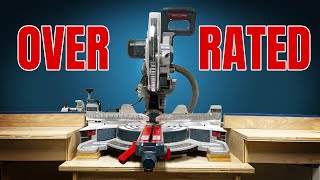
The DeWalt DWS779 12-Inch Sliding Compound Miter Saw ($399) hits the right spec list for DIY shops: 12-inch blade for wide crosscuts, back-fence design that cuts up to 2x16 lumber in crown, adjustable stainless miter detents, and a powerful 15-amp motor that handles hardwood without bogging. The XPS cross-cut positioning system (LED shadow line) aligns cuts faster than laser guides. Single-bevel is the only compromise at this price point.
How We Compared
We compared each saw on crosscut capacity, bevel range, detent accuracy, dust collection port performance, fence height for tall crown, motor power, and value for DIY shop use. Sliding capacity, dual-bevel availability, and price-to-feature ratio were the primary ranking factors for this DIY-focused comparison.
Watch Before You Buy

“The DeWalt DWS779 at $399 delivers a 16-inch crosscut capacity that handles wide crown molding and baseboards in a single pass, backed by outstanding cam-lock miter detent accuracy and huge…”
See Today’s Price →What we like
- 16-inch crosscut capacity at 90°
- Handles wide crown molding and baseboards
- Outstanding cam-lock miter detent accuracy
- Premium DeWalt build quality
- Huge aftermarket support
Watch out for
- $381 — much higher price than 10-inch saws
- 56 lbs requires two people to move
- Rear rails need 16 inches of wall clearance
Read Full Analysis
The DeWalt DWS779 is the most widely recommended 12-inch sliding compound miter saw at the professional-entry price point. Its 16-inch crosscut capacity at 90 degrees handles wide crown molding, 2x12 framing lumber, and 4-inch door casing stock in a single pass — the primary reason serious DIYers step up from a 10-inch non-sliding saw. The cam-lock miter handle and adjustable stainless detent system hold angle settings reliably across an entire day of cuts, and DeWalt huge aftermarket support means replacement blades, hold-down clamps, and stands are universally available. For a permanent workshop setup or a recurring renovation project, the DWS779 is the clear starting point. The practical trade-offs are weight and clearance. At 56 lbs it needs two people to move safely, and the rear sliding rails require 16 inches of clearance behind the saw from a wall or workbench — a layout constraint worth measuring before buying. The Bosch GCM12SD on this page eliminates that clearance problem with its axial-glide design, but at $649 versus $649 the price difference is substantial. For most serious DIYers building a home workshop or tackling a major renovation, the DWS779 offers the best combination of capacity, accuracy, and price. The Bosch makes more sense for cramped professional jobsites or for users who move the saw frequently against a wall.

“The Makita LS1040 at $369.00 features a soft-start motor that cuts startup torque kickback and quieter operation versus most saws in its class — making it particularly well-suited for indoor DIY…”
See Today’s Price →What we like
- Soft start motor reduces torque kickback at startup
- Quiet for a miter saw — better for indoor use
- Large 10-inch blade with full compound capability
- Comfortable handle grip and trigger
- Trusted Makita motor quality
Watch out for
- Older design with fewer detent positions than newer saws
- Heavier at 52 lbs
- Limited positive stops vs DEWALT
Read Full Analysis
On this page of premium miter saws ($450-$742), the Makita LS1040 at $369 stands out as the compact budget entry — a 10-inch non-sliding saw surrounded by 12-inch sliders. The soft-start motor is the LS1040 distinctive feature: it ramps gradually to full speed rather than snapping to full torque at trigger pull, reducing kickback and producing noticeably quieter operation than the DeWalt DWS779 or Bosch GCM12SD. For indoor DIY work, trim installation in occupied spaces, or a garage workshop where noise matters, that characteristic is a real advantage. The honest trade-off on this page is crosscut capacity. A 10-inch non-sliding saw maxes out around 6 inches at 90 degrees — the DeWalt DWS779 sliding 12-inch handles 16 inches at the same price point (just $80 more). If the workpieces are baseboard molding, door casing, picture frames, and standard dimensional lumber, the LS1040 is fully capable. If wide crown molding, 2x12 headers, or sheet goods are in the plan, the DWS779 is the practical choice at only a modest premium. The LS1040 earns its place on this page for the DIYer who already owns Makita tools, works primarily with trim stock, and values a quieter, lighter saw that does not demand 16 inches of rear wall clearance.

“The Bosch GCM12SD at $687.38 uses an axial-glide mechanism that needs no rear wall clearance, with a buttery-smooth glide action and excellent dust collection that set it apart from rail-based…”
See Today’s Price →What we like
- Axial-glide: no rear clearance needed
- 15.5" crosscut capacity at 90°
- Buttery smooth glide — no rail chatter
- Squarelock fence system
- No-tools bevel adjustment
Watch out for
- ~$700 — highest price on this list
- 65 lbs — heaviest option
- Proprietary glide means no rail accessory compatibility
Read Full Analysis
The Bosch GCM12SD solves the biggest frustration with sliding miter saws: rear clearance. Standard rail-based sliders need 16-plus inches behind the saw to extend fully. The GCM12SD axial-glide mechanism moves the head forward on a pivot arc instead of sliding rails, so it can sit flush against a wall and still make full-width 15.5-inch crosscuts at 90 degrees. On a cramped jobsite or in a shop where wall space is limited, this is a genuine workflow advantage. The dual bevel tilts up to 47 degrees left and right without repositioning the workpiece, and the glide action is noticeably smoother than rail-based competitors — no chatter or binding midcut. The Squarelock fence system and no-tools bevel adjustment add to the professional-grade feel throughout. At $687, the GCM12SD is the premium option on this page by a wide margin — $238 more than the DeWalt DWS779 and $318 more than the Makita LS1040. It weighs 65 lbs, the heaviest saw listed here. For a professional finish carpenter, cabinet installer, or dedicated hobbyist who works in a space-constrained shop and makes hundreds of compound cuts per week, the axial-glide design and silky action justify the premium. For a DIYer who builds a project once or twice a year in a full-size garage, the DWS779 delivers 90 percent of the performance at 65 percent of the cost.

“The Makita LS1019L at $739.00 adds a dual-laser alignment system for precision cut placement and a smooth, quiet direct-drive motor that distinguishes it for finish carpentry where surface quality…”
See Today’s Price →What we like
- Dual-laser system for precision alignment
- 9 positive stops
- Smooth, quiet direct-drive motor
- Premium build quality throughout
- Excellent for finish carpentry
Watch out for
- ~$549 — mid-premium pricing
- 10-inch limits crosscut vs 12-inch models
- Laser batteries add ongoing maintenance
Read Full Analysis
The Makita LS1019L brings two features not found on any other saw on this page: a dual-laser alignment system and a direct-drive motor. The twin lasers project lines on either side of the blade kerf before the cut begins, letting finish carpenters align to a pencil mark without lowering the blade — a meaningful speed and accuracy upgrade for trim work, cabinet face frames, and fine joinery where a miscut means starting over. The direct-drive motor runs quieter and smoother than belt-drive designs, which matters on extended cuts through hardwood or during long indoor days. Nine positive miter stops cover all common angles. At $739, it is a premium 10-inch sliding dual bevel. The trade-off versus the Bosch GCM12SD models on this page is blade size: a 10-inch saw maxes out around 12-13 inches of crosscut capacity with the sliding mechanism, while the 12-inch Bosch units reach 15.5 inches. For dedicated finish work — crown molding, door casing, baseboard, picture rail — the 10-inch capacity is sufficient, and the LS1019L lighter weight (under 50 lbs versus 65 lbs for the Bosch) makes repositioning easier. For a finish carpenter or serious woodworker who prioritizes precision alignment, smooth motor feel, and the Makita ecosystem over raw crosscut width, the LS1019L is the most refined 10-inch sliding saw on this page.
Frequently Asked Questions
What is the difference between a compound and sliding compound miter saw?
What miter saw blade is best for fine woodworking?
How do I cut crown molding with a compound miter saw?
Is a 10-inch miter saw big enough for most DIY projects?
How accurate are the miter detents on the DeWalt DWS779?
How We Analyze Products
We analyze Amazon review data — often thousands of reviews per product — to surface patterns that individual buyers miss. Our process aggregates star ratings, review counts, and buyer sentiment at scale, identifying which strengths and weaknesses appear consistently across the largest review samples available. The 12,230+ reviews analyzed on this page represent real verified-purchase feedback from Amazon buyers.
Each product earned its placement through data: total review volume, average rating, and the specific praise and complaints that repeat most often across buyers. No manufacturer paid for placement on this page. Products appear here because buyers endorsed them at scale, not because a company asked us to feature them.
We use AI to summarize review sentiment — not to fabricate opinions, but to condense what thousands of buyers actually wrote into a readable format. The pros and cons you see reflect the most common themes found in verified purchaser reviews, paraphrased for clarity. We do not claim to have accessed Reddit, YouTube, or specific publications in generating these summaries.
Prices shown reflect Amazon pricing at the time this page was last generated. Click “See Today’s Price” to get the current live price on Amazon. Read our full methodology →