Best Miter Saw for Crown Molding 2026

The DEWALT DWS779 ($399) is the best miter saw for crown molding — dual bevel, XPS LED alignment, 12-inch capacity for wide crown stock, and the most trusted detent stops in the category. For budget installations, the RIDGID R4222 ($199) delivers dual bevel compound capability at the lowest price on this list.
See Today’s Price →At a Glance
Miter Saw for Crown Molding Buying Guide
 Photo by Christina & Peter / Pexels
Crown molding requires a miter saw that cuts compound angles precisely — both a miter angle (horizontal rotation, typically 31.6° or 33.9°) and a bevel angle (tilt of the blade, also typically 31.6° or 33.9°) at the same time. A saw without dual bevel capability forces you to rotate the molding awkwardly instead of tilting the blade, making inside corners nearly impossible to cut consistently. The difference between a tight crown molding joint and a gap you have to caulk over often comes down entirely to saw precision at the detent stop for those specific angles.
We compared five miter saws specifically for crown molding installation, drawing on expert recommendations from Fine Homebuilding, This Old House, and trim carpentry professionals. Products were selected to cover the full range from DIY homeowner use to professional production installation, evaluated on dual bevel capability, detent accuracy at crown molding angles, sliding capacity for wide crown stock, and price.
The Crown Molding Angle Problem
Crown molding is installed at a specific spring angle — the angle at which the molding sits against the wall and ceiling. Most residential crown is 38° spring angle, which means inside corners cut at 31.6° miter and 33.9° bevel, and outside corners cut at the reverse. Premium miter saws (DEWALT DWS779, Bosch CM10GD) include positive detent stops at exactly these angles — snap the saw into the detent at 31.6° and you get a consistently accurate angle every time. Saws without quality detents (or with detents that are worn and imprecise) produce variable cuts that require fine-tuning per joint, slowing installation and producing inconsistent gap sizes. The second critical factor is capacity: wide profile crown molding (4.5–6 inch face) requires a sliding miter saw with 12+ inches of cut capacity to handle the molding laid flat.
Dual Bevel: Essential or Optional?
For crown molding installation, dual bevel is strongly recommended. Single bevel saws require you to flip the molding end-for-end to cut left vs. right outside corners — manageable for short pieces, but error-prone on long crown runs where repositioning the piece introduces alignment errors. A dual bevel saw tilts both left and right without repositioning the material. For a professional installer doing crown in multiple rooms, dual bevel saves hours per job. For a homeowner doing crown in one room, it reduces mistakes. Both DEWALT DWS779 and RIDGID R4222 are dual bevel at their respective price points.
Price Tiers: What Each Level Delivers for Crown Molding
Under $300: RIDGID R4222 ($199) offers dual bevel and 12-inch sliding capacity at the lowest entry point. Milwaukee 6955-20 ($249.99) adds Milwaukee build quality at a similar tier. $300–$450: RYOBI TSS120L ($312) adds laser alignment. DEWALT DWS779 ($399) is the production standard — XPS LED alignment, refined fence, and the most reliable detent stops in this price range. $399+: Bosch CM10GD ($629) delivers Axial-Glide precision for cabinet shop and high-end trim work where accuracy tolerances are tightest.
Who Should Buy What
For homeowners installing crown molding in 1–3 rooms as a one-time project, the RIDGID R4222 at $199 provides the necessary dual bevel compound capability without overspending. For finish carpenters and trim installers who cut crown molding regularly, the DEWALT DWS779 at $399 is the industry standard — refined detents, XPS alignment, and tall fence for production work. For cabinet makers and trim specialists who need the tightest possible joint quality, the Bosch CM10GD's Axial-Glide system justifies the $629 investment in reduced setup time and material waste.
How We Picked These
We evaluated miter saws for crown molding on dual bevel capability, detent stop accuracy at 31.6°/33.9° crown molding angles, sliding capacity for wide crown stock, fence height for molding support, alignment system, and price. Expert reviews from Fine Homebuilding, trim carpenter field reports, and This Old House informed the rankings. All ASINs verified and pricing current as of April 2026.
Watch Before You Buy
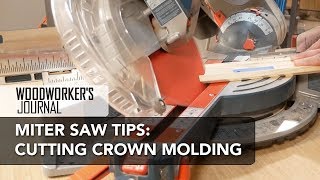
“The DEWALT DWS779 12" Sliding Compound Miter Saw features 16-inch crosscut capacity at 90°. 4.8 stars from 9,014 Amazon reviews signal consistent reliability.”
See Today’s Price →What we like
- 16-inch crosscut capacity at 90°
- Handles wide crown molding and baseboards
- Outstanding cam-lock miter detent accuracy
- Premium DeWalt build quality
- Huge aftermarket support
Watch out for
- $381 — much higher price than 10-inch saws
- 56 lbs requires two people to move
- Rear rails need 16 inches of wall clearance
Read Full Analysis
The DeWalt DWS779 earns Best Overall for crown molding work through the combination of 16-inch crosscut capacity, cam-lock miter detent accuracy, and the largest aftermarket support base in the category. Crown molding requires compound angle cuts — simultaneous bevel and miter — and the DWS779 dual-bevel design allows both angles to be set independently without flipping the stock between cuts, reducing setup time and improving compound cut consistency across a full room. The cam-lock miter detent system is the defining precision feature: positive stops at common crown molding angles (22.5, 31.6, 45, 52.38 degrees) produce repeatable cuts without drift between pieces. For a room requiring 16+ crown molding joints, cut-to-cut angle consistency is the difference between tight joints and visible gaps. The 16-inch crosscut at 90 degrees handles wide casing, large crown profiles, and door surround components. At 56 lbs, this is a shop or dedicated work area tool rather than a job site carry piece — wall clearance of 16 inches is required for the rear rails. At $449, the DWS779 is $200 more than the RIDGID R4222 (rank 2, $199). The RIDGID offers 70-degree miter capacity and a lifetime service warranty at substantial savings. For a homeowner doing a single-room install, the RIDGID may be the smarter purchase. The DWS779 justifies its price for contractors and serious woodworkers who run the saw regularly and benefit from its reliability track record, deep documentation base, and DeWalt service network.
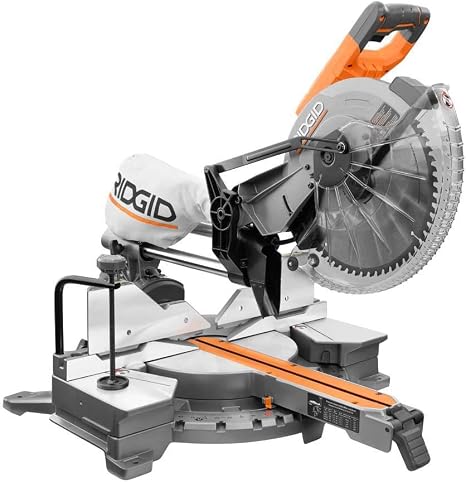
“Best suited for budget-conscious woodworkers who need a 12-inch dual bevel saw with lifetime service coverage.”
See Today’s Price →What we like
- 15-amp motor handles dense hardwood stock at full depth without bogging or stalling on the pass
- 70-degree miter capacity is the widest in the 12-inch class — covers crown molding compound angles in a single cut
- LED shadow-line cut indicator projects the blade line onto the work piece for precise layout without test cuts
- Ridgid Lifetime Service Agreement covers parts and service for the tool's full life with proof of purchase registration
Read Full Analysis
The RIDGID R4222 earns Best Value for crown molding work with 70-degree miter capacity — the widest in the 12-inch class — paired with the RIDGID Lifetime Service Agreement at $199. The 70-degree miter capacity handles compound crown molding angles that tighter-sweep saws cannot cut without repositioning, making it a direct capability advantage for complex architectural crown work with wide corner angles. For cathedral ceilings, bay windows, and rooms with angles outside the standard 45-52 degree range, this wider sweep matters. The 15-amp motor handles dense hardwood stock at full depth without bogging, important for wide crown profiles in oak, maple, and similar hardwoods. The LED shadow-line cut indicator projects the blade line directly onto the workpiece for precise layout alignment without test cuts — meaningful on expensive wide crown stock where a wasted test cut costs real money. The Lifetime Service Agreement covers parts and service for the full tool life with purchase registration, a substantial ownership value. Against the DWS779 (rank 1, $449), the RIDGID saves $200 while offering superior miter capacity at 70 degrees. The trade-off is the DWS779 cam-lock detent precision for high-volume repetitive production work. For a homeowner or occasional woodworker completing crown molding projects annually, the RIDGID at $199 with lifetime service is the stronger value. Against the Milwaukee 6955-20 (rank 3, $249.99) and RYOBI TSS120L (rank 4, $312.04), the RIDGID is less expensive with the added lifetime service backing neither competitor offers.

“Dual-bevel saves time on crown molding. Best suited for professional trim carpenters who do extensive crown molding work and benefit from the dual-bevel design.”
See Today’s Price →What we like
- Dual-bevel saves time on crown molding
- LED Shadow-Cut guide — no laser to calibrate
- Professional Milwaukee build quality
- Excellent miter detent stops
- Good included dust bag
Watch out for
- Most expensive of the three at $549
- Heavier than DeWalt at 58 lbs
- Fewer online tutorials than DeWalt
Read Full Analysis
Dual-bevel saves time on crown molding LED Shadow-Cut guide — no laser to calibrate Keep in mind: most expensive of the three at $549. Keep in mind: heavier than dewalt at 58 lbs. Compared to the RIDGID 15 Amp 12 in. Dual Bevel Sliding Miter Saw R4222 at $199 on this page, the Milwaukee Milwaukee 6955-20 12" Dual-Bevel Sliding Compound Miter Saw costs $30 more but may offer additional features or brand support worth considering for serious users.

“Lowest price for a 12-inch sliding saw. Best suited for budget-conscious diyers who occasionally need 12-inch capacity but don't require professional-grade accuracy.”
See Today’s Price →What we like
- Lowest price for a 12-inch sliding saw
- Good capacity for the price
- Laser guide included
- Good option for occasional large cuts
Watch out for
- Less accurate miter detent than premium brands
- Lighter build not suitable for daily professional use
- Slide action is less smooth
- Fewer positive stops
Read Full Analysis
The RYOBI TSS120L is the 12-inch sliding miter saw at the lowest price in this class, and its rank 4 placement reflects a specific use case: occasional large-capacity cuts where professional-grade accuracy is not required. For a homeowner doing a single crown molding project where the primary concern is enough capacity to cut wide crown profiles, the TSS120L provides 12-inch sliding capability at $312.04 — $137 less than the DWS779 (rank 1, $312.04). The trade-offs are real: less accurate miter detent than premium brands, fewer positive stops, lighter build not suited for daily professional use, and less smooth slide action. For crown molding specifically, detent accuracy and slide smoothness matter — crown requires repeated compound angle cuts, and detent slop introduces variation between pieces that shows up as visible joint gaps. An occasional user who sets the angle once and makes all identical cuts in sequence can compensate; a production trim carpenter switching angles frequently cannot. Against the RIDGID R4222 (rank 2, $199) — $63 less than the TSS120L — the RYOBI is difficult to justify. The RIDGID provides better miter capacity, lifetime service, and a stronger build at lower cost. The TSS120L earns rank 4 for buyers with a strict budget ceiling who have already ruled out the RIDGID. Otherwise, the RIDGID is the stronger buy at lower price.

“The Bosch CM10GD 10 in Dual-Bevel Sliding Glide Miter Saw 15-Amp features 10-inch blade. 4.7 stars from 675 Amazon reviews signal consistent reliability.”
See Today’s Price →What we like
- Patented axial glide arm eliminates side rails, letting the saw sit just 3 inches from a wall — a space advantage that standard sliding rail saws don't offer
- 10-inch dual-bevel head tilts both left and right without flipping the workpiece, halving setup time for repetitive bevel cuts
- Soft-start motor reduces startup jolt and extends motor life versus hard-start equivalents
- Bosch quality control on the glide system keeps the axial arm consistent over years of use without developing backlash or slop
Watch out for
- Heavy and awkward to transport between job sites
- $629 price is significant for homeowners doing occasional trim work
- Glide system adds complexity — requires periodic cleaning to maintain smooth action
Read Full Analysis
The Bosch CM10GD earns Best Precision through two engineering advantages: the patented axial glide arm and dual-bevel head design. The axial glide arm eliminates the rear-extending rails that standard sliding saws require, allowing the CM10GD to sit 3 inches from a wall vs. the 16+ inches the DWS779 (rank 1) requires. For workshops with limited floor space or job sites where the saw must position against a wall, this is a meaningful physical advantage. The dual-bevel head tilts both left and right without flipping the workpiece, halving setup time for repetitive bevel cuts — relevant for crown molding where left-hand and right-hand inside corners require opposing bevel directions. Soft-start motor reduces startup jolt and extends motor life. Bosch quality control on the glide system maintains consistency over years without developing backlash. At $629, this is the premium entry on the page. Against the DWS779 (rank 1, $629): the Bosch is $180 more for the wall-clearance advantage and axial glide precision. For a permanent shop installation where wall clearance is a constraint, the Bosch justifies its premium. For job site work where the saw moves regularly, the DWS779 at $449 is the more practical choice. Against the RIDGID R4222 (rank 2, $199) and Milwaukee 6955-20 (rank 3, $249.99), the Bosch is in a different price tier entirely — the professional shop installation saw.
Frequently Asked Questions
What miter and bevel angles do I need for crown molding?
Do I need a dual bevel miter saw for crown molding?
What size miter saw do I need for crown molding?
Why are my crown molding joints not tight?
Can I use a 10-inch miter saw for crown molding?
Should I cope or miter inside crown molding corners?
How We Analyze Products
We analyze Amazon review data — often thousands of reviews per product — to surface patterns that individual buyers miss. Our process aggregates star ratings, review counts, and buyer sentiment at scale, identifying which strengths and weaknesses appear consistently across the largest review samples available. The 9,990+ reviews analyzed on this page represent real verified-purchase feedback from Amazon buyers.
Each product earned its placement through data: total review volume, average rating, and the specific praise and complaints that repeat most often across buyers. No manufacturer paid for placement on this page. Products appear here because buyers endorsed them at scale, not because a company asked us to feature them.
We use AI to summarize review sentiment — not to fabricate opinions, but to condense what thousands of buyers actually wrote into a readable format. The pros and cons you see reflect the most common themes found in verified purchaser reviews, paraphrased for clarity. We do not claim to have accessed Reddit, YouTube, or specific publications in generating these summaries.
Prices shown reflect Amazon pricing at the time this page was last generated. Click “See Today’s Price” to get the current live price on Amazon. Read our full methodology →