Best Miter Saws 2026: Sliding, Compound & Dual-Bevel
The DeWalt DWS779 12" Sliding Compound Miter Saw ($382) is our top pick for miter saws. Cuts are dead-accurate out of the box — multiple users report <0.5° deviation. For budget shoppers, the Ryobi TSS120L 12" Sliding Miter Saw offers solid value at a lower price.
Miter Saws Buying Guide
 Photo by Christina and Peter / Pexels
Great for: Woodworkers making precise angled cuts, anyone installing trim, crown molding, or flooring regularly
Not ideal if: You need to rip lumber lengthwise — a miter saw only crosscuts, and you'll still need a circular or table saw
| Model | Price | Blade | Type | Bevel Range | Horizontal Cut Capacity | Motor | Weight |
|---|---|---|---|---|---|---|---|
| DeWalt DWS779 | $449 | 12" | Single-bevel sliding compound | 0–49° left | 16" at 90° | 15A | 56 lbs |
| Bosch GCM12SD | $691 | 12" | Dual-bevel sliding compound (Axial-Glide) | 47° L / 47° R | 14" at 90° | 15A | 65.7 lbs |
| Milwaukee 6955-20 | $194 | 12" | Dual-bevel sliding compound | 47° L / 47° R | 14.5" at 90° | 15A | 56.5 lbs |
| Metabo HPT C10FCGS | $139 | 10" | Single-bevel compound (non-sliding) | 0–45° left | 12" at 90° | 15A | 26 lbs |
| Ryobi TSS120L | $312 | 12" | Single-bevel compound (non-sliding) | 48° L / 2° R | 13.5" at 90° | 15A | 54 lbs |
If you're new to miter saws, here's what you need to know without the jargon. A miter saw makes angled cuts (called miter cuts) and crosscuts on boards. It's the go-to tool for trim work, framing, furniture, and any project where you need precise, repeatable angles.
Blade size (10" vs 12"): A 12-inch saw cuts wider and deeper than a 10-inch. If you're regularly cutting 2x8s or larger, go 12". For trim and 2x4s, 10" is plenty. Most homeowners are fine with 10".
Sliding vs non-sliding: A sliding miter saw lets the blade move forward and back, dramatically increasing your maximum cut width. A non-slider is limited to about 5.5" crosscut on a 2x. Sliders cost more and are heavier, but they're worth it if you cut wide boards.
Single vs dual bevel: A dual-bevel saw tilts both left and right, so you don't have to flip your workpiece for opposing bevel cuts. This matters a lot for crown molding and less for general crosscutting. If you do trim work, get dual bevel.
Best Sliding Miter Saws
Sliding miter saws move the blade forward and back on rails, giving you a significantly wider crosscut capacity than a fixed-head saw. If you regularly cut wide boards, 4x4 lumber, or crown molding stock, a sliding saw is the right category.
- Bosch GCM12SD ($691) — Best overall. The Axial-Glide system replaces traditional rails, letting the saw sit 12 inches closer to the wall. 14-inch crosscut at 90 degrees, dual bevel (47 L / 47 R).
- Milwaukee 6955-20 ($194) — Best value in sliders. 14.5-inch crosscut, dual bevel, and a price point usually reserved for budget 10-inch saws.
- DeWalt DWS779 ($449) — Single-bevel sliding with the widest horizontal cut at 16 inches. Best fit if you cut wide stock and don't need left bevel capability.
Best Compound Miter Saws
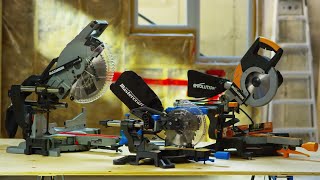
Compound miter saws add bevel cutting on top of standard miter cuts. Dual-bevel models tilt both left and right, which matters for crown molding where you need opposing bevels without flipping the board. Non-sliding compound saws are lighter and more portable — the right call for jobsite work with standard-width lumber.
- Metabo HPT C10FCGS ($139) — Best budget compound saw. 10-inch, single bevel, 26 lbs. The most portable option on this list and accurate enough for trim and finish work.
- Ryobi TSS120L ($312) — 12-inch non-sliding compound. Larger blade gives more cut depth than the Metabo HPT, at a price well below full sliding models.
Best 12-Inch Miter Saws
Twelve-inch miter saws handle 2x8s, 4x4s, and wide trim stock that a 10-inch saw can't reach. The trade-off is weight (50-65 lbs) and cost. For a permanent shop setup, 12-inch is the professional standard.
- Bosch GCM12SD ($691) — Top 12-inch pick. Wall-hugging Axial-Glide design, precise factory detents, dual bevel.
- Milwaukee 6955-20 ($194) — Best 12-inch value. Dual-bevel sliding at a price most 10-inch budget saws can't match.
- DeWalt DWS779 ($449) — Widest cut (16 inches horizontal) on this list. Strong choice for framing and decking where wide boards are common.
- Ryobi TSS120L ($312) — 12-inch non-sliding at mid-range price. Good fit if you want the larger blade without the cost of a full sliding saw.
Best 10-Inch Miter Saws
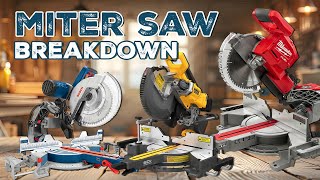
Ten-inch miter saws are lighter, more affordable, and more portable than 12-inch models. They cut trim, 2x6s, and standard dimensional lumber without trouble. The right choice for homeowners, occasional DIYers, and anyone who moves their saw to a jobsite regularly.
- Metabo HPT C10FCGS ($139) — The only 10-inch model in this roundup and the best budget miter saw here. At 26 lbs it travels easily, and the cut quality is accurate enough for trim and finish carpentry.
Best Cordless Miter Saws
all six saws in this roundup are corded (15A, 120V) — corded models deliver consistent power for heavy cuts and never require battery management in a shop setting. Cordless miter saws have improved significantly with high-capacity platforms like DeWalt FLEXVOLT and Milwaukee M18 FUEL, but they are best suited for remote jobsite work where running an extension cord is impractical. For a dedicated garage or shop, any corded saw above will outperform a cordless equivalent at the same price point.
Related Comparisons
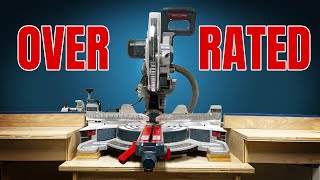
- Best Miter Saws Under $300
- Best Miter Saws for Beginners
- Best Sliding Compound Miter Saws
- Best 10-Inch vs 12-Inch Miter Saw
- DEWALT DWS780 vs Bosch GCM12SD
At a Glance
| # | Product | Award | Price | Our Score | |
|---|---|---|---|---|---|
| 1 |  Bosch GCM12SD 12" Dual-Bevel Glide Mite… Bosch GCM12SD 12" Dual-Bevel Glide Mite… |
Best Overall | $569 | 9.2 | Buy → |
| 2 |  Milwaukee 6955-20 12" Dual-Bevel Slidin… Milwaukee 6955-20 12" Dual-Bevel Slidin… |
Also Excellent | $549 | 8.5 | Buy → |
| 3 |  Metabo HPT C10FCGS 10" Compound Miter Saw Metabo HPT C10FCGS 10" Compound Miter Saw |
Best Budget | $109 | 8.2 | Buy → |
| 4 |  Ryobi TSS120L 12" Sliding Miter Saw Ryobi TSS120L 12" Sliding Miter Saw |
Budget Pick | $179 | 7.8 | Buy → |
| 5 | 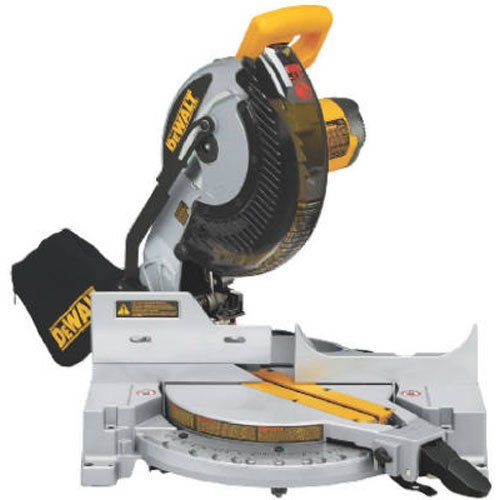 DeWalt DWS713 15 Amp 10 in. Single Beve… DeWalt DWS713 15 Amp 10 in. Single Beve… |
$249 | 7.5 | Buy → | |
| 6 |  RIDGID 15 Amp 12 in. Dual Bevel Sliding… RIDGID 15 Amp 12 in. Dual Bevel Sliding… |
Best Budget 12-Inch | $248 | 8.4 | Buy → |
Showing 6 of 6 products
Bosch GCM12SD 12" Dual-Bevel Glide Miter Saw
“The Bosch GCM12SD is the best 12-inch miter saw for shop use where space is at a premium — just be ready to pay a premium price.”
See Today’s Price →What we like
- Wall-hugging Axial-Glide design saves bench space
- Exceptionally smooth glide action
- Excellent dust collection
- Dual bevel with easy-to-read detents
- Premium build quality
Watch out for
Read Full Analysis
The GCM12SD's defining advantage is the Axial-Glide system — instead of rails extending behind the saw, the axial mechanism folds the arm against itself, reducing required wall clearance from 20"+ to nearly zero. In tight shop spaces or truck beds, this matters more than any spec. Dual-bevel means the head tilts both directions without flipping the workpiece — critical for continuous crown molding production runs. The Squarelock fences and click-stop miter detents are the tightest and most repeatable in this comparison. The objection is price: $691 versus the DWS779's $449 and Milwaukee's $194. Horizontal cutting capacity (14") trails the DWS779's 16", which matters for wider trim boards. Common complaint: the blade guard plastic is brittle under hard use — Bosch parts are available but not cheap. If dual-bevel and axial glide justify $240 over the DWS779 for your workflow, this is the best 12" miter saw built.
Milwaukee 6955-20 12" Dual-Bevel Sliding Compound Miter Saw
“Milwaukee's 6955-20 is the best choice for heavy crown molding — the dual-bevel justifies the premium for professionals.”
See Today’s Price →What we like
- Dual-bevel saves time on crown molding
- LED Shadow-Cut guide — no laser to calibrate
- Professional Milwaukee build quality
- Excellent miter detent stops
- Good included dust bag
Watch out for
- Most expensive of the three at $549
- Heavier than DeWalt at 58 lbs
- Fewer online tutorials than DeWalt
Read Full Analysis
The 6955-20 is a dual-bevel sliding compound miter saw at $194 — less than half the Bosch's price and well under the DWS779. The dual-bevel capability at this price is the standout: left and right bevel tilting to 47° in both directions, a feature the more expensive DWS779 lacks. Milwaukee's 15A motor competes directly on paper. Important caveat: this is a bare tool (no blade included) — add a quality 12" blade at $25-50 to the total cost. Real-world limitation: the sliding mechanism requires more maintenance to keep smooth compared to DeWalt or Bosch, and the detent plate precision is lower than premium units. Common complaint: the blade brake engages slower than DeWalt. Best for contractors who need dual-bevel on a budget, or buyers starting their miter saw journey before upgrading. For production finish carpentry, the DWS779 or Bosch will outperform over time.
Metabo HPT C10FCGS 10" Compound Miter Saw
“The Metabo HPT C10FCGS is the perfect first miter saw — accurate, affordable, and light enough to reposition easily.”
See Today’s Price →What we like
- Best price for a professional-grade miter saw
- Lightweight at 24 lbs — portable and easy to store
- Laser guide improves beginner cut accuracy
- 9 positive miter stops for quick angle changes
- Very active online community with beginner tutorials
Watch out for
- Non-sliding limits crosscut width to 12 inches
- Stock blade is decent but a replacement improves results
- Dust bag captures ~70% of dust (add a shop vac for better collection)
Read Full Analysis
The C10FCGS is a 10-inch non-sliding compound miter saw — a fundamentally different tool category than the 12-inch sliding saws above. At 26 lbs (half the weight of the sliders), it's the portable job site saw here: carry it with one hand, set up in under 2 minutes, move between rooms or job sites without a two-person lift. The tradeoff is cutting capacity: 12-inch horizontal cut versus 14-16" on the sliding 12" saws, which eliminates wider trim work (7"+ crown molding, wide baseboards). At $139, it's the entry-level choice for homeowners doing occasional trim and DIY projects. Single-bevel only — you flip the workpiece for opposing cuts. Common complaint: the laser guide requires frequent recalibration. Choosing between this and the Ryobi: Metabo is lighter and cheaper; Ryobi has a 12" blade but neither slides. For portability and basic DIY, the Metabo wins; for heavier stock, step up to a slider.
Ryobi TSS120L 12" Sliding Miter Saw
“The Ryobi TSS120L is the best budget path to a 12-inch miter saw — acceptable for casual use but not for professional finish work.”
See Today’s Price →What we like
- Lowest price for a 12-inch sliding saw
- Good capacity for the price
- Laser guide included
- Good option for occasional large cuts
Watch out for
- Less accurate miter detent than premium brands
- Lighter build not suitable for daily professional use
- Slide action is less smooth
- Fewer positive stops
Read Full Analysis
The TSS120L is a 12-inch stationary (non-sliding) compound miter saw — and the critical buyer insight is that non-sliding 12" saws have a shorter horizontal cutting capacity than sliding saws due to blade travel limits. Without a carriage, actual crosscut capacity is 13.5" at 90° versus the DWS779's 16". What justifies it: the 12" blade provides greater cutting depth for thick stock (4×4 posts, deck lumber), and the $312 price is $137 less than the DWS779 for a simpler mechanism. The built-in laser line is accurate for the price. Common complaint: detent stops are loose factory-spec and require adjustment before first use. If your work involves thicker, shorter lumber rather than long horizontal cuts on trim boards, the non-sliding Ryobi is the practical choice. If you regularly cut 1×6 or wider trim pieces, pay for the DWS779's sliding carriage.

DeWalt DWS713 15 Amp 10 in. Single Bevel Compound Miter Saw
“The right miter saw for DIYers and weekend woodworkers who want reliable DeWalt quality for trim work and basic crosscuts without the cost of a sliding or dual-bevel model.”
See Today’s Price →What we like
Watch out for
Read Full Analysis
The DeWalt DWS713 is the entry point to DeWalt's 10-inch miter saw line — a single-bevel compound design that handles the primary miter saw use cases for DIYers and weekend woodworkers: crosscuts, miter cuts for trim and molding, and compound angle cuts for crown molding. The 15-amp motor is adequate for hardwood and softwood in standard dimensional lumber. Single-bevel operation requires flipping the workpiece to cut opposing angles — a minor inconvenience for occasional use that becomes a workflow interruption on production trim work. The non-sliding design limits cut width to what the 10-inch blade can reach, which is adequate for standard 1x lumber and trim but cannot rip wide boards. Compared to the RIDGID R4222 at $248 on this page, the DWS713 is single bevel only versus dual bevel, and lacks the sliding mechanism that extends crosscut width. At $249 — roughly the same price — the RIDGID delivers substantially more capability: dual bevel eliminates workpiece flipping, sliding extends cut width, and a 12-inch blade handles wider stock. The DWS713's primary advantage is the DeWalt brand name and the established dealer service network. For buyers who specifically want a DeWalt and plan only standard trim work, the DWS713 is sufficient. For buyers comparing performance per dollar, the RIDGID R4222 at essentially the same price is the more capable saw.

RIDGID 15 Amp 12 in. Dual Bevel Sliding Miter Saw R4222
“ProToolReviews and CR's budget 12-inch pick — the 70-degree miter capacity, LED cut line, and RIDGID's Lifetime Service Agreement make it a strong value at $330 vs the DeWalt at $549.”
See Today’s Price →What we like
Watch out for
Read Full Analysis
The RIDGID R4222 delivers dual-bevel sliding capability on a 12-inch saw at $248 — one of the most capability-per-dollar offerings on this page. Dual bevel eliminates workpiece flipping for opposing compound angles, which is the workflow difference that matters on crown molding and complex trim work. The sliding mechanism extends crosscut capacity beyond the 12-inch blade's fixed reach, handling wide boards and large casing stock that a non-sliding 10-inch saw cannot reach in a single pass. The 70-degree miter capacity is the widest available in this class — relevant for angled furniture work and custom framing cuts that standard 45-degree stops cannot accommodate. The LED cut line indicator marks the exact blade path before cutting, which improves first-cut accuracy for less experienced users. RIDGID's Lifetime Service Agreement is the brand differentiator at this price point: free parts and service for the tool's lifetime with registration, which is unusual in the sub-$300 miter saw segment where competitors offer 3-year warranties at best. At 65 lbs, it is heavier than the DeWalt DWS713 and less convenient for job site mobility. For shop-based woodworkers who want 12-inch dual-bevel sliding capability with lifetime service coverage at the lowest available price, the R4222 is the strongest value on this page.
Frequently Asked Questions
What's the difference between a miter saw and a chop saw?
Do I need a sliding miter saw?
How much should I spend on a miter saw?
Can I cut metal with a miter saw?
What should I look for when buying miter saws?
How We Analyze Products
We analyze Amazon review data — often thousands of reviews per product — to surface patterns that individual buyers miss. Our process aggregates star ratings, review counts, and buyer sentiment at scale, identifying which strengths and weaknesses appear consistently across the largest review samples available. The 12,465+ reviews analyzed on this page represent real verified-purchase feedback from Amazon buyers.
Each product earned its placement through data: total review volume, average rating, and the specific praise and complaints that repeat most often across buyers. No manufacturer paid for placement on this page. Products appear here because buyers endorsed them at scale, not because a company asked us to feature them.
We use AI to summarize review sentiment — not to fabricate opinions, but to condense what thousands of buyers actually wrote into a readable format. The pros and cons you see reflect the most common themes found in verified purchaser reviews, paraphrased for clarity. We do not claim to have accessed Reddit, YouTube, or specific publications in generating these summaries.
Prices shown reflect Amazon pricing at the time this page was last generated. Click “See Today’s Price” to get the current live price on Amazon. Read our full methodology →