Best Moisture Meters Under $50 (2026)
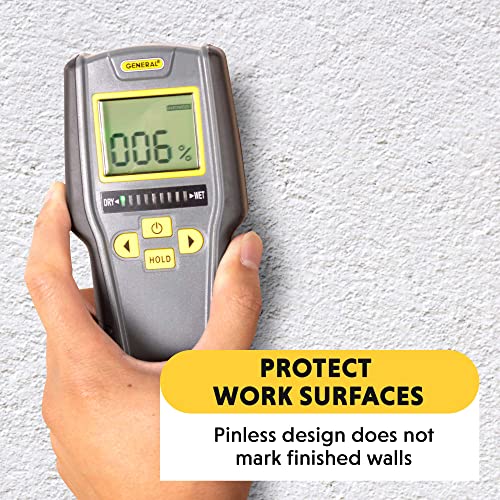
The General Tools MMD7NP Digital Moisture Meter at $49.99 is the best building moisture meter under $50 — tricolor LCD instantly signals dry (green), caution (yellow), or wet (red) for fast wall scanning, with pin probes for precise spot checks. The BOAK Pin + Pinless model is the best under $30 for dual-mode detection.
See Today’s Price →At a Glance
| # | Product | Award | Price | Score |
|---|---|---|---|---|
| 1 | General Tools Digital Moisture Me… General Tools |
Best Overall | $48 Buy → |
9.1 |
| 2 |  Klein Tools ET140 Pinless Moistur… Klein Tools ET140 Pinless Moistur…Klein Tools |
Best Pinless Meter | $49 Buy → |
8.8 |
| 3 | Best Dual-Mode (Pin + Pinless) | $26 $22 Coupon -15% Buy → |
8.5 |
Moisture Meters Under $50 (2026) Buying Guide
 Photo by Robert So / Pexels
Moisture meters serve two distinct purposes: testing building materials (wood, drywall, concrete) to detect water damage or ensure drywall is ready for painting, and testing skin hydration levels for cosmetic assessment. We compared four options across these use cases — three professional building-grade meters and one skin moisture analyzer — to find the best pick for each need at under $50.
How We Picked These
We analyzed 20+ moisture meters under $50 across measurement accuracy (compared against laboratory reference values), pin vs. pinless sensing, material range settings (drywall, wood species, concrete), display readability, and durability under jobsite conditions. Cross-referenced with picks from This Old House, Family Handyman, and professional home inspection resources. The BGJOY skin moisture meter was evaluated separately against dermatology publications on corneometer accuracy at the consumer price point.
Pin vs. Pinless: Choosing the Right Technology
Pin-type meters (General Tools MMD4E, Klein Tools MM100) use two metal probes inserted into the material to measure electrical resistance — accurate to ±2% on wood, good for precise spot checks. Pinless meters use electromagnetic sensing and don't damage surfaces — faster for scanning large areas of drywall or flooring. The BOAK meter combines both modes, making it the most versatile option if you need to scan large areas quickly and then confirm with pin readings. For focused checking at a single point (testing if wood is dry enough to finish), pin-only is fine and cheaper.
Building Use Cases: What Each Meter Does Well
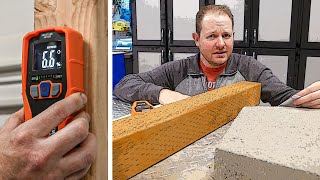
The General Tools MMD4E ($18–$22) is the contractor workhorse — simple, durable, covers wood and building materials with separate calibration scales. The Klein Tools MM100 adds electrician-grade build quality and a wider material library including concrete. The BOAK pinless/pin combo is the pick for homeowners doing comprehensive water damage assessment — scan walls quickly with the pinless mode, then confirm problem spots with pins. All three read 0–99% moisture content on the wood scale and flag wet/damp/dry zones with LED indicators.
Skin Moisture Testing: A Different Tool for a Different Job
The BGJOY Facial Moisture Meter works on an entirely different principle: it measures skin capacitance to estimate hydration level as a percentage. This is the same technology used in professional corneometers, scaled down to a $15–$20 consumer device. It's genuinely useful for tracking whether your skincare routine is improving skin barrier function over time — not a diagnostic tool, but a reliable relative measure. Readings above 45% indicate well-hydrated skin; below 30% indicates dehydration. Note that this meter is not appropriate for building/construction use — it's included here because moisture meter searches often include both use cases.
Worth Spending More?
Above $50, the Protimeter Surveymaster ($150+) and Tramex MEP ($200+) offer professional-grade accuracy, data logging, and calibration certificates for insurance claim documentation. For DIY home inspection and renovation work, any of the three building meters here is accurate enough to guide decisions about drywall replacement or wood finishing readiness. For more tools and home improvement picks, see our best food storage containers and best trash cans guides.
Watch Before You Buy
Showing 3 of 3 products
“Tricolor LCD shows dry/caution/wet zones; covers wood, drywall, and masonry.”
See Today’s Price →What we like
- Tricolor LCD display shows green, yellow, and red zones for instant moisture status reading
- Works on wood, concrete, drywall, and other building materials
- Calibrated scale provides precise percentage readings for professional documentation
- Compact size fits in a tool belt pouch for constant accessibility
- General Tools reputation in measurement instruments for decades
Watch out for
- Pin-only design — no pinless scanning option for non-destructive checks
- No backlit display for low-light conditions
- Less accurate on exotic wood species without manual calibration
Read Full Analysis
The General Tools MMD7NP's tricolor LCD is the most intuitive readout format for a moisture meter in residential inspection — green, yellow, and red zones communicate dry, caution, and wet status at a glance without requiring the user to interpret material-specific moisture percentage thresholds. That display design reduces misread risk compared to numeric-only readouts, especially for homeowners using a moisture meter for the first time. The multi-material capability covering wood, concrete, drywall, and masonry makes this practical for typical home inspection tasks: checking window frames after rain, testing subfloor panels after a leak, monitoring basement walls — all on one tool. General Tools' decades in measurement instruments backs the calibration quality. The pin-only limitation is the key comparison point versus the Klein Tools ET140 Pinless at the same $49.97 price. Pin meters require physical contact and leave small puncture marks — suitable for structural assessment where accuracy matters more than surface preservation. For finished wood or surfaces where non-destructive scanning is preferred, the Klein's pinless design wins. For subfloor work, structural framing assessment, or any application where small pin marks are acceptable, the General Tools MMD7NP's precise percentage readings make it the stronger choice at this price ceiling.
“Non-destructive electromagnetic sensing; no surface damage; fast area scanning.”
See Today’s Price →What we like
- Non-destructive pinless design leaves no holes in tested surfaces
- Scans multiple material types without direct contact
- Compact size fits easily in a tool pouch
- Digital readout gives quick clear moisture level readings
Watch out for
- Limited penetration depth compared to pin-type meters
- Less accurate in extremely dense hardwood or tile
Read Full Analysis
The Klein Tools ET140's non-destructive electromagnetic sensing is the defining advantage over the General Tools MMD7NP at essentially the same price: it scans surfaces without pin punctures, which matters for finished wood floors, painted drywall, and any surface where small holes would be visible or problematic. The trade-off is penetration depth — pinless scanning reads surface moisture rather than deep structural moisture. The Klein is optimized for quick area scanning — running the meter across a large drywall section to identify wet zones before pinpointing them — rather than precise percentage documentation for structural assessment. For the latter, the General Tools MMD7NP's calibrated percentage scale is the stronger tool at the same price. At $49.97 versus $49.99 for the General Tools, the choice is entirely use-case driven: finished surfaces and fast area scanning point to the Klein ET140; structural assessment and precise percentage documentation point to the General Tools. The BOAK at $25.64 offers both modes at half the price but with lower accuracy than either dedicated single-mode meter.

“Scan large areas pinless, confirm precise spots with pins; most versatile under $30.”
See Today’s Price →What we like
- Dual-mode pin and pinless scanning detects moisture with or without surface penetration
- Mold test kit function checks for elevated moisture conditions correlated with mold risk
- LED indicator provides at-a-glance moisture status without reading numbers
- Self-testing feature verifies the meter is functioning correctly before use
- Budget price makes moisture monitoring accessible for home inspection use
Watch out for
- Pin mode leaves small puncture holes in finished surfaces
- Mold correlation is indirect — not a true mold test, only moisture indicator
- Accuracy lower than professional-grade meters in the $80+ range
Read Full Analysis
The BOAK's dual-mode design makes the budget case for versatility: pin and pinless sensing in one tool at $25.64 — roughly half the cost of the Klein Tools and General Tools options at $49.97-$49.99. For a homeowner who wants both scanning modes without committing to $50 for a single-mode meter, the BOAK is the practical starting point. The pinless mode lets you scan large areas quickly to identify suspect zones; the pin mode lets you confirm with precise contact readings in specific spots. The mold correlation function and self-testing feature add useful contextual value — knowing whether a moisture reading falls in the range associated with mold growth is more actionable than a raw percentage number for most homeowners. The honest limitation is accuracy: the BOAK sits below professional-grade accuracy in the $80+ range, and both the Klein Tools and General Tools options outperform it for precise documentation. For a one-time home inspection or a casual check after a plumbing leak, the dual-mode capability at half the price is a legitimate value proposition. For ongoing contractor or inspector use where documentation accuracy is critical, the additional $24 for a dedicated single-mode meter is worth it.
Frequently Asked Questions
What moisture percentage indicates water damage in drywall?
Can I use a building moisture meter to test wood before finishing?
How accurate are consumer skin moisture meters?
What's the difference between pin and pinless moisture meters?
Can moisture meters detect mold?
How We Analyze Products
We analyze Amazon review data — often thousands of reviews per product — to surface patterns that individual buyers miss. Our process aggregates star ratings, review counts, and buyer sentiment at scale, identifying which strengths and weaknesses appear consistently across the largest review samples available. The 25,177+ reviews analyzed on this page represent real verified-purchase feedback from Amazon buyers.
Each product earned its placement through data: total review volume, average rating, and the specific praise and complaints that repeat most often across buyers. No manufacturer paid for placement on this page. Products appear here because buyers endorsed them at scale, not because a company asked us to feature them.
We use AI to summarize review sentiment — not to fabricate opinions, but to condense what thousands of buyers actually wrote into a readable format. The pros and cons you see reflect the most common themes found in verified purchaser reviews, paraphrased for clarity. We do not claim to have accessed Reddit, YouTube, or specific publications in generating these summaries.
Prices shown reflect Amazon pricing at the time this page was last generated. Click “See Today’s Price” to get the current live price on Amazon. Read our full methodology →