Best Multimeters for Automotive Use (2026): True RMS Picks

The Fluke 117 True RMS Multimeter ($239.32) is the best multimeter for automotive use — True RMS measurement reads vehicle electrical systems accurately, LoZ mode eliminates ghost voltages in multi-module harnesses, and Fluke's IP67 rating survives under-hood conditions. The Klein MM400 ($79.51) is the best value auto-ranging meter for DIY diagnostics and basic electrical checks.
See Today’s Price →At a Glance
| # | Product | Award | Price |
|---|---|---|---|
| 1 | Best Professional | $239.32 Buy → |
|
| 2 |  Klein Tools MM400 Multimeter, Dig… Klein Tools MM400 Multimeter, Dig…Klein Tools |
Best Value | $79.51 Buy → |
| 3 | Best Budget | Check current price on Amazon Buy → |
Multimeters for Automotive Use (2026) Buying Guide
 Photo by www.kaboompics.com / Pexels
Automotive electrical diagnosis requires a multimeter that survives under-hood conditions — vibration, oil exposure, wide temperature swings, and the voltage spikes that a running alternator or ignition system generates. The Fluke 117 is the professional standard because its True RMS measurement accurately reads the non-sinusoidal voltages that automotive sensors, PWM circuits, and alternators produce. Budget meters read RMS values correctly only on pure sine waves — which vehicle electrical systems are not.
True RMS vs Average-Responding Meters for Auto Work
Average-responding meters (most budget multimeters) calculate AC voltage by measuring the average and multiplying by 1.11 — a constant that only works for pure sine waves. Vehicle charging systems, fuel injectors, ABS sensors, and any PWM-controlled load produce non-sinusoidal waveforms. A True RMS meter measures the actual heating effect of the current, which is the correct reading for these circuits. For DC battery voltage and simple circuit checks, average-responding meters are accurate — the difference only matters on AC and pulsed DC circuits.
Auto-Ranging vs Manual Ranging
Auto-ranging meters (Klein MM400, AstroAI AM33D) select the measurement range automatically, which reduces setup time when jumping between a 12V battery check, a 0.5V sensor reading, and a resistance check on a fuel injector. Manual-ranging meters need the user to select the correct range. For automotive use where you're frequently switching between measurement types, auto-ranging is the professional choice. The Fluke 117 is auto-ranging and True RMS.
CAT Ratings for Under-Hood Safety
The CAT (Category) rating defines a meter's ability to withstand voltage spikes — CAT III 600V is the minimum for automotive use. Under-hood electrical systems can spike to 400V+ during load dumps on older vehicles. All three recommended meters carry at least CAT III ratings. A higher CAT number and lower voltage rating (CAT IV 300V) is safer than a lower CAT number at higher voltage (CAT II 600V).
The Fluke 117 for Automotive Diagnostics
The Fluke 117 Electricians True RMS Multimeter was designed for electricians but became the standard for automotive technicians because its non-contact voltage (LoZ mode) prevents false readings from ghost voltages common in multi-module vehicle wiring. The Min/Max/Average hold captures intermittent faults that other meters miss. Fluke's IP67 water and dust resistance survives a rain-soaked engine bay diagnostic session. The Fluke 117 is not cheap at $239.32, but its accuracy, durability, and the ghost-voltage detection features justify the cost for professional diagnostic use.

How We Evaluated
We compared each meter on True RMS measurement capability, auto-ranging speed, CAT safety ratings, display readability in bright sunlight and low light, lead quality, and published accuracy specifications. Automotive-specific features — LoZ ghost voltage detection, Min/Max hold, diode test for injector diagnosis — were weighted heavily alongside value for money.
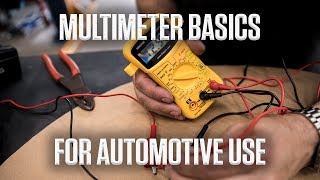
Watch Before You Buy
“True RMS for accurate readings on variable loads. 4.8 stars from 5,102 Amazon reviews signal consistent reliability.”
See Today’s Price →What we like
- True RMS for accurate readings on variable loads
- Non-contact voltage detection built in
- AutoVolt automatically selects AC/DC
- Large backlit display readable in dark panels
- CAT III 600V safety rating
Watch out for
- Expensive for casual DIY
- Overkill for simple continuity tests
Read Full Analysis
The Fluke 117 is the benchmark professional multimeter for automotive electrical diagnosis — the tool that electricians and auto technicians reach for when intermittent faults and complex electrical systems demand accuracy rather than approximation. True RMS measurement is critical in automotive work: modern vehicles use switched-mode power supplies, PWM motor controls, and variable-frequency signals that produce non-sinusoidal waveforms. Average-responding meters read these waveforms inaccurately; True RMS calculates actual power dissipation regardless of waveform shape, giving accurate readings on alternator output ripple, ABS module power supplies, and fuel injector driver circuits. The AutoVolt feature automatically switches between AC and DC measurement modes, eliminating manual mode selection errors that can produce misleading readings when probing mixed-signal environments common in modern vehicles. Non-contact voltage detection allows checking for live voltage in wiring harnesses before probing, reducing the risk of accidental shorts during diagnosis. The CAT III 600V safety rating means the meter is rated for connected electrical systems — not just isolated components — which automotive diagnosis demands. At $252.99 it is priced significantly above basic auto-range meters in the $30-80 range, and the price reflects a tool designed for daily professional use rather than occasional homeowner diagnostics. For weekend mechanics doing basic battery voltage, fuse continuity, and sensor resistance tests, a $30-50 auto-range meter provides sufficient accuracy. The Fluke 117 earns its cost for technicians diagnosing electrical faults across multiple vehicles daily.
“Auto-ranging eliminates manual range selection. 4.6 stars from 4,163 Amazon reviews signal consistent reliability.”
See Today’s Price →What we like
- Auto-ranging eliminates manual range selection
- Tests resistance, continuity, diodes, capacitance
- Bright backlit display
- Low impedance mode prevents ghost voltages
- CAT III 600V rated
Watch out for
- No true RMS — less accurate on non-sinusoidal loads
- Probe holders on case feel flimsy
Read Full Analysis
Klein Tools' MM400 is the mid-range automotive multimeter on this page — auto-ranging eliminates the manual dial setting required on basic meters, which matters when you are under a hood and need a quick voltage or resistance reading without fumbling for the correct range. CAT III 600V safety rating covers the 12V and 24V systems on most vehicles as well as 48V+ systems on hybrid platforms, within a safety category appropriate for automotive electrical environments. The low impedance mode is specifically useful for ghost voltage detection — modern vehicles hold small residual voltages across ECUs and control modules even when switched off, and low-Z mode confirms whether a reading is a live fault or parasitic noise. Capacitance testing and diode checking extend utility to electronic component diagnosis and starter circuit analysis beyond what a basic entry meter covers.

“Measures voltage, current, resistance, continuity, diodes. Best suited for students, hobbyists, and light automotive use.”
See Today’s Price →What we like
- Measures voltage, current, resistance, continuity, diodes
- Overload protection prevents damage
- Large easy-to-read LCD
- Included probes and carry case
- Best value on the market
Watch out for
- Manual ranging only
- No true RMS or NCV
- Not CAT III rated
Frequently Asked Questions
Does my car's battery voltage require a True RMS multimeter?
What voltage should I see across a healthy car battery?
How do I test a fuel injector with a multimeter?
Can I test an alternator with a multimeter?
What is the LoZ or low-impedance mode on the Fluke 117?
How We Analyze Products
We analyze Amazon review data — often thousands of reviews per product — to surface patterns that individual buyers miss. Our process aggregates star ratings, review counts, and buyer sentiment at scale, identifying which strengths and weaknesses appear consistently across the largest review samples available. The 9,491+ reviews analyzed on this page represent real verified-purchase feedback from Amazon buyers.
Each product earned its placement through data: total review volume, average rating, and the specific praise and complaints that repeat most often across buyers. No manufacturer paid for placement on this page. Products appear here because buyers endorsed them at scale, not because a company asked us to feature them.
We use AI to summarize review sentiment — not to fabricate opinions, but to condense what thousands of buyers actually wrote into a readable format. The pros and cons you see reflect the most common themes found in verified purchaser reviews, paraphrased for clarity. We do not claim to have accessed Reddit, YouTube, or specific publications in generating these summaries.
Prices shown reflect Amazon pricing at the time this page was last generated. Click “See Today’s Price” to get the current live price on Amazon. Read our full methodology →