Best Non-Contact Voltage Testers 2026

The Klein Tools NCVT-1P Non-Contact Voltage Tester is our top pick — reliable detection from 50–1000V AC, bright tip LED indicator, and the CATIII/CATIV 600V safety rating that professionals use. Klein Tools is the brand electricians trust, and this tester proves why.
See Today’s Price →At a Glance
Showing 3 of 3 products
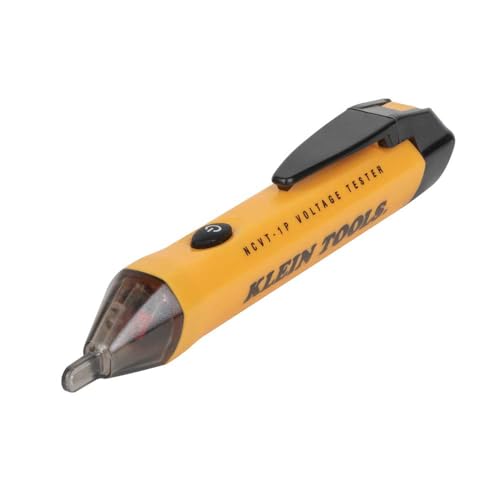
Klein Tools NCVT1P Voltage Tester Non-Contact 50V to 1000V AC
“Klein NCVT1P delivers Klein professional build quality at a lower price — covers standard 120/240V household circuits with pocket clip and clear alerts.”
See Today’s Price →What we like
- Klein Tools professional grade
- 50-1000V covers household wiring
- Audible and LED alerts
- Pocket clip
- Lower price than NCVT2P
Watch out for
- 50V minimum — misses low voltage below 50V
- Single range
Read Full Analysis
Klein Tools makes the voltage tester that electricians keep on their belt. The NCVT-1P detects 50–1000V AC instantly through wire insulation, produces both an audible beep and a bright LED tip glow, and is rated CATIII/CATIV 600V for safety in professional environments. The pocket clip is sturdy enough for daily tool belt use.

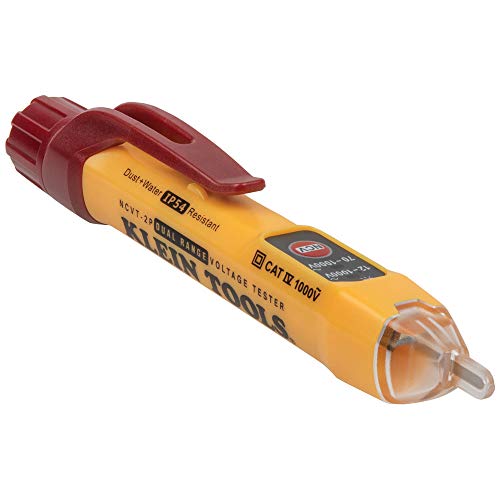
Klein Tools NCVT2P Non-Contact Voltage Tester Dual Range 12-1000V
“Klein Tools NCVT2P is the most trusted non-contact tester — dual range from 12V covers EV charging circuits, doorbells, and doorbells in addition to standard 120/240V household wiring.”
See Today’s Price →What we like
- Dual range 12-1000V AC
- Visual and audible alerts
- Auto power-off saves battery
- Pocket clip for tool belt
- Klein Tools professional grade
Watch out for
- More expensive than single-range
- No multimeter function
Read Full Analysis
The NCVT-2P adds the ability to detect low-voltage AC circuits in the 12–90V range — doorbell transformers, thermostat wiring, and landscape lighting — that a standard 90V+ tester would miss entirely. A slide switch toggles between the low-voltage and standard (90–1000V) modes, and both provide simultaneous visual LED and audible alerts. A green LED confirms the absence of voltage for safe-to-touch verification. The CAT IV 1000V safety rating covers the most demanding electrical environments. The trade-off is cost — the dual-range design adds cost over single-range testers, so if you only work with standard 120/240V circuits, a simpler single-range model covers everything you need at a lower price. Best for homeowners and electricians who regularly encounter low-voltage wiring alongside standard circuits.

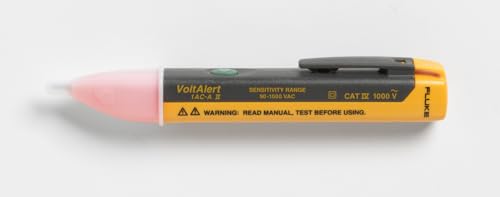
Fluke 1AC-A1-II VoltAlert Non-Contact Voltage Tester
“Fluke's VoltAlert is the tester most electricians carry daily — Fluke's professional-grade reliability in a slim pen form that fits any pocket, with LED detection right at the tip.”
See Today’s Price →What we like
- Fluke professional reliability
- 90-1000V AC
- LED tip glows at wire tip
- Slim pocket-pen design
- Most trusted brand in electrical
Watch out for
- No built-in flashlight
- Single range sensitivity
Read Full Analysis
Fluke is the gold standard in electrical testing equipment, and the 1AC VoltAlert applies that reputation to a compact pocket tester. The pencil-thin form factor slips into a shirt pocket, and the continuous self-test confirms the unit is working before every use — a critical safety feature most budget testers lack. The 90–1000V AC range covers all standard residential and commercial voltages, and CAT IV 1000V provides maximum protection. An audible/silent mode toggle is useful for working in sensitive environments. The trade-off is no low-voltage detection: the 1AC starts at 90V, so doorbell transformers, thermostat wiring, and 12V landscape circuits won't register — the Klein NCVT2P handles those tasks better. Best for electricians and serious DIYers who work with standard voltages and want professional-grade reliability in a compact form.
Non-Contact Voltage Testers Buying Guide
 Photo by Sami TÜRK / Pexels
Great for: Anyone doing electrical work, troubleshooting car issues, or verifying outlets and circuits before touching them
Not ideal if: You call an electrician for everything and never DIY wiring — but even then, a non-contact tester is a safety must-have
Non-contact voltage testers (NCV testers) detect the electromagnetic field that surrounds an energized wire — no probes required. Hold the tip near a wire, outlet, or switch; if it beeps and lights up, voltage is present.
- 50–1000V AC: Standard range. Covers all residential wiring (120V/240V) and commercial up to 1000V.
- 12–1000V AC: Dual-range detection. Detects low-voltage wiring (doorbell wire, thermostat wire, landscape lighting at 12–24V).
If you ever work with low-voltage wiring, get dual-range. For outlet/switch work only, standard range is fine.
Look for CAT III (600V) or CAT IV (600V) ratings. These indicate the tool has been tested against transient voltage spikes. Never use an untested/unrated tool for electrical work.
-
Always verify the tester works on a KNOWN live outlet before using it to check questionable wires
-
Test through wire insulation — you don't need bare wire contact
-
Testers can false-positive near other live wires running in parallel
Watch Before You Buy

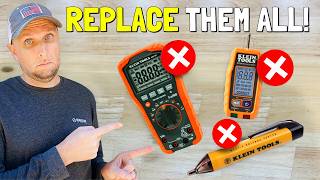
Frequently Asked Questions
Is a non-contact voltage tester accurate enough for real electrical work?
Can a non-contact tester detect DC voltage?
What's the difference between Klein NCVT-1P and NCVT-2P?
What should I look for when buying non contact voltage testers?
How much should I expect to spend on non contact voltage testers?
How We Analyze Products
We analyze Amazon review data — often thousands of reviews per product — to surface patterns that individual buyers miss. Our process aggregates star ratings, review counts, and buyer sentiment at scale, identifying which strengths and weaknesses appear consistently across the largest review samples available. The 23,662+ reviews analyzed on this page represent real verified-purchase feedback from Amazon buyers.
Each product earned its placement through data: total review volume, average rating, and the specific praise and complaints that repeat most often across buyers. No manufacturer paid for placement on this page. Products appear here because buyers endorsed them at scale, not because a company asked us to feature them.
We use AI to summarize review sentiment — not to fabricate opinions, but to condense what thousands of buyers actually wrote into a readable format. The pros and cons you see reflect the most common themes found in verified purchaser reviews, paraphrased for clarity. We do not claim to have accessed Reddit, YouTube, or specific publications in generating these summaries.
Prices shown reflect Amazon pricing at the time this page was last generated. Click “See Today’s Price” to get the current live price on Amazon. Read our full methodology →