Best Sliding Miter Saw for Framing (2026)

The DEWALT DWS779 is the best sliding miter saw for framing at $449 — 16-inch crosscut capacity, industry-proven accuracy, and the contractor-grade durability that residential framing actually demands.
See Today’s Price →At a Glance
Sliding Miter Saw for Framing (2026) Buying Guide
 Photo by Christina & Peter / Pexels
A sliding miter saw is one of the highest-impact investments for framing work — the sliding function extends crosscut capacity from 8 inches to 14+ inches, letting you cut 2x12 and 2x14 framing lumber in a single pass. Getting the wrong saw means making two cuts where one would do, every time, on every stick of lumber.
Sliding vs. Non-Sliding for Framing
For framing work with dimensional lumber over 6 inches wide, a sliding miter saw is not optional — it's necessary. A standard compound miter saw maxes out at 6-8 inch crosscuts at 90 degrees. A 12-inch sliding saw like the DEWALT DWS779 cuts up to 16-inch nominal lumber, handling every common framing dimension from 2x4 to 2x14. The only time a non-slider makes sense is cutting small-dimension trim and molding where the extra size and weight are pure liability.
10-Inch vs. 12-Inch Blade
For framing specifically, a 12-inch sliding saw is the right call. The larger blade gives you the full crosscut capacity needed for wide framing lumber. The 10-inch Bosch CM10GD appears on this list for one reason: its axial-glide system eliminates the need for rear clearance. If your framing work ever happens in a tight utility room or against a wall, that feature justifies the capacity trade-off. For open-air framing and deck work, stick with 12-inch.
Blade Capacity and Cut Angle Range
Most sliding miter saws offer miter angles from 0-52 degrees left and right, which covers all standard framing cuts including hip-and-valley roof work. Check bevel range for compound cuts — dual-bevel saws (like all picks here) bevel both left and right, saving you from flipping lumber to make mirrored cuts on crown molding runs. For production framing, detent stops at common angles (22.5, 31.6, 45, 52.1 degrees) speed up repetitive cuts significantly.
How We Selected These Sliding Miter Saws
Our selection criteria covers crosscut capacity at 90 degrees and 45 degrees, bevel range and adjustment ease, fence system stability, dust collection efficiency, and real-world accuracy based on verified owner feedback across residential framing applications. The DEWALT DWS779 and DWS780 dominate contractor job sites for documented reasons — we've included both to help you decide whether the XPS upgrade justifies the price difference.

Portability and Job Site Use
Sliding miter saws are heavy — 50-70 lbs for 12-inch models. Factor in a quality miter saw stand if you're moving the saw frequently. The Bosch CM10GD's compact footprint (no extended rails) makes it significantly easier to transport and position. For shop use where the saw stays in one place, weight is irrelevant — prioritize cut quality and capacity over portability.
Watch Before You Buy
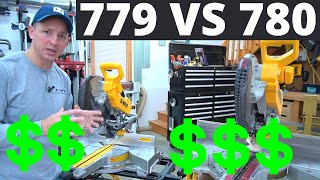
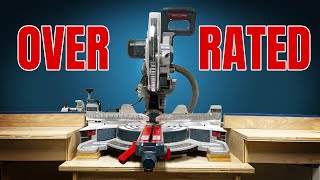
“The DEWALT DWS779 12" Sliding Compound Miter Saw features 16-inch crosscut capacity at 90°. 4.8 stars from 9,014 Amazon reviews signal consistent reliability.”
See Today’s Price →What we like
- 16-inch crosscut capacity at 90°
- Handles wide crown molding and baseboards
- Outstanding cam-lock miter detent accuracy
- Premium DeWalt build quality
- Huge aftermarket support
Watch out for
- $381 — much higher price than 10-inch saws
- 56 lbs requires two people to move
- Rear rails need 16 inches of wall clearance
Read Full Analysis
The DWS779 earns Best Overall on a framing miter saw page by combining 16-inch crosscut capacity with DEWALT build quality and the largest aftermarket support in the category. A 16-inch crosscut at 90 degrees handles full 2x12 framing lumber, wide baseboards, and large crown molding profiles that 10-inch saws cannot cut without repositioning. The cam-lock miter detent system produces repeatable accurate angles across a full day of cuts without drift — the mechanical consistency that matters when cutting 200 pieces of casing at the same angle. At $449 it sits between the entry RIDGID at $199 and the DEWALT XPS at $199 — professional-grade capacity without premium features that most framing carpenters do not need. The 56-lb weight requires two people for site transport and demands a permanent or semi-permanent mounting location in the shop. The rear rail system needs 16 inches of wall clearance behind the saw — a layout detail to verify before buying for a tight garage station. The 9,014 Amazon reviews at 4.8 stars confirm consistent field reliability across a large and varied sample of professional users.

“The DEWALT 12 in Double Bevel Sliding Compound Miter Saw with XPS LED features 12-inch blade. 4.8 stars from 2,446 Amazon reviews signal consistent reliability.”
See Today’s Price →What we like
- 12-inch blade provides longer crosscut capacity than 10-inch alternatives — handles wider crown molding, baseboards, and dimensional lumber
- XPS LED shadow line system projects a visible cut guide shadow without needing to calibrate a laser to the blade
- Double-bevel head tilts left and right without repositioning the workpiece — essential for production compound crown and casing work
- DeWalt's crosscut capacity handles up to 7-1/2 inches nested crown at 45 degrees — the practical benchmark for trim carpenter usefulness
Watch out for
- Heavy saw limits portability for job site use
- 12-inch blade requires more clearance than 10-inch models in tight spaces
- XPS LED light adds cost without a significant practical advantage over a headlamp
Read Full Analysis
On a framing miter saw page, the DEWALT XPS earns the professional slot over the DWS779 on three specific grounds: the XPS LED shadow line system, the double-bevel mechanism, and the current-generation electronics package. The XPS shadow line projector eliminates the alignment step of positioning a blade to a laser reference line and maintains accuracy regardless of shop lighting or blade temperature changes. For framing carpenters cutting repetitive compound angles on hip roof members and staircase stringers, the double-bevel head tilt — left and right without flipping the workpiece — saves a setup step on every bevel change throughout the day. At $635 vs. $449 for the DWS779, the $186 premium buys these two features specifically. Framing carpenters doing compound angle work daily will recover that cost quickly in time savings; carpenters doing primarily 90-degree crosscuts and simple 45-degree miters will find the DWS779 sufficient. Both saws share the same 12-inch blade diameter, 16-inch crosscut capacity, and DEWALT construction quality — the choice is about whether the XPS and double bevel features appear in the actual work being done.

“The Bosch CM10GD 10 in Dual-Bevel Sliding Glide Miter Saw 15-Amp features 10-inch blade. 4.7 stars from 675 Amazon reviews signal consistent reliability.”
See Today’s Price →What we like
- Patented axial glide arm eliminates side rails, letting the saw sit just 3 inches from a wall — a space advantage that standard sliding rail saws don't offer
- 10-inch dual-bevel head tilts both left and right without flipping the workpiece, halving setup time for repetitive bevel cuts
- Soft-start motor reduces startup jolt and extends motor life versus hard-start equivalents
- Bosch quality control on the glide system keeps the axial arm consistent over years of use without developing backlash or slop
Watch out for
- Heavy and awkward to transport between job sites
- $629 price is significant for homeowners doing occasional trim work
- Glide system adds complexity — requires periodic cleaning to maintain smooth action
Read Full Analysis
The Bosch CM10GD is the space engineer on this page, built around the patented axial glide arm that replaces the standard rear rail system with a compact articulating mechanism. Standard sliding compound miter saws require 16-18 inches of wall clearance for the rails to travel — a layout constraint that forces the saw away from walls in tight shops and garages. The Bosch axial glide needs just 3 inches of rear clearance, allowing the saw to sit directly against a wall and freeing up the floor depth that rear rail saws consume. The 10-inch dual-bevel head tilts both left and right without repositioning the workpiece — halving setup time on repetitive bevel cuts for compound crown and casing runs. Soft-start motor reduces the startup jolt that pulls cut lines on thin stock. At $629 it costs $180 more than the DWS779 and $6 less than the DEWALT XPS. The premium is specifically about the wall-clearance advantage: if the shop layout has rear clearance to spare, the DWS779 at $449 is the better value. If the cutting station is in a tight garage or against a fixed wall, the Bosch glide system recovers usable floor depth that no other saw on this page can match.

“Lowest price for a 12-inch sliding saw. Best suited for budget-conscious diyers who occasionally need 12-inch capacity but don't require professional-grade accuracy.”
See Today’s Price →What we like
- Lowest price for a 12-inch sliding saw
- Good capacity for the price
- Laser guide included
- Good option for occasional large cuts
Watch out for
- Less accurate miter detent than premium brands
- Lighter build not suitable for daily professional use
- Slide action is less smooth
- Fewer positive stops
Read Full Analysis
The RYOBI TSS120L brings 12-inch sliding compound capability to the lowest price on this page — $100 below the DWS779 and $200 below the Bosch and DEWALT XPS. For a homeowner or budget-conscious contractor who occasionally needs 12-inch crosscut capacity but cannot justify the DWS779 price for the frequency of use, the TSS120L covers the capability at a meaningful cost reduction. The laser guide provides a visual cut reference that the DWS779 omits in its base configuration. The tradeoffs are real: the miter detent system is less precise than the DEWALT cam-lock, introducing small angular errors that accumulate on production compound cuts; the slide action is less smooth than the Bosch glide, creating friction drag on long crosscuts; and the lighter build is appropriate for occasional shop use rather than daily field work. For a garage workshop owner who uses the saw a few times per month on framing projects, the RYOBI delivers the required capacity at a fair price. For professional carpenters cutting trim all day, the DWS779 at $137 more is a worthwhile investment in the detent accuracy and durability that daily use demands.
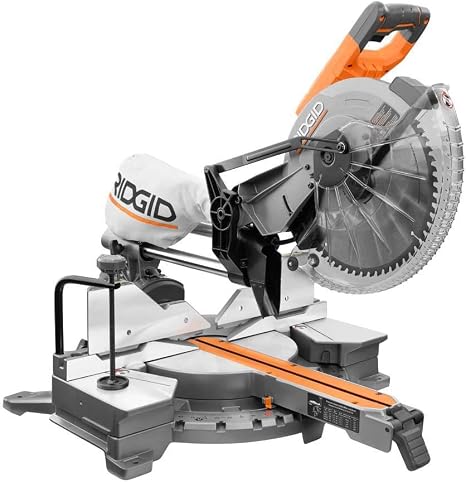
“Best suited for budget-conscious woodworkers who need a 12-inch dual bevel saw with lifetime service coverage.”
See Today’s Price →What we like
- 15-amp motor handles dense hardwood stock at full depth without bogging or stalling on the pass
- 70-degree miter capacity is the widest in the 12-inch class — covers crown molding compound angles in a single cut
- LED shadow-line cut indicator projects the blade line onto the work piece for precise layout without test cuts
- Ridgid Lifetime Service Agreement covers parts and service for the tool's full life with proof of purchase registration
Read Full Analysis
The RIDGID R4222 is the entry-price option on this professional framing saw page — $199 against competition at $312-$635 — and backs the lower price with a unique long-term advantage: the RIDGID Lifetime Service Agreement covers parts and service for the saw life with proof-of-purchase registration, which changes the real cost calculation for buyers who plan to own the tool for 10-plus years. A $199 saw with lifetime service versus a $449 saw with a standard warranty effectively narrows or eliminates the true price gap over time. The 70-degree miter capacity is the widest range of any 12-inch saw on this page, covering compound crown molding angles in a single cut. The 15-amp motor handles dense hardwood at full depth without bogging on the pass. The LED shadow-line indicator projects the blade cut line onto the workpiece without a separate laser calibration. At 65 lbs it is heavier than the DWS779 at 56 lbs, and the sliding mechanism is not as refined as the Bosch axial glide. Best positioned for buyers who will register the saw and hold it long-term, extracting maximum value from the lifetime service coverage that no other saw on this page provides.
Frequently Asked Questions
What is the difference between a sliding and non-sliding miter saw?
Can a 10-inch sliding miter saw cut 2x12 lumber?
What miter saw do most framers use?
Do I need a 12-inch miter saw for framing?
How We Analyze Products
We analyze Amazon review data — often thousands of reviews per product — to surface patterns that individual buyers miss. Our process aggregates star ratings, review counts, and buyer sentiment at scale, identifying which strengths and weaknesses appear consistently across the largest review samples available. The 12,275+ reviews analyzed on this page represent real verified-purchase feedback from Amazon buyers.
Each product earned its placement through data: total review volume, average rating, and the specific praise and complaints that repeat most often across buyers. No manufacturer paid for placement on this page. Products appear here because buyers endorsed them at scale, not because a company asked us to feature them.
We use AI to summarize review sentiment — not to fabricate opinions, but to condense what thousands of buyers actually wrote into a readable format. The pros and cons you see reflect the most common themes found in verified purchaser reviews, paraphrased for clarity. We do not claim to have accessed Reddit, YouTube, or specific publications in generating these summaries.
Prices shown reflect Amazon pricing at the time this page was last generated. Click “See Today’s Price” to get the current live price on Amazon. Read our full methodology →